
Bombyx hibisci Fabricius, 1775
|
publication ID |
https://doi.org/10.11646/zootaxa.4471.2.11 |
|
publication LSID |
lsid:zoobank.org:pub:E4B9CE3E-BA2D-4728-A9F6-BD60BF09D846 |
|
DOI |
https://doi.org/10.5281/zenodo.5989845 |
|
persistent identifier |
https://treatment.plazi.org/id/03C95220-E94D-AA34-37FA-13B1FCDBF8A3 |
|
treatment provided by |
Plazi |
|
scientific name |
Bombyx hibisci Fabricius, 1775 |
| status |
|
Bombyx hibisci Fabricius, 1775
Systema entomologiae: sistens insectorvm classes, ordines, genera, species, adiectis synonymis, locis, descriptionibvs, observationibvs: 564. TL: “Habitat in Hibisco populneo Indiae orientalis . Mus. Tottianum”.
The species Bombyx Hibisci Fabricius 1775 was described from an unspecified number of moths in the “Mus. Tottianum” ( Fig. 1 View FIGURES 1–2 ). Otto Thott was the Count in the Danish Government, and Fabricius used his entomological collection to describe several dozen new species with a remark “Mus. Tottianum” ( Zimsen, 1964). After Thott’s death in 1785 his collection was sold by auction, and a part was obtained by William Hunter ( Glasgow) who bequeathed it to the University of Glasgow. Thus, in 1807 the Hunterian Museum (and Art Gallery) was first opened, and is now the oldest museum in Scotland. A part of Fabricius’ entomological collection with his original labels is presented here today. The collection is available now digitally under The Hunterian online catalogue (https://www.gla.ac.uk/hunterian/collections/searchourcollections/#d.en. 190654 and http://collections.gla.ac.uk/ #view=list&id=cb15&keywords= hibisci ).
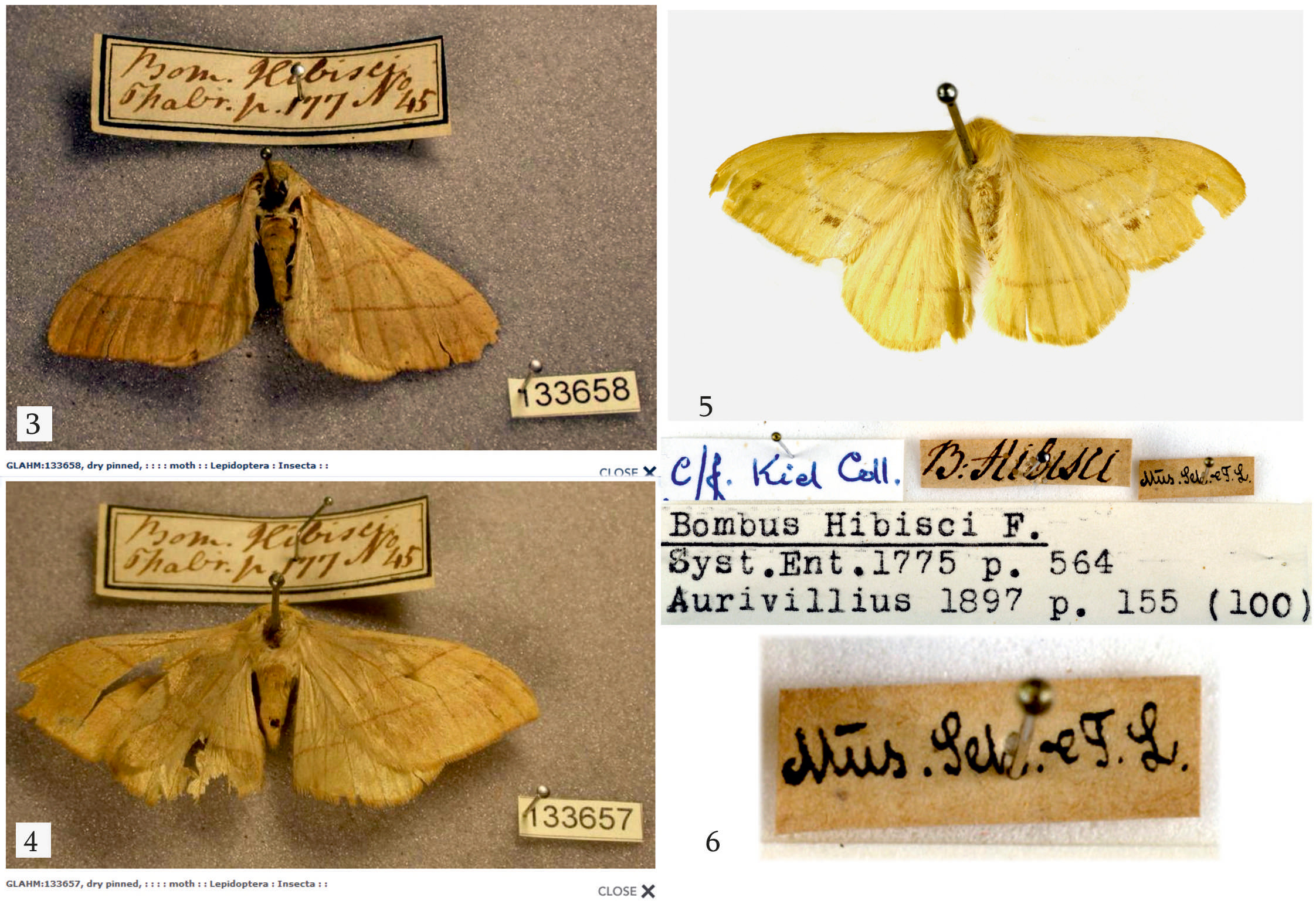
Two specimens of Bombyx hibisci were thus discovered ( Figs 3, 4 View FIGURES 3–6 ), and they perfectly fit with the original description, which translates as ‘yellow with two dark fasciae on the forewing, the postmedia shortened; [there is] a single fascia on the hindwing’.
The better preserved male of the species is designated here as the lectotype of this taxon. It bears an inventory number “133658” and a bottom label with ink inscription by Fabricius’ hand: “Bom. Hibisci | Fabr. P. 177. №45” (with double black frame). It will be supplied with a standard red rectangular label with corresponding printed text.
The species is attributed to the genus Eupterote Hübner, 1820 , and the following combination (originally established by Aurivillius (1897) but for another species!—see below) is here confirmed, Eupterote hibisci ( Fabricius, 1775) .
It is likely that Horanpella placida Moore, 1883 , The Lepidoptera of Ceylon 2: 143, pl. 137, fig. 1, described after females from Ceylon, is conspecific; however, males are necessary to address this problem.
Aurivillius (1897) who worked in 1892-1894 with Fabricius’ collection in Copenhagen, wrongly identified a male of B. orientalis Fabricius from the ZMUC as a type of B. hibisci . Thus, he wrongly established a specific synonymy between B. hibisci and E. geminata (Walker, 1855) ; however, these species are not closely related. It is likely that Aurivillius had not seen a type specimen of B. hibisci .

No known copyright restrictions apply. See Agosti, D., Egloff, W., 2009. Taxonomic information exchange and copyright: the Plazi approach. BMC Research Notes 2009, 2:53 for further explanation.
|
Kingdom |
|
|
Phylum |
|
|
Class |
|
|
Order |
|
|
Family |
|
|
Genus |