
Amplaria Chamberlin, 1941
|
publication ID |
https://doi.org/10.11646/zootaxa.4311.2.4 |
|
publication LSID |
lsid:zoobank.org:pub:E246BBD3-FCE0-4CB8-9442-70DC421E3D96 |
|
DOI |
https://doi.org/10.5281/zenodo.6016027 |
|
persistent identifier |
https://treatment.plazi.org/id/B5431E4D-6268-D01E-FF03-FCD481422053 |
|
treatment provided by |
Plazi |
|
scientific name |
Amplaria Chamberlin, 1941 |
| status |
|
Genus Amplaria Chamberlin, 1941 View in CoL
Amplaria Chamberlin 1941 , p. 9; Causey 1958, p. 180; Shear & Krejca 2007, p. 25 (rediagnosis and redescription). Speostriaria Causey 1960 View in CoL , p. 26. Synonymized by Shear & Krejca 2007.
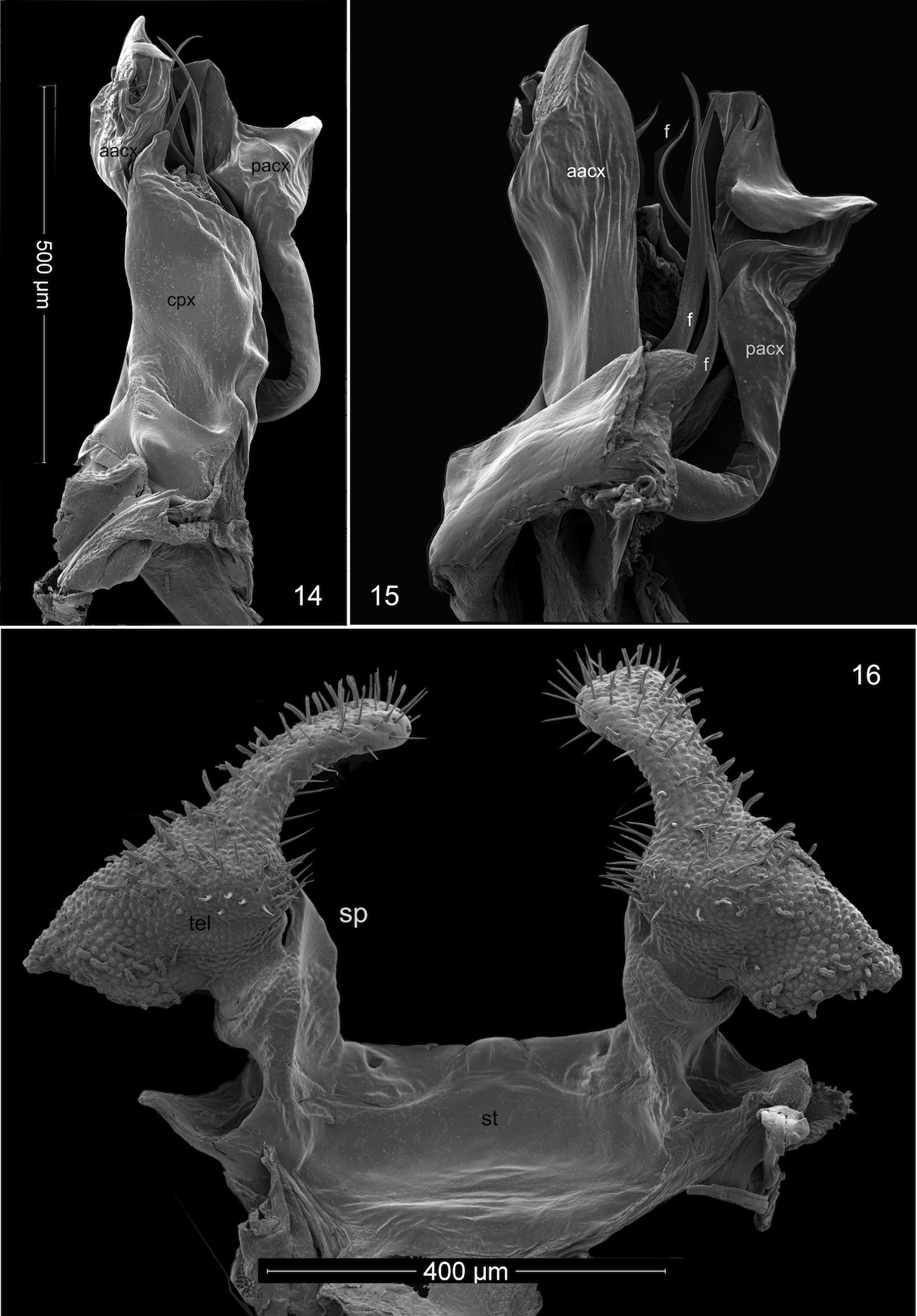
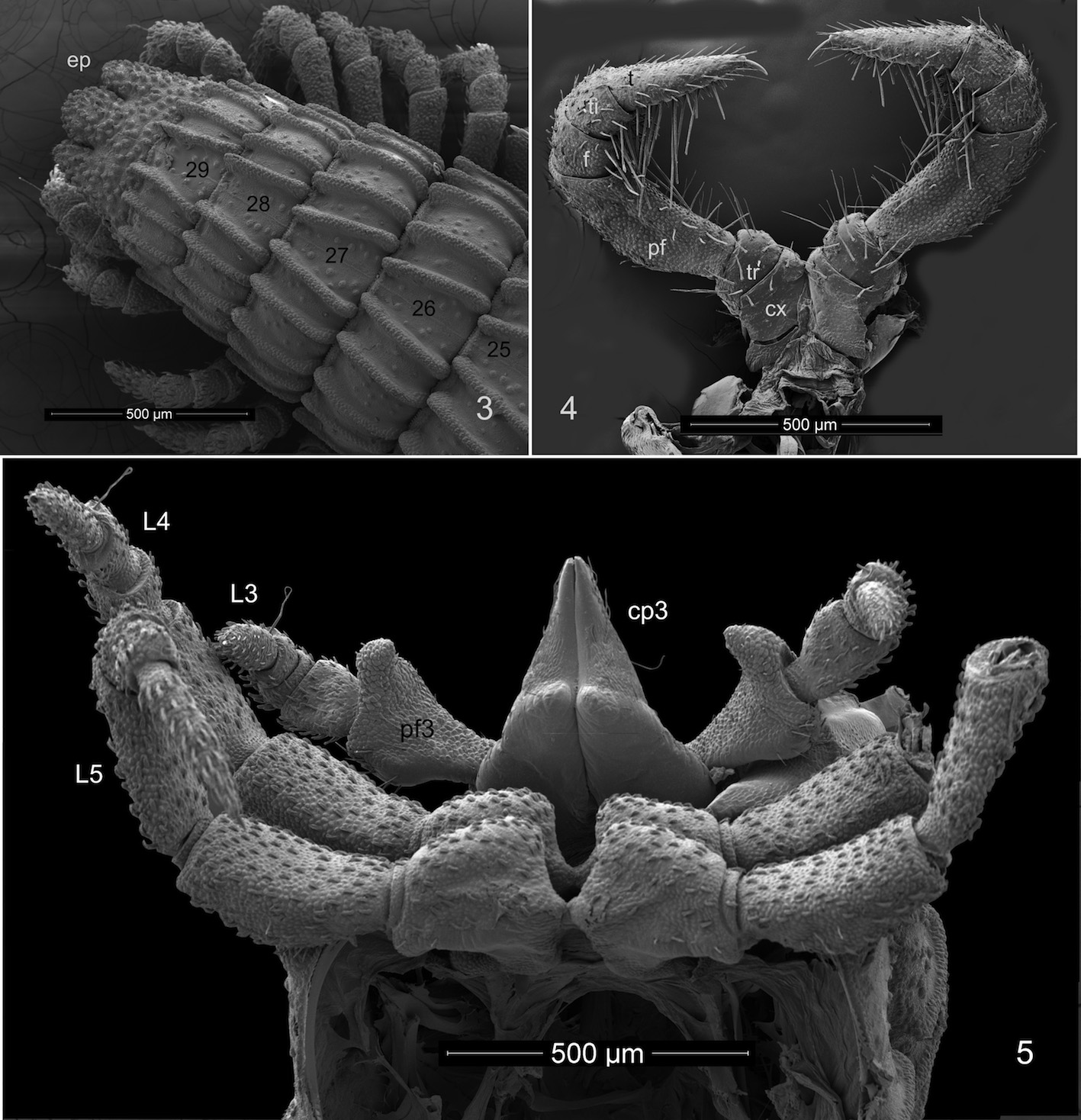
Amplaria presently consists of seven species, including nazinta View in CoL , and possibly eight depending on the ultimate disposition of Striaria californica Cook, 1899 View in CoL ( Shear & Krejca 2007). A detailed diagnosis of the genus is provided by Shear and Krejca (2007). Based on the discovery of A. nazinta View in CoL and re-evaluation of available material, a few additions to this previous diagnosis must be made. They are as follows. In males, the third and fourth metazonites have expanded ventrolateral margins. The sigmoid lateral spines of the male labrum may be reduced. The telopodite of the male ninth legs may have a long, mesoventral extension ( Fig. 14 View FIGURES 14 – 16 ). The sculpture of the epiproct consists of small tubercles and its surface lacks the crests present on previous diplosegments ( Fig. 3 View FIGURES 3 – 5 ).
No known copyright restrictions apply. See Agosti, D., Egloff, W., 2009. Taxonomic information exchange and copyright: the Plazi approach. BMC Research Notes 2009, 2:53 for further explanation.
|
Kingdom |
|
|
Phylum |
|
|
Class |
|
|
Order |
|
|
Family |

Amplaria Chamberlin, 1941
| Shear, William A., Nosler, Philip & Marek, Paul 2017 |
Speostriaria
| Causey 1960 |
Amplaria
| Chamberlin 1941 |
Amplaria
| Chamberlin 1941 |
nazinta
| Chamberlin 1910 |
A. nazinta
| Chamberlin 1910 |
Striaria californica
| Cook 1899 |