
Klinckowstroemia
|
publication ID |
https://doi.org/10.5281/zenodo.207115 |
|
DOI |
https://doi.org/10.5281/zenodo.5627911 |
|
persistent identifier |
https://treatment.plazi.org/id/03828782-9537-FFA8-FF6C-FB0FFA75FC1E |
|
treatment provided by |
Plazi |
|
scientific name |
Klinckowstroemia |
| status |
|
Key to the species of Klinckowstroemia based on females (modified from Rosario & Hunter, 1988).
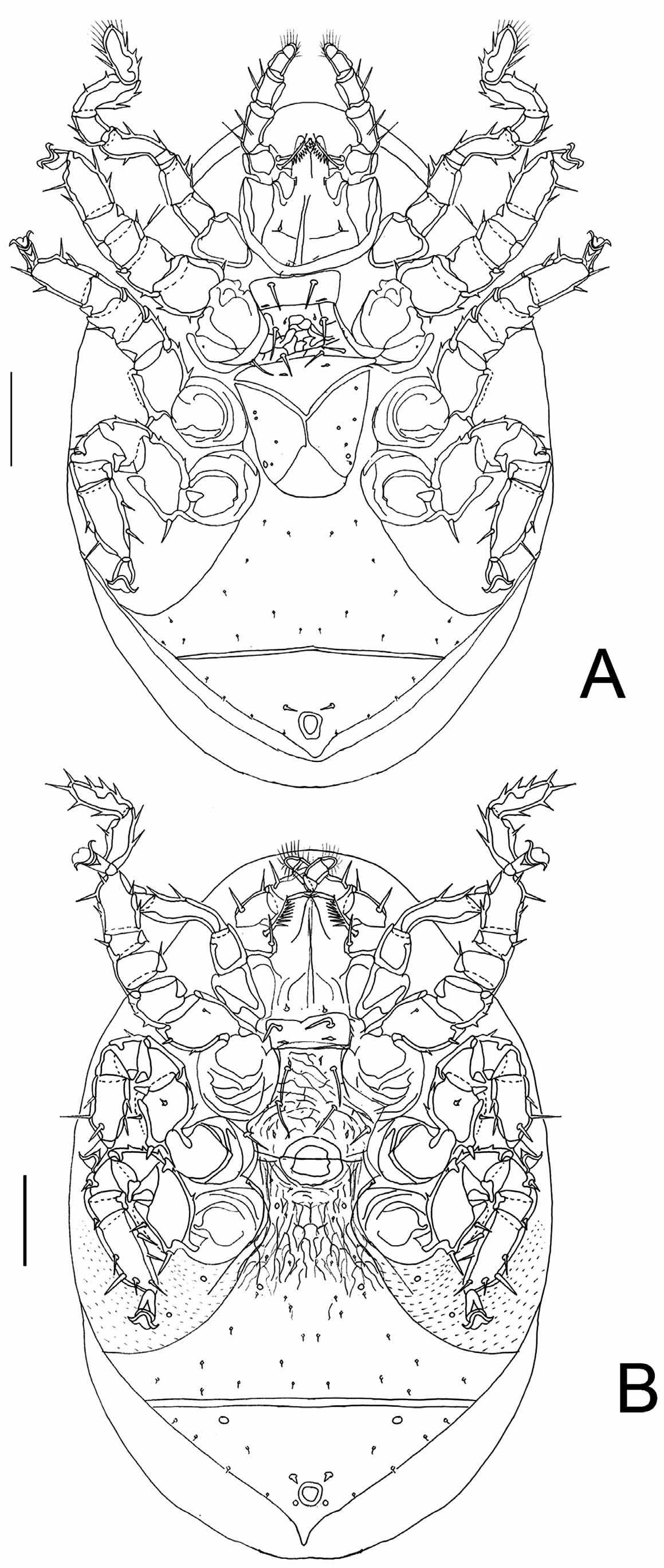
1. Medial margins of latigynal shields wavy ( Fig. 2 View FIGURE 2 )............................................................ 2
- Medial margins of latigynal shields straight or pointed, never wavy ( Fig. 7 View FIGURE 7 A)...................................... 8
2. Sternal and latigynal setae barbed and/or serrated............................................................. 4
- Sternal and latigynal setae smooth......................................................................... 3
3. All sternal setae of equal length.............................................................. K. simplesetosa
- Sternal setae st 2, st 3 and st 4 are microsetae ( Fig. 2 View FIGURE 2 G)................................................ .. K. pennula
4. With four pairs of setae a; st 1 long and barbed, not serrated............................................... K. scotti
- With one pair of setae a, st 1 serrated, not barbed.............................................................5
5. Seta st 1 long (31–40) and serrated, setae st 3 and st 4 are medium and/or microsetae.................................6
- Seta st 1 medium (21–29) and serrated, setae st 3 and st 4 are short....................................... K. montanoi
6. Setae st 3 of medium length..............................................................................7
- Setae st 3 and st 4 are microsetae................................................................... K. valdezi
7. Seta st 4 short................................................................................ K. victoriae
- Seta st 4 a microseta ( Fig. 4 View FIGURE 4 H).................................................................... K. melissae
8. Sternal seta st 1 barbed or bifurcate........................................................................ 9
- Sternal seta st 1 smooth................................................................................ 19
9. Sternal seta st 1 barbed................................................................................. 10
- Sternal seta st 1 bifurcate...................................................................... .. K. bifurcata
10. Sternal seta st 2 barbed................................................................................. 11
- Sternal seta st 2 smooth................................................................................. 14
11. Sternal setae st 3 and st 4 smooth.................................................................. K. candidoi
- Sternal setae st 3 and st 4 barbed and serrated................................................................ 12
12. Sternal seta st 1 very long, st 2 and st 3 medium; with 6–10 serrated setae on latigynal shields................ K. santibanezi
- Sternal setae st 1, st 2 and st 3 are long and serrated........................................................... 13
13. Sternal shield granulated..................................................................... K. ballesterosi
- Sternal shield reticulated ( Fig. 7 View FIGURE 7 A)............................................................... K. oconnori
14. Mesogynal shield rounded anteriorly.......................................................... K. atramaculata
- Mesogynal shield pointed anteriorly...................................................................... 15
15. Medial margins of latigynal shields pointed..................................................... K. tapachulensis
- Medial margins of latigynal shields truncate............................................................... 16
16. Seta st 2 short or medium; body more than 900 µm long...................................................... 17
- Seta st 2 microseta, body less than 900 µm long............................................................. 18
17. Seta st 1 is the longest of sternal setae............................................................. K. schusteri
- Seta st 3 is the longest of sternal setae.............................................................. K. cristinae
18. Latigynal shields with 4–6 setae setae st 3 and st 4 microsetae..................................... K. brevimarginata
- Latigynal shields with three setae, setae st 3 and st 4 short......................................... K. rectimarginata
19. Two pairs of setae on latigynal shield............................................................. K. tragardhi
- More than two pairs of setae on latigynal shields............................................................ 20
20. Posterior margin of ventral shield concave......................................................... K. concava
- Posterior margin of ventral shield truncate................................................................. 21
21. Mesogynal shield extending anteriorly to sternogynal shield; medial margins of latigynal shields pointed............... 22
- Mesogynal shield not extending anteriorly to sternogynal shield; medial margins of latigynal shields truncated........... 26
22. Mesogynal shield extending anteriorly to sternogynal shield slightly............................................ 23
- Mesogynal shield extending anteriorly to sternogynal shield deeply............................................. 24
23. Seta st 1 microseta, st 2 short and simple, hyp 3 serrated................................................ K. franckei
- Seta st 1 short and simple, st 2 microseta, hyp 3 simple.................................................. K. hunteri
24. Lateral margins of mesogynal shield concave; all sternal setae of equal length......................... K. multisetillosa
- Lateral margins of mesogynal shield straight............................................................... 25
25. Sternal setae medium length, sternal and sternogynal shields reticulated..................................... K. starri
- Sternal setae are microsetae, sternal and sternogynal shields granulated ( Fig. 6 View FIGURE 6 C).............................. K. stilla
26. Lateral margins of mesogynal shield concave; five or six pairs of setae on latigynal shield.................. K. grabowskii
- Lateral margins of mesogynal shield straight; three or four pairs of setae on latigynal shield.......................... 27
27. Sternal seta st 2 shorter than st 3 and st 4; three pairs of setae on latigynal shields.............................. K. reyesi Sternal seta st 2 longer than st 3 and st 4; four pairs of setae on latigynal shields.............................. K. truncata


No known copyright restrictions apply. See Agosti, D., Egloff, W., 2009. Taxonomic information exchange and copyright: the Plazi approach. BMC Research Notes 2009, 2:53 for further explanation.
|
Kingdom |
|
|
Phylum |
|
|
Class |
|
|
Order |
|
|
Family |