
Neobubastes, Blackburn, 1892
|
publication ID |
https://doi.org/10.11646/zootaxa.4329.1.5 |
|
publication LSID |
lsid:zoobank.org:pub:A75Bbd23-Bbf3-4Dd9-B21B-A123Ec639319 |
|
DOI |
https://doi.org/10.5281/zenodo.6033663 |
|
persistent identifier |
https://treatment.plazi.org/id/03848C23-6679-7A12-FF23-FBE4EC94F9F4 |
|
treatment provided by |
Plazi |
|
scientific name |
Neobubastes |
| status |
|
Key to species of the genus Neobubastes View in CoL
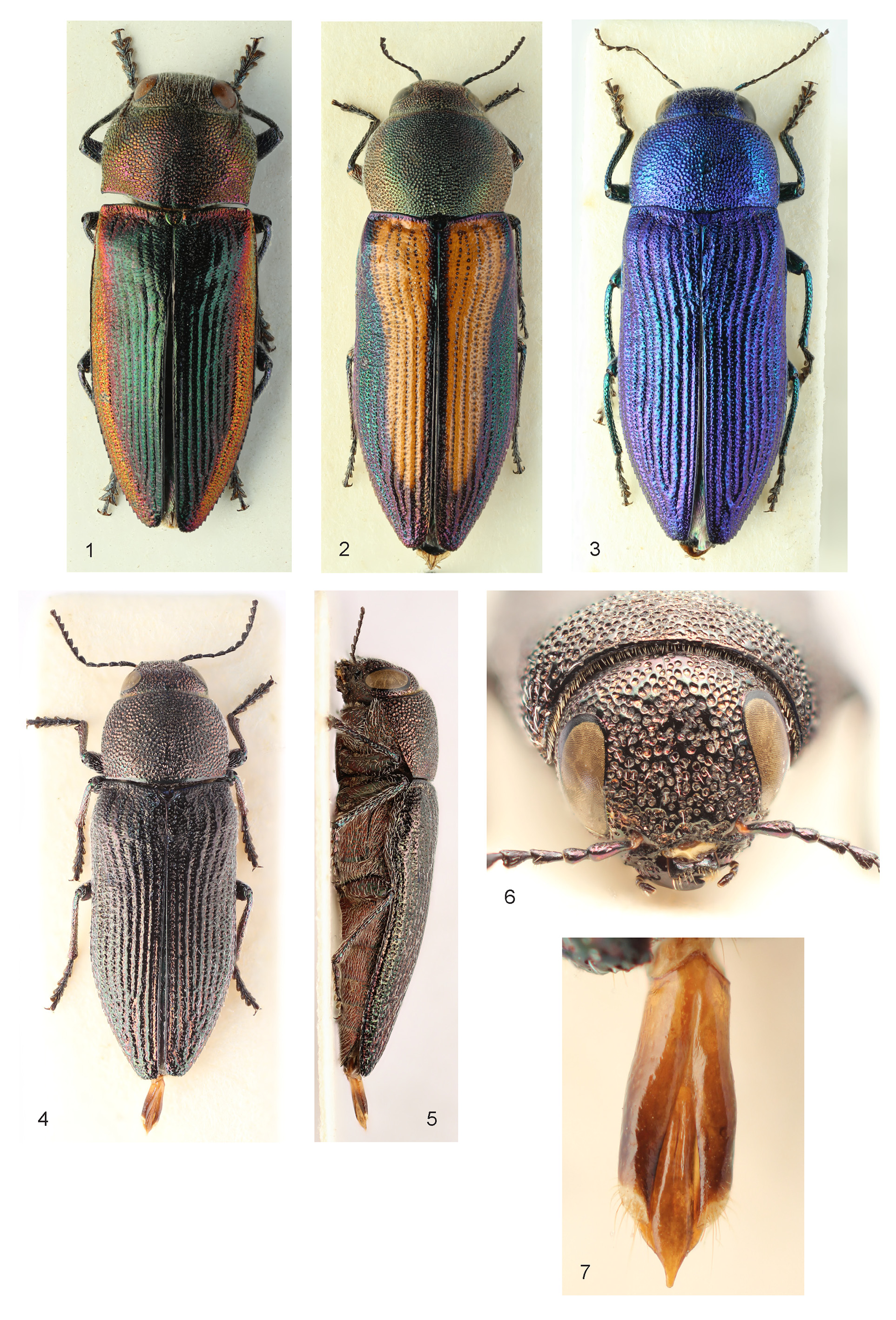
1 Frons flat, pronotum weakly bell-shaped, lateral pronotal margins straight in posterior half or weakly emarginate anteriorly of rectangular posterior angles; head and pronotum coppery-red, elytra dark blue-green with red base and lateral margins ( Fig. 1 View FIGURES 1 – 7 ); 10.0–18.0 mm; N.T., S.A., V., W.A................................................................................................. N. aureocincta Blackburn, 1892 View in CoL
- Frons convex, lateral pronotal margins regularly rounded, posterior angles obtuse-angled; entire body unicolorous or elytra dark green with wide, yellow, longitudinal stripes.................................................................................................................................... 2
2 Sculpture of pronotum homogeneous consisting of dense, simple, deep punctures; antennae short, hardly reaching midlength of lateral pronotal margins when laid alongside; vertex and pronotal disc black-green, frons and lateral sides of pronotum with purple tinge; elytra dark metallic green, each elytron with wide, yellow, longitudinal stripe not reaching elytral apex; ( Fig. 2 View FIGURES 1 – 7 ); 8.0– 17.0 mm; W.A......................................................................................................................................... N. flavovittata Carter, 1922 View in CoL
- Sculpture of pronotum rough consisting of coarse, rounded or somewhat transversely widened punctures and short transverse rugae; pronotum usually with short, narrow and glabrous, medial line; antennae long reaching posterior two thirds of lateral pronotal margins when laid alongside; body unicolorous, black or blue-violet..................................................................................... 3
3 Entire body blue, blue-green or blue-violet, female—ventral surface bright blue-green, male—ventral surface red-copper; pronotum and elytra asetose, ventral surface with very short and sparse, white pubescence; ( Fig. 3 View FIGURES 1 – 7 ); 8.0–15.0 mm; W.A.................................................................................................................................................................................... N. nickerli ( Obenberger, 1928) View in CoL
- Entire body black with fine blue-violet or bronze lustre, ventral surface black-bronze; lateral sides of pronotum and elytra with sparse, semierect, white pubescence, ventral surface with long, dense, almost lanuginose, recumbent, white pubescence ( Figs. 4, 5 View FIGURES 1 – 7 ); 8.5–14.2 mm; W.A.......................................................................................................................................... N. obscura sp. nov.
No known copyright restrictions apply. See Agosti, D., Egloff, W., 2009. Taxonomic information exchange and copyright: the Plazi approach. BMC Research Notes 2009, 2:53 for further explanation.
|
Kingdom |
|
|
Phylum |
|
|
Class |
|
|
Order |
|
|
Family |