
Euscelophilus longispinus Xie & Liang
|
publication ID |
https://doi.org/10.5281/zenodo.182748 |
|
persistent identifier |
https://treatment.plazi.org/id/0384E271-FFB6-FFB5-DAA5-FF72955775AC |
|
treatment provided by |
Plazi |
|
scientific name |
Euscelophilus longispinus Xie & Liang |
| status |
sp. n. |
Euscelophilus longispinus Xie & Liang , sp. n.
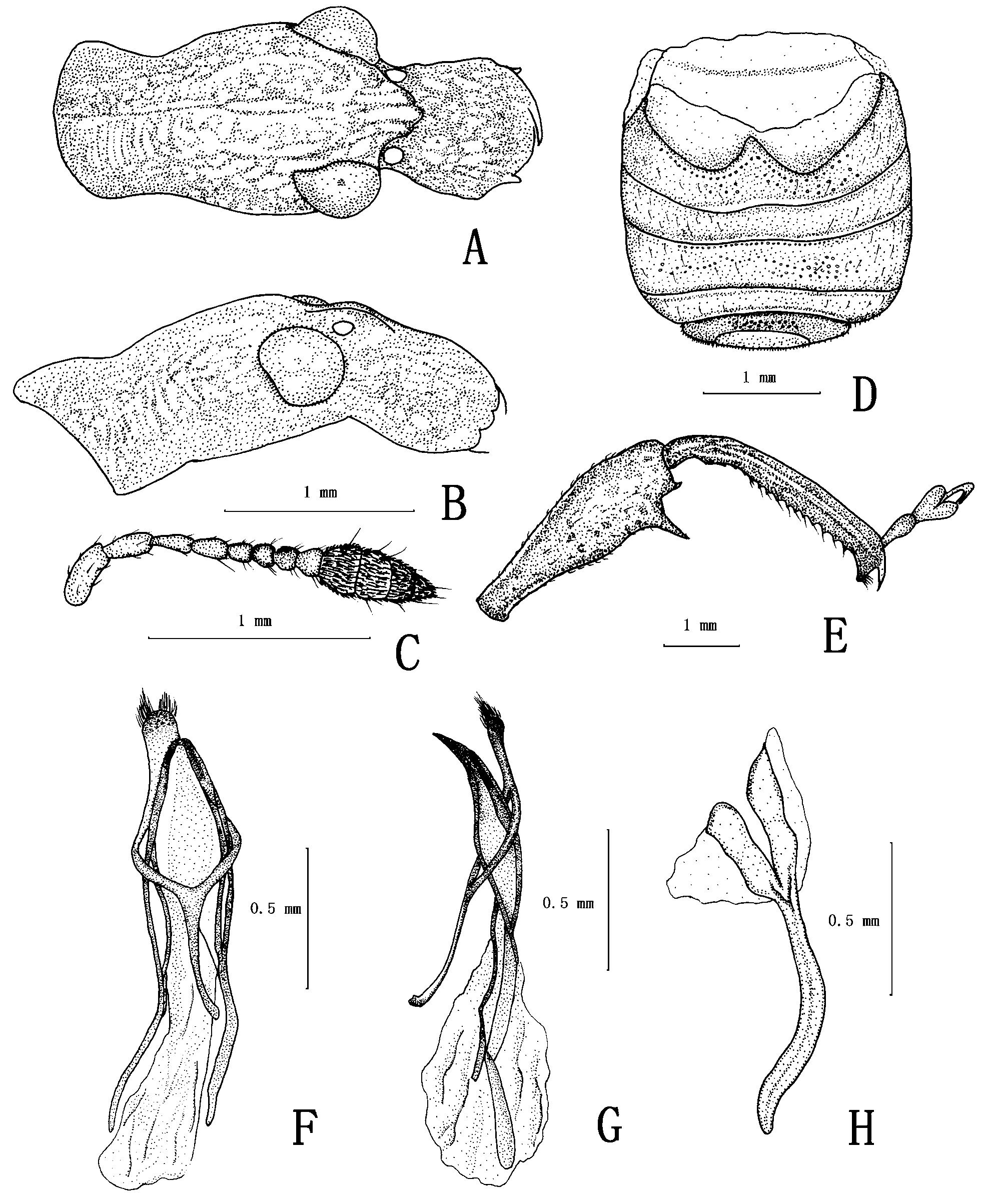
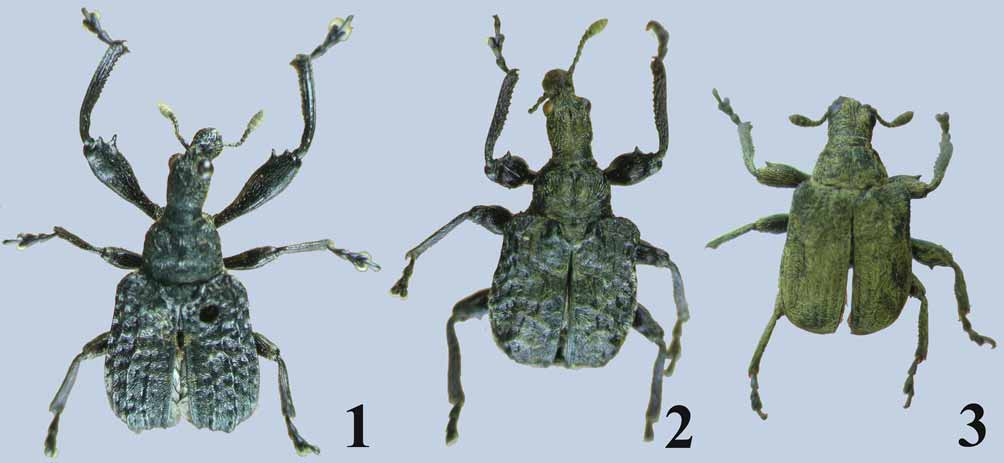
( Figs. 1 View FIGURES 1 – 3 , 4 View FIGURE 4 A–H)
Description. Male (figs. 1, 4). Length 7.2–7.3 mm. Coloration and vestiture: black, except abdomen dark brown; head, thorax and elytra covered with sparse, soft, golden hairs; antennae, prosternum, mesepisternum, mesepimeron and scutellum with similar but denser setation. Head (figs. 4 A, B) elongate, with dense punctures and strong sculpture, constricted at basal 1 / 5. Rostrum slightly longer than broad, with variously sized punctures. Antennae (fig. 4 C) inserted close to eyes as typical in genus; scape robust, cylindrical; 1 st funicular segment elongate, 3 / 4 as long as scape; 2 nd and 3 rd slightly shorter than 1 st but narrower and slender; 4 th, 5 th, 6 th and 7 th globular, increasingly inflated; club robust, 2 nd segment as long as 1 st, 3 rd and 4 th segments fused. Area between antennal insertions forming a blunt tumour. Frons weakly concave between eyes. Eyes hemispherical, moderately convex, dorsally separated by more than their width. Frontal ridge pronounced but smooth, with lateral ridges in apical 1 / 3, forming a distinct, straight, fine, median furrow in basal 2 / 3. Prothorax 1.4 x broader than long, broadest at base, roundly narrowed anteriorly, strongly sculptured. Pronotal disc with a smooth, longitudinal, median double ridge from basal 1 / 6 to apical 1 / 6, glabrous; laterally with an interrupted longitudinal groove; anteriorly and posteriorly transversely depressed, anterior depression continuous but posterior one divided into three; also two V-shaped dimples adjacent to median ridge, without hair. Remaining area of prothorax rugose, ridges glabrous and grooves mostly pilose. Scutellum trapezoidal, 1.8 x broader than long, covered with golden hairs except for rough median process. Elytra subrectangular, about 1.3 x longer than broad, with lateral margins subparallel, slightly dilated posteriorly; striae and intervals irregular; punctures wide and deep, almost round at the base of elytra but partially confluent in posterior half; posterior half of 2 nd, entire 4 th and basal half of 6 th interval forming three curved glabrous ridges; a pair of blunt protuberances at scutellum and another at each humerus, humeri prominent; fossae partly pilose, a line of hairs in posterior half of sutural ridge. Legs (fig. 4 E). Femora moderately strong, asymmetrically clavate, straight and slender in basal 1 / 3. Front femur about 1.5 x longer than middle and hind femora, smooth, ventrally with two apical spines, distal one small and short, proximal one long and sharp; middle and hind femora clavate, with two small spines. Front tibia longer than others, slightly curved, thin and narrow, ventrally with a row of equidistant denticles each bearing a tiff seta, dorsal contour smooth, with a single, stout uncus; middle tibia shortest, slightly compressed, weakly bisinuate, dorsal contour with rounded lobe. Abdomen (fig. 4 D) subrectangular, a little broader than long; sides almost parallel, apically weakly rounded. Ventrites 1 to 4 finely and sparsely punctuate in middle, densely wrinkled at sides; 5 very short, with punctures and a line of hairs at apical margin. Pygidium with a straight median line and laterally covered with dense punctures. Genitalia as in figs. 4 F–H. Female differing from male, except in primary sexual characters, only as follows: slightly larger (length 7.9 mm); proximal spine of front femur short and blunt; all tibiae with two unci.
Material examined. Holotype male: CHINA: Guizhou Province (Daozhen County, sanqiaozhen), 27 - May- 2004, Yang Yu Coll. (HBU); paratypes: 1 female, same data; 1 male, 1 female CHINA: Guizhou Province (Daozhen County, dashahe), 17 -August- 2004, Xiu-juan Yang Coll. (HBU); 1 male, CHINA: Guizhou Province (Leishan County, fangxiang), 15 -September- 2005, Ji-liang Wang Coll. (HBU); 1 male, CHINA: Guizhou Province (Daozhen County, yuheba), 25 -May- 2004, Yang Yu Coll. (HBU); 1 female, CHINA: Guizhou Province (Daozhen County, xiannüdong), 17 -August- 2004, Xiu-juan Yang Coll. (HBU); 1 female, CHINA: Guangxi Province (Luocheng County, pingying), 27 -September- 2003, Xiu-juan Yang Coll. (HBU); 1 male, CHINA: Guangxi Province (Leye County, yachang), 26 -July- 2004, Yang Yu Coll. (HBU); 1 female, CHINA: Chongqing City (Jiangjin County, dawopu), 3 -August- 2003, Cai-xia Yuan Coll. (HBU); 1 female, CHINA: Chongqing City (Jiangjin County, dahonghai), 5 -August- 2003, Cai-xia Yuan Coll. (HBU); 1 male, CHINA: Chongqing City (Nanchuan County, jinfoshan), 7 -July- 2003, Cai-xia Yuan Coll. (HBU).
Etymology. The name longispinus refers to the diagnostic, long and sharp, subapical ventral spine of the front femur ( Fig. 4 View FIGURE 4 E) in the male.
Distribution. P. R. China: Guizhou, Guangxi, Chongqing.
Notes. In the shape and sculpture of the prothorax, E. longispinus is most similar to E. niger Liang , but it can be distinguished from the former as follows: first three funicular segments subequal, 3 rd not shorter than 2 nd; head constricted at basal 1 / 5; front femur with two apical spines, the proximal one long and sharp; covered only with sparse golden hair observed. The constriction of the head is also a distinguishing character from other species of the genus.
No known copyright restrictions apply. See Agosti, D., Egloff, W., 2009. Taxonomic information exchange and copyright: the Plazi approach. BMC Research Notes 2009, 2:53 for further explanation.
|
Kingdom |
|
|
Phylum |
|
|
Class |
|
|
Order |
|
|
Family |
|
|
Genus |