
Fannia pretiosa (Schiner, 1862)
|
publication ID |
https://doi.org/10.11646/zootaxa.5264.2.2 |
|
publication LSID |
lsid:zoobank.org:pub:97A03469-519D-49D7-8D0E-2F6648CCB922 |
|
DOI |
https://doi.org/10.5281/zenodo.7836353 |
|
persistent identifier |
https://treatment.plazi.org/id/0396A100-C21C-EE71-DDF7-FF0440F31580 |
|
treatment provided by |
Plazi |
|
scientific name |
Fannia pretiosa |
| status |
|
Fannia pretiosa View in CoL -group species from Mexico
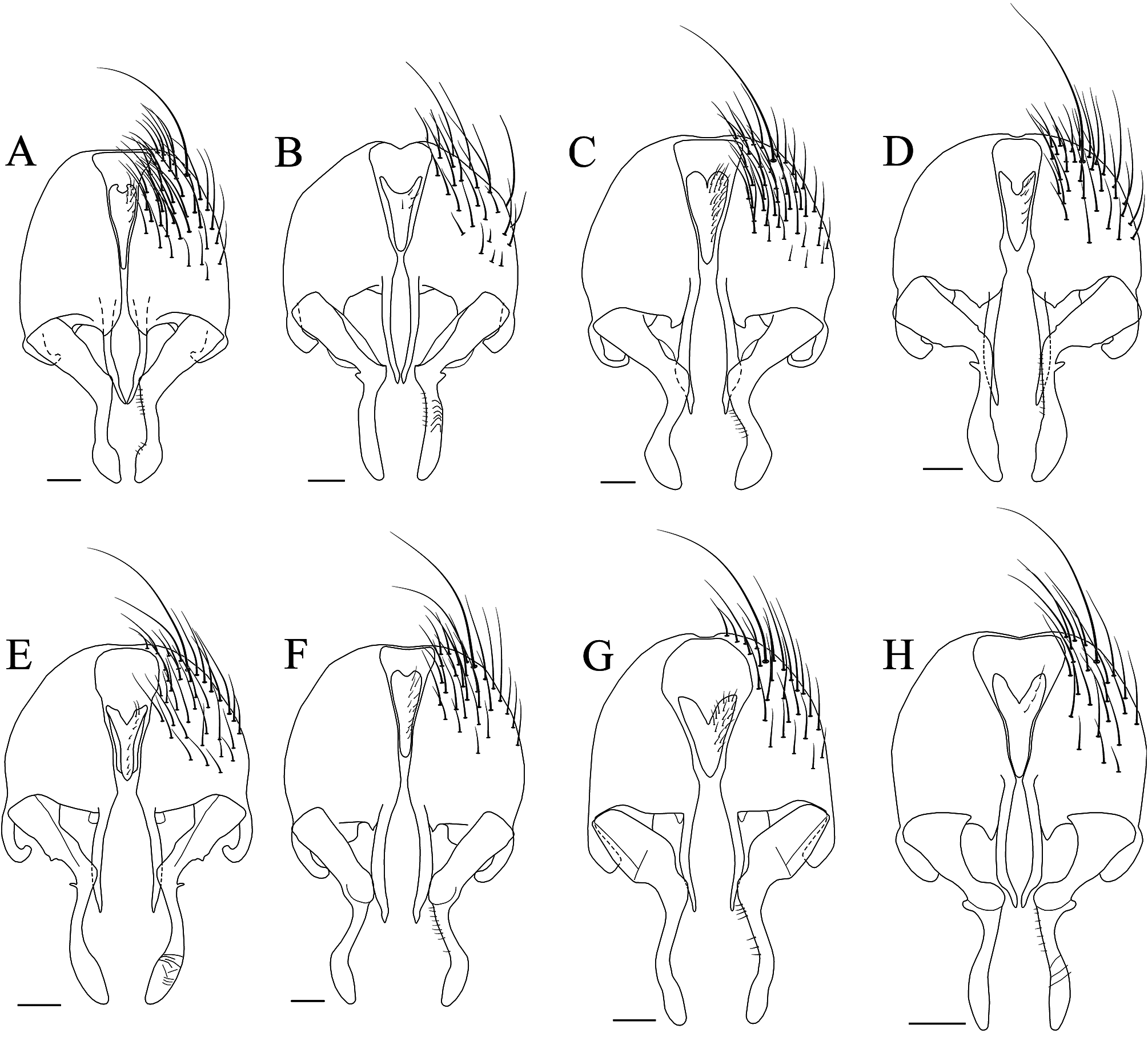
Diagnosis. Body metallic black-bluish to dark grey with silver pruinosity. Eyes short setulose. Parafacial bare. Scape and pedicel black. Postpedicel 3 times longer than pedicel. Arista black, with short pubescence, rays shorter than width of base of arista. Palpus black and slightly spatulate apically. Prealar 2. Proepimeron with 2 setae and covered with setulae. Notopleural 2. Postpronotum with 2 setae and covered with setulae. One pair of prescutelar setae. Dorsocentrals 2+3. Katepisternum 1+1. Male legs: fore femur very setulose on p surface, with 1 row of long pv and pd; ad to v surface bare; fore tibia with 1 pre-apical d; 1 short apical pv and v; fore tarsi white-yellowish (except F. arcuata and F. bisetata sp. nov.); mid tibia constricted ventrally on basal half, enlarged and covered with several ventral setulae on apical half; hind femur with pre-apical swelling on v surface, covered with a tuft of long posteroventral setae ( F. amplitarsis sp. nov., F. bisetata sp. nov., and F. grisalesae sp. nov. also have an anteroventral tuft of setae); hind tibia with 1 long submedian d seta (with a third of the tibia length), 1 submedian ad ( F. amplitarsis sp. nov., F. arcuata , F. bisetata sp. nov. also have a full row of short ad setae), and 1 pre-apical d shorter (about half-length of the longer one). Sternite 1 setulose (densely setulose in F. bisetata sp. nov.). Male syntergosternite with 2–5 lateral setae. Male terminalia with long and curved surstyli and a long bacilliform process ( Fig. 4 View FIGURE 4 ).
No known copyright restrictions apply. See Agosti, D., Egloff, W., 2009. Taxonomic information exchange and copyright: the Plazi approach. BMC Research Notes 2009, 2:53 for further explanation.