
Otomantis gracilis Lombardo & Ippolito, 2014
|
publication ID |
https://dx.doi.org/10.11646/zootaxa.3797.1.13 |
|
publication LSID |
lsid:zoobank.org:pub:058AE196-A5DE-480D-BE32-ED4E81DC2ABD |
|
DOI |
https://doi.org/10.5281/zenodo.4915439 |
|
persistent identifier |
https://treatment.plazi.org/id/03A82104-FF90-FF94-FF0A-FF2694657F8B |
|
treatment provided by |
Felipe |
|
scientific name |
Otomantis gracilis Lombardo & Ippolito |
| status |
sp. n. |
Otomantis centralis Lombardo & Stiewe sp. n.
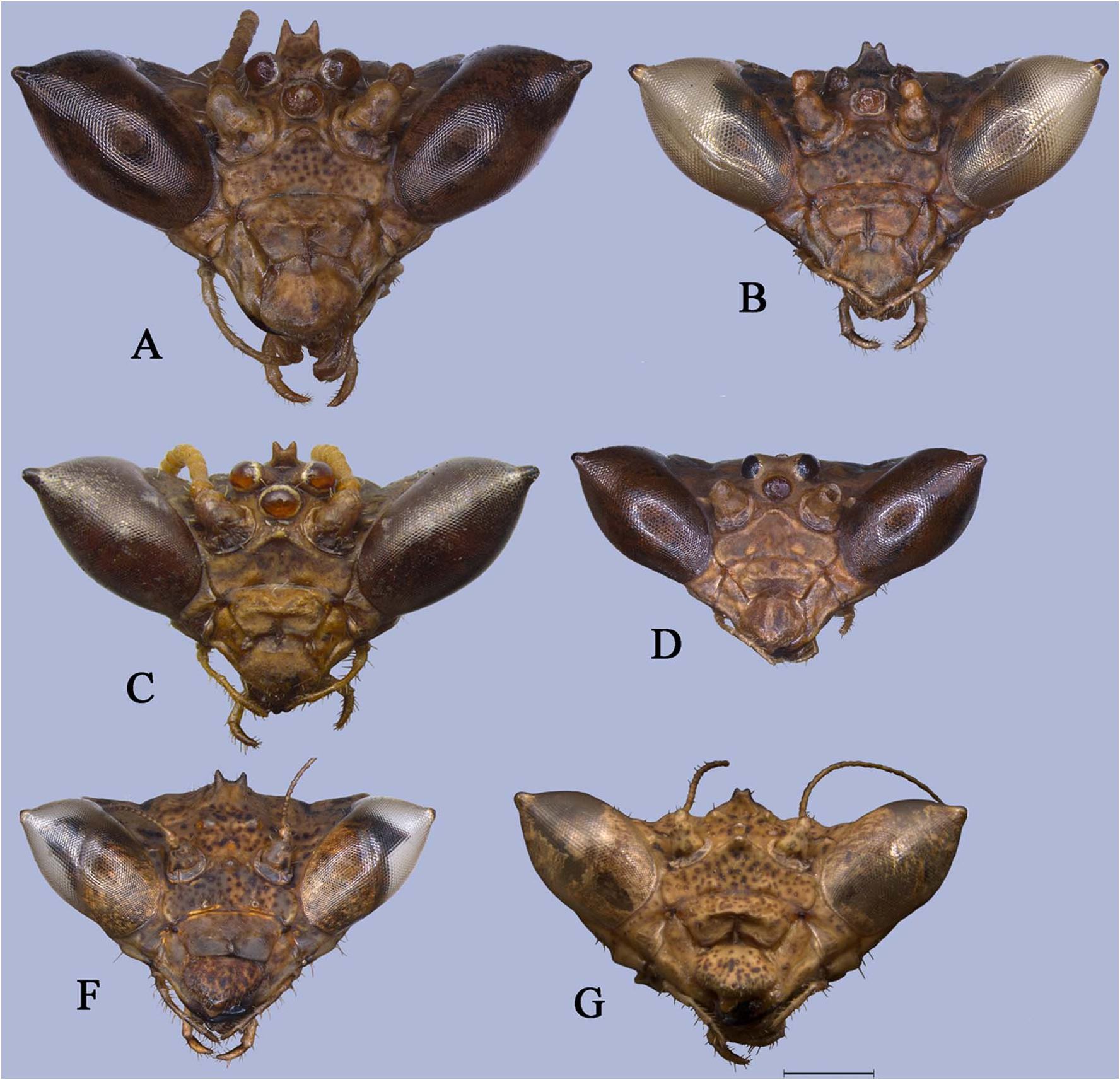
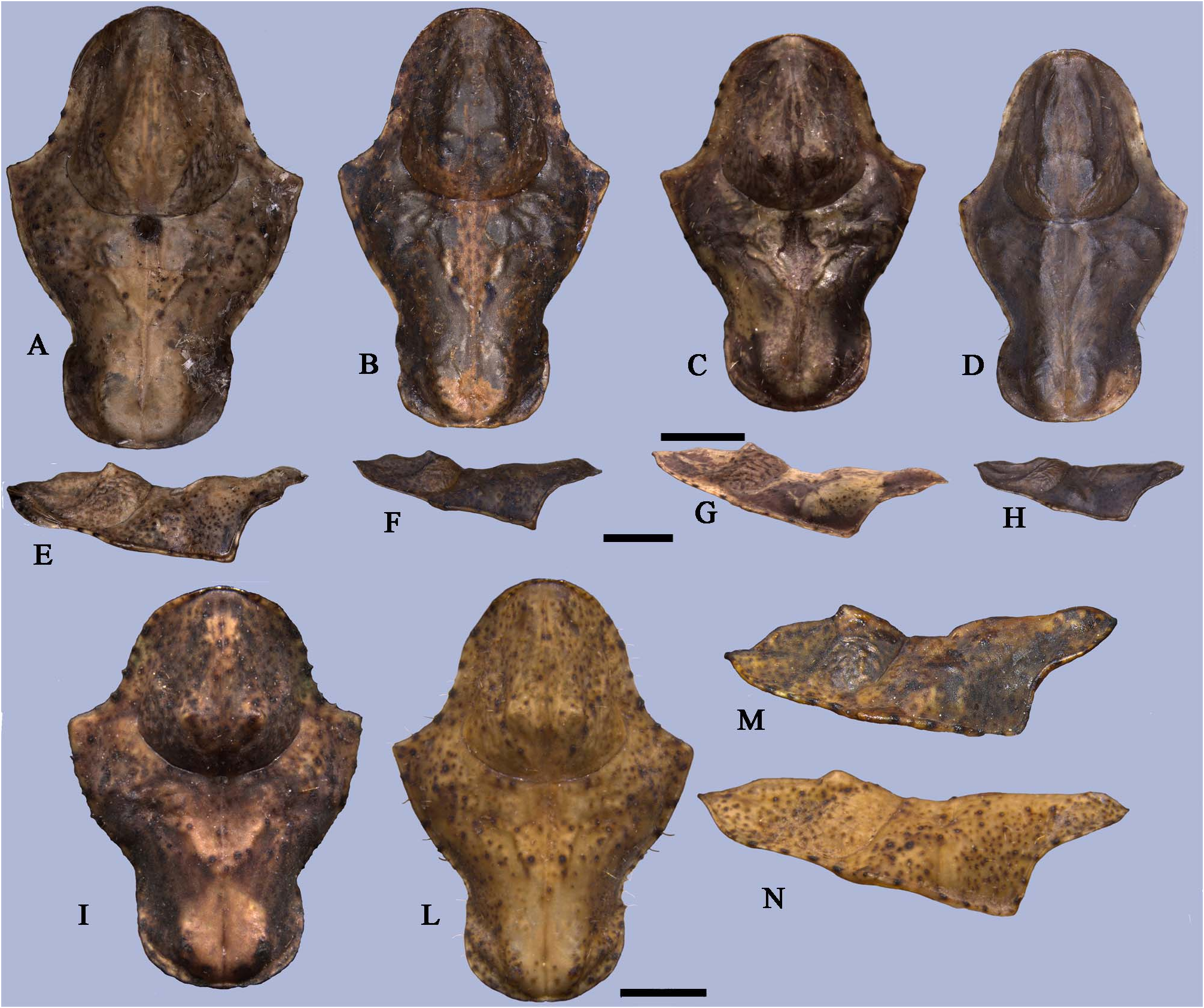
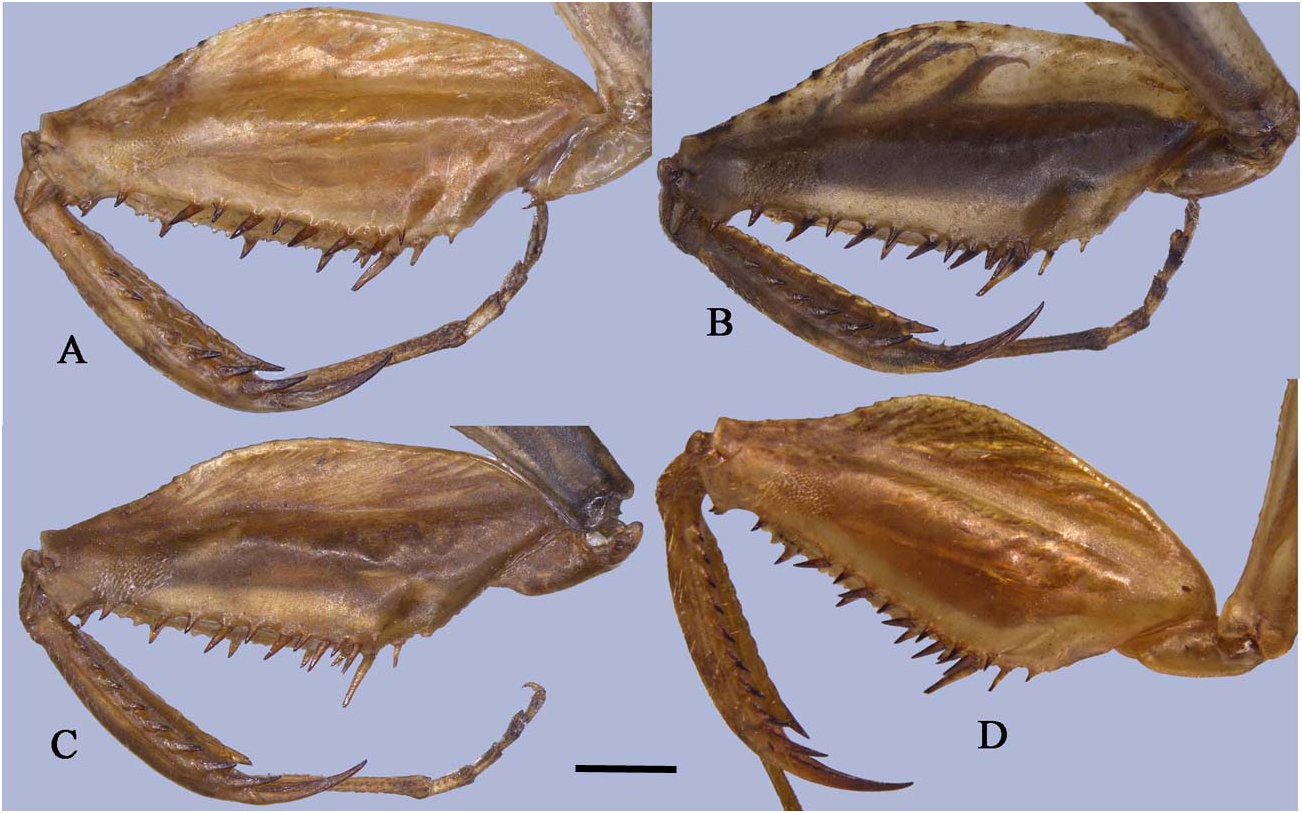
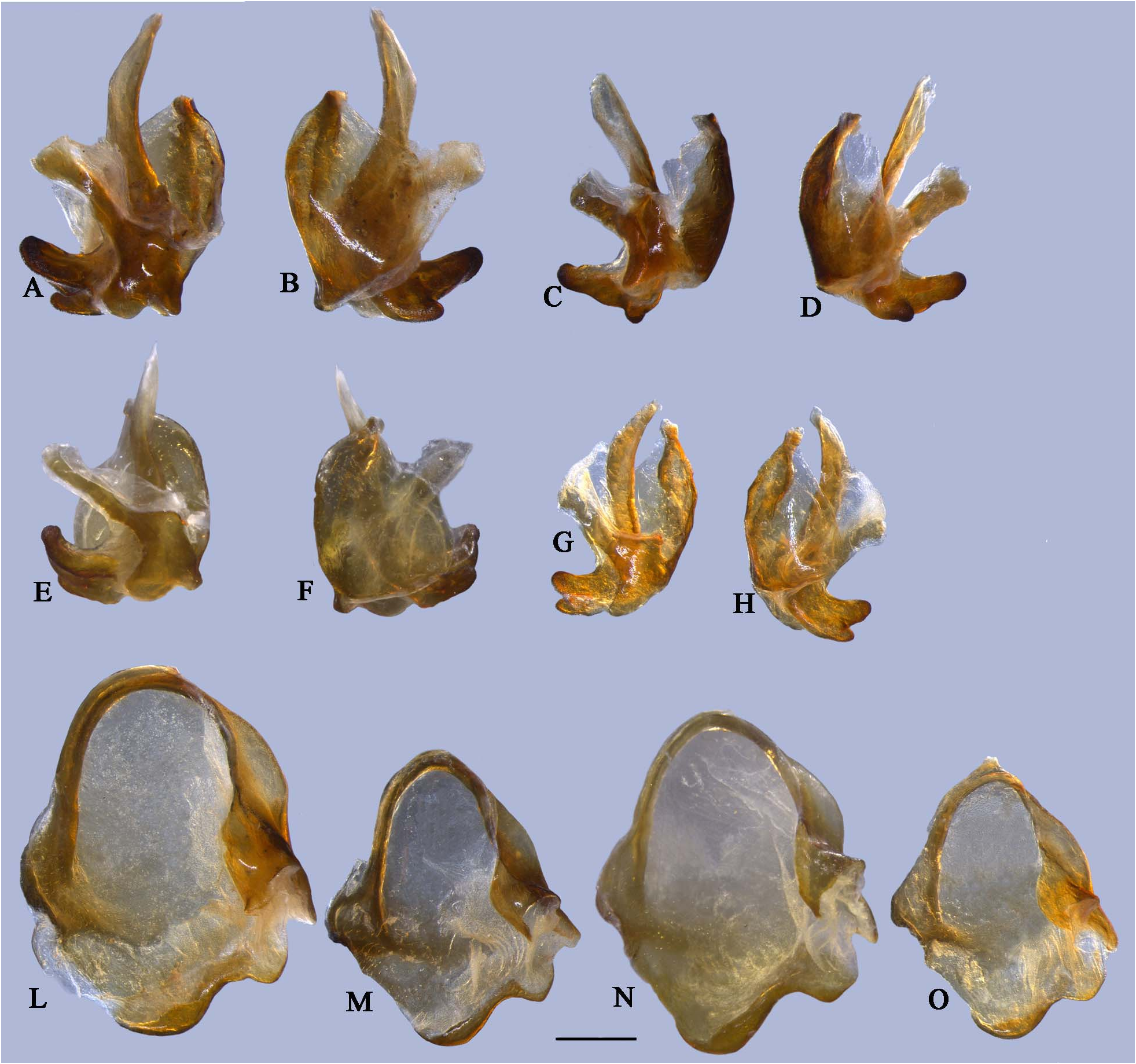
( Figs 9B, G View FIGURE 9 ; 10B, F, L, N View FIGURE 10 ; 11B View FIGURE 11 ; 12C–D, M View FIGURE 12 ; 13 View FIGURE 13 )
Type specimens. Holotype 1♂, D. R. CONGO: Nyangwe , 15/ 30-III-1918, (leg. R. Maynè) ( MDAB) ; Paratypes D. R. CONGO: 1 ♀ Sankuru, Gandajika, 1954 ( P. de Francquen) ( MABC); REP. POP . CONGO: 1♂ M`be, J.F. Cornic, 3.II.1973, Stiewe genitalia prep. Ot.C. 01, ( MNHN) . CONGO: 5 ♂ Djoumouna, C. Morin, 16.05.73; 13.03.75; 29.10.75, Roy genitalia prep. 2352; 28.02.76; 25.09.76; ( MNHN); Voka, C. Morin , 10.04.74, 1♀ ( MNHN) ; ANGOLA: Centro Entomologico Salazar [N'dalatando], Hosp. Desc., Collected by Ventura, 8.10.72, E 26596 View Materials , 1♀, ( IICT)-(ex collection Huambo, Angola ( IIA); Centro Entomologico Salazar [N'dalatando], Hosp. Desc., collected by Ventura, 14.10.72, E 26894 View Materials , Roy genitalia prep. 2284, 1 ♂, ( IICT)-(ex collection Huambo, Angola ( IIA)
Diagnosis. Similar to O. capirica , from which it can be distinguished by the male having a stockier prozone and a phalloid apophysis with more divergent apical lobes.
Description male.
General coloration: Body ochre with small dark spots, more numerous on the head and on the pronotum. Maxillar palpi ochre with last two segments darkish inside; mandibles and labial palpi ochre with dark apex. Anterior legs ochre.
Measurements (mm): TL 20.5; HW 4; PL 3.8; ML 2.1; SDW 2.6; MPW 1.4 CL 4.5; FL 5; MFW 2.3; WL 19.5 x 4.5.
Head ( Fig. 9B View FIGURE 9 ): Transverse, 1.5 times wider than pronotal supracoxal dilation; vertex straight, vertical process of vertex short and bifid; juxta-ocular tubercles conical; eyes oval/ovoid, with a short apical spine. Antennae elongated; frontal shield transverse, pentagonal, 2.84 times wider than high, apex with a distinct projected spike.
Thorax: Pronotum ( Fig. 10B, F View FIGURE 10 ) rhomboidal, 1.52 times longer than wide; prozone elongated, lateral margins with 4–5 dark tubercles, disc with two acute conical tubercles near the supracoxal sulcus. Disc of metazone with a longitudinal median carina; lateral margins of supracoxal dilation forming an obtuse angle.
Forelegs: Coxae about 1.2 times longer than pronotum, anterior margin with a series of small dark granules, each bearing a seta at the apex, internal apical lobes divergent. Femora flattened, 2.17 times longer than wide, dorsal margin toothed, curved and with widest part at the 2/3 from the base ( Fig. 11B View FIGURE 11 ) Spination formula F=4ES/ 11IS/4DS and T =10ES/8IS, all spines of femora and tibiae brown with dark apex.
Meso and metathoracic legs: Femora robust, with distal triangular lobe that is bigger in metafemora and more acuminated in mesofemora. Tibiae shorter than femora, with a triangular, basal lobe.
Wings: Hyaline, exceeding the apex of abdomen. Costal field of mesothoracic wings opaque, discoidal area hyaline, with numerous scattered dark spots. Metathoracic wings semi-hyaline and chestnut colored.
Abdomen: Cylindrical, subgenital plate longer than wide, apex not incised.
External genitalia: Ventral phallomere ovoid ( Fig. 12M View FIGURE 12 ), slightly longer than wide and with a lobe-like distal process (dp) with a large auriculated lamina on its right side and outer margin sinuous. Left phallomere with elongated dorsal lamina (dl) ( Fig.12D View FIGURE 12 ), slightly widened at the base and gradually narrowing towards the apex; ventral lamina ( Fig. 12C View FIGURE 12 , vl) more or less square, with a long arm on the anterior margin. Phalloid apophysis (af) well developed, with two divergent apical processes of which the anterior is considerably more developed.
Female description.
General coloration: Body ochre, with numerous small dark spots. Antennae with scape, pedicel and proximal 1/3 of flagellum ochre, remaining parts dark. Internal surface of coxae and femora black; external spines ochre with dark apex, internal spines dark. Mesothoracic wings opaque and ochre, with numerous small, chestnut colored spots; metathoracic wings semi hyaline and chestnut colored.
Measurements (mm): Tl 21; HW 4.8; PL 5.1; ML 2.6; SDW 3.7; MPW 1.8; CL 5.1; FL 6.8; MFW 1.8; WL 17.
Head ( Fig. 9G View FIGURE 9 ): Transverse, 1.29 times wider than pronotal supracoxal dilation; vertical process of vertex small and bifid; juxta-ocular tubercles conical and robust, with acuminated apex; frontal shield transverse, with a small spike on upper margin.
Thorax: Pronotum ( Fig. 10L, N View FIGURE 10 ) similar to male but more robust, 1.37 times longer than wide.
Forelegs: Coxae robust; anterior margin with 5–6 minute dark tubercles, internal surface scattered with dark spots, internal lobes divergent. Femora 3.7 times longer than wide, dorsal margin with a series of small granules. Spination formula F=4ES/11IS/4 DS and T =12ES/10IS.
Meso and metathoracic legs: Femora with distal triangular lobes with rounded apex, lateral margin broadened.
Wings: Mesothoracic wings opaque brown, with numerous dark patches differing in size, costal area with numerous brown cross-veins. Metathoracic wings semi-hyaline and auburn colored, longitudinal veins on discoidal area dark brown.
Abdomen: Enlarged; supra-anal plate triangular in shape with rounded apex.
Distribution. This species occurs in the eastern Congo and northern Angola ( Fig. 13 View FIGURE 13 ).
Etymology. The new species is named after the distribution area Central Africa.
Otomantis gracilis Lombardo & Ippolito sp. n.
( Figs 9D View FIGURE 9 ; 10D, H View FIGURE 10 ; 11D View FIGURE 11 ; 12G–H, O View FIGURE 12 ; 13 View FIGURE 13 )
Type material: Holotype 1♂ D. R. CONGO: Mayidi, 1942, Rév. P. Van Eyen, ( MDAB) ; Paratypes: 1♂ Congo , Grand Bois, J.-P. Grillot, 24.05.72, Roy genitalia prep. 1859, ( MNHN) D. R. Congo : 1♂ Lovanium , ( Kinshasa), XII.1968, P. M. Elsen, Roy genitalia prep. 3134 ( IICT) .
Diagnosis. This species differs from all other species in the capirica group in its smaller size and the significantly reduced vertical process of vertex ( Fig. 9D View FIGURE 9 ). The female is unknown for the species.
Male description.
General Coloration: Body ochre with scattered small dark spots; head ochre with dark spots on the vertex and near the eyes; legs ochre; abdomen dark brown dorsally.
Measurements (mm): TL 17; HW 3.8; PL 3.5; MPW 2.2; ML 1.9; SDW 2.1; CL 4.1; FL 4.7; MFW 2; WL 17.5 x 4.3.
Head ( Fig. 9D View FIGURE 9 ): Transverse, vertex straight, vertical process of vertex reduced to a small spike; juxta-ocular tubercles conical; eyes oval, apical spine with rounded apex; antennae elongated; frontal shield transverse, pentagonal, 2.54 times wider than high, lateral margins straight, apex with a small rounded spike folded forward.
Thorax: Pronotum ( Fig. 10D, H View FIGURE 10 ) rhomboidal, slender, 1.59 times longer than wide. Prozone elongated, disc with two flattened median tubercles, lateral margins with 4–5 dark small tubercles; metazone with a triangular depression behind supracoxal sulcus; lateral margins of supracoxal dilation form an obtuse angle.
Forelegs: Slender; coxae about 1.17 times longer than pronotum, anterior margin with 8–10 small dark spines; internal apical lobes divergent; anterior femora ( Fig. 11D View FIGURE 11 ) flattened, 2.25 times longer than wide, dorsal margin toothed, curved and its widest part at the 2/3 from the base; spination formula F=4ES/11IS/4DS and T =10ES/9IS; external spines ochre with dark apex.
Meso and metathoracic legs: Femora slender with distal triangular lobes with rounded apex, lobes nearly same size on meso and metafemora, lateral margin broadened.
Wings: Hyaline, exceeding the apex of abdomen. Costal field of mesothoracic wings opaque, discoidal area hyaline with numerous scattered dark spots. Metathoracic wings hyaline.
Abdomen: Cylindrical; supra-anal plate triangular in shape, with rounded apex; subgenital plate longer than wide, not incised at apex and with two small styli. Cerci conical, shorter than in O. scutigera .
External genitalia: Ventral phallomere ( Fig. 12O View FIGURE 12 ) similar to O. capirica , but with a smaller auriculated lamina. Left phallomere with dorsal lamina (dl) elongated ( Fig. 12H View FIGURE 12 ), slightly wider at the base, ventral lamina ( Fig. 12G View FIGURE 12 , vl) more or less square, with a long arm on the anterior margin. Phalloid apophysis (af) well-developed, with two short apical processes.
Distribution. This species occurs in R. Congo ( Fig. 13 View FIGURE 13 ).
Etymology. Named in reference to its delicate appearance.
Otomantis gracilis Lombardo & Ippolito sp. n.
( Figs 9D View FIGURE 9 ; 10D, H View FIGURE 10 ; 11D View FIGURE 11 ; 12G–H, O View FIGURE 12 ; 13 View FIGURE 13 )
Type material: Holotype 1♂ D. R. CONGO: Mayidi, 1942, Rév. P. Van Eyen, ( MDAB) ; Paratypes: 1♂ Congo , Grand Bois, J.-P. Grillot, 24.05.72, Roy genitalia prep. 1859, ( MNHN) D. R. Congo : 1♂ Lovanium , ( Kinshasa), XII.1968, P. M. Elsen, Roy genitalia prep. 3134 ( IICT) .
Diagnosis. This species differs from all other species in the capirica group in its smaller size and the significantly reduced vertical process of vertex ( Fig. 9D View FIGURE 9 ). The female is unknown for the species.
Male description.
General Coloration: Body ochre with scattered small dark spots; head ochre with dark spots on the vertex and near the eyes; legs ochre; abdomen dark brown dorsally.
Measurements (mm): TL 17; HW 3.8; PL 3.5; MPW 2.2; ML 1.9; SDW 2.1; CL 4.1; FL 4.7; MFW 2; WL 17.5 x 4.3.
Head ( Fig. 9D View FIGURE 9 ): Transverse, vertex straight, vertical process of vertex reduced to a small spike; juxta-ocular tubercles conical; eyes oval, apical spine with rounded apex; antennae elongated; frontal shield transverse, pentagonal, 2.54 times wider than high, lateral margins straight, apex with a small rounded spike folded forward.
Thorax: Pronotum ( Fig. 10D, H View FIGURE 10 ) rhomboidal, slender, 1.59 times longer than wide. Prozone elongated, disc with two flattened median tubercles, lateral margins with 4–5 dark small tubercles; metazone with a triangular depression behind supracoxal sulcus; lateral margins of supracoxal dilation form an obtuse angle.
Forelegs: Slender; coxae about 1.17 times longer than pronotum, anterior margin with 8–10 small dark spines; internal apical lobes divergent; anterior femora ( Fig. 11D View FIGURE 11 ) flattened, 2.25 times longer than wide, dorsal margin toothed, curved and its widest part at the 2/3 from the base; spination formula F=4ES/11IS/4DS and T =10ES/9IS; external spines ochre with dark apex.
Meso and metathoracic legs: Femora slender with distal triangular lobes with rounded apex, lobes nearly same size on meso and metafemora, lateral margin broadened.
Wings: Hyaline, exceeding the apex of abdomen. Costal field of mesothoracic wings opaque, discoidal area hyaline with numerous scattered dark spots. Metathoracic wings hyaline.
Abdomen: Cylindrical; supra-anal plate triangular in shape, with rounded apex; subgenital plate longer than wide, not incised at apex and with two small styli. Cerci conical, shorter than in O. scutigera .
External genitalia: Ventral phallomere ( Fig. 12O View FIGURE 12 ) similar to O. capirica , but with a smaller auriculated lamina. Left phallomere with dorsal lamina (dl) elongated ( Fig. 12H View FIGURE 12 ), slightly wider at the base, ventral lamina ( Fig. 12G View FIGURE 12 , vl) more or less square, with a long arm on the anterior margin. Phalloid apophysis (af) well-developed, with two short apical processes.
Distribution. This species occurs in R. Congo ( Fig. 13 View FIGURE 13 ).
Etymology. Named in reference to its delicate appearance.

| R |
Departamento de Geologia, Universidad de Chile |
| REP |
Desert Experiment Station of the W.I.R. |
| POP |
Tatranské muzeum v Poprade |
| MNHN |
Museum National d'Histoire Naturelle |
| IICT |
Centro de Zoologia do I.I.C.T. |
| PL |
Západoceské muzeum v Plzni |
| ML |
Musee de Lectoure |
| MFW |
Museum Freriks |
| T |
Tavera, Department of Geology and Geophysics |
No known copyright restrictions apply. See Agosti, D., Egloff, W., 2009. Taxonomic information exchange and copyright: the Plazi approach. BMC Research Notes 2009, 2:53 for further explanation.