
Pseudolathra cyanea ( LAST , 1984), 2014
|
publication ID |
https://doi.org/10.5281/zenodo.5307614 |
|
publication LSID |
lsid:zoobank.org:pub:92B4E5B9-EEBA-473C-8526-0F639725F04F |
|
persistent identifier |
https://treatment.plazi.org/id/03AF87F3-FFC1-190C-FF6C-FEC0FC05C49D |
|
treatment provided by |
Marcus |
|
scientific name |
Pseudolathra cyanea ( LAST , 1984) |
| status |
nov.comb. |
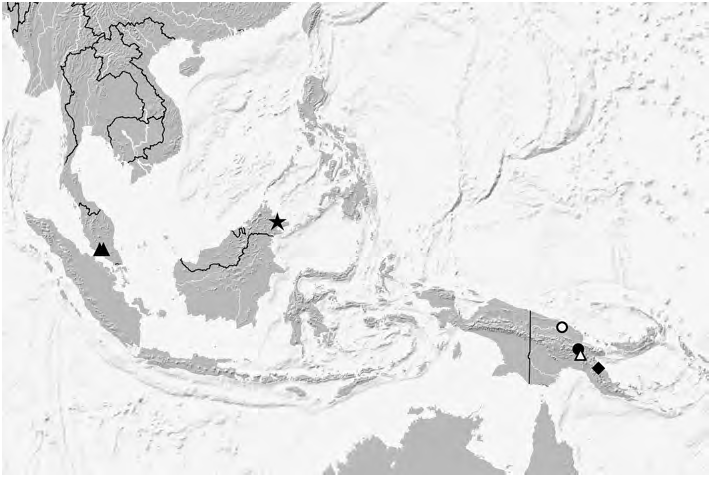
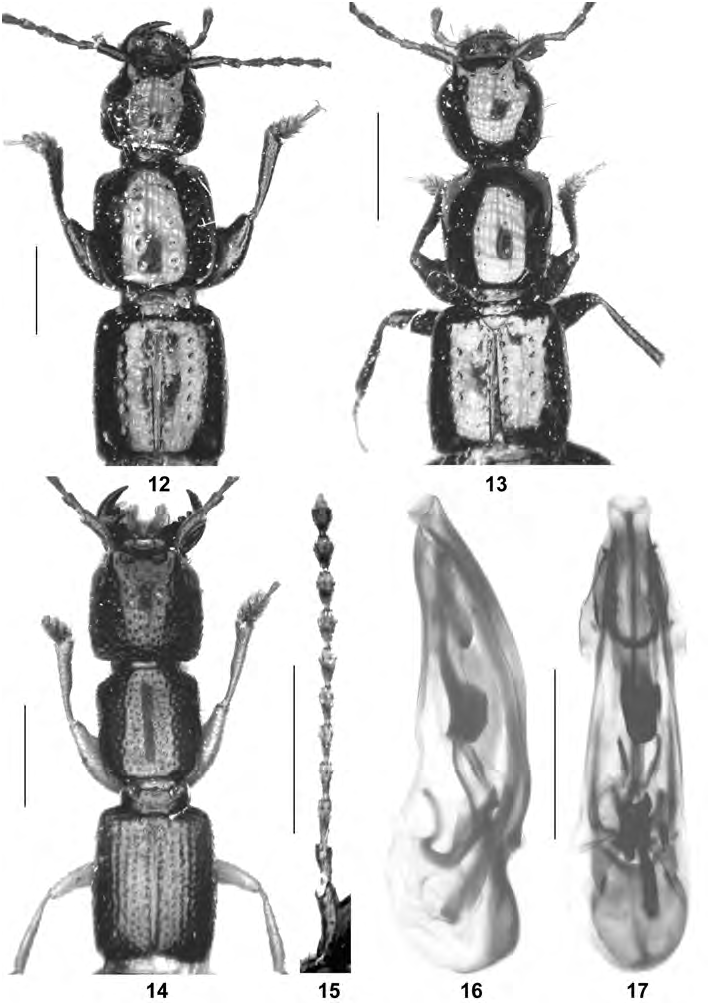
Pseudolathra cyanea ( LAST, 1984) , nov.comb. ( Fig. 13 View Figs 12-17 , Map 2 View Map 2 )
Lathrobium cyanea LAST, 1984: 121 f.
T y p e m a t e r i a l e x a m i n e d: Holotype: " Middle Waria , New Guinea, 29-7-1970,
R. Hornabrook / Holotype / Brit. Mus. 1985-401 / Lathrobium cyanea sp.n., H.R. Last. det., Type / Pseudolathra cyanea (Last) , det. V. Assing 2014" (BMNH).
C o m m e n t: The original description is based on a unique female holotype from "Middle Waria, ..., beaten from foliage"" ( LAST 1984). The species clearly does not belong to Lathrobium . Based on the external characters (punctation pattern, habitus, presence of an epipleural line), it is attributed to Pseulolathra.
R e d e s c r i p t i o n: Body length 8.2 mm; length of forebody 3.9 mm. Coloration highly distinctive: body shiny and black, with pronounced metallic greenish-blue hue; abdomen black with weak bluish hue; legs blackish, with the tarsi and the narrow bases of the tibiae yellowish-brown; antennae reddish, with the median antennomeres somewhat darker.
Head ( Fig. 13 View Figs 12-17 ) 1.05 times as broad as long; posterior angles obsolete; lateral margins behind eyes smoothly rounded towards posterior constriction in dorsal view; dorsal surface with few scattered coarse macropunctures in anterior and lateral portions, otherwise impunctate; microsculpture absent. Eyes large, much longer than distance from posterior margin of eye to posterior constriction. Antenna slender, 2.6 mm long; all antennomeres oblong; antennomeres IV-X gradually decreasing in length and decreasingly oblong.
Pronotum ( Fig. 13 View Figs 12-17 ) strongly convex in cross-section, 1.11 times as long as broad and approximately as broad as head, widest near anterior angles, distinctly tapering posteriorly; dorsal series broadly separated, each composed of 1+3 coarse punctures; lateral portions with few scattered macropunctures; microsculpture absent.
Elytra ( Fig. 13 View Figs 12-17 ) 0.93 times as long as pronotum; epipleural line pronounced (lateral view); dorsal surface with a sutural series composed of 6-7 punctures, a median series composed of 3-4 punctures, and a lateral series composed of 5-7 punctures, otherwise impunctate. Hind wings fully developed. Metatarsomere I shorter than II. Protarsomeres I-IV moderately strongly dilated.
Abdomen slightly narrower than elytra; punctation rather sparse, sparser on posterior than on anterior tergites; interstices with microsculpture; posterior margin of tergite VII with palisade fringe.
: unknown.
C o m p a r a t i v e n o t e s: This species is distinguished from all its congeners by the conspicuous coloration alone.
D i s t r i b u t i o n a n d n a t u r a l h i s t o r y: Thetypelocalityisapparently a river valley in the Bowutu Mountains in eastern Papua New Guinea ( Map 2 View Map 2 ). According to LAST (1984), the holotype was beaten from the foliage of a tree.
No known copyright restrictions apply. See Agosti, D., Egloff, W., 2009. Taxonomic information exchange and copyright: the Plazi approach. BMC Research Notes 2009, 2:53 for further explanation.
|
Kingdom |
|
|
Phylum |
|
|
Class |
|
|
Order |
|
|
Family |
|
|
Genus |

Pseudolathra cyanea ( LAST , 1984)
| Assing, V. 2014 |
Lathrobium cyanea
| LAST H 1984: 121 |