
Oosternum
|
publication ID |
https://doi.org/10.5281/zenodo.186668 |
|
DOI |
https://doi.org/10.5281/zenodo.5680133 |
|
persistent identifier |
https://treatment.plazi.org/id/03B74947-FF87-FFAE-23B2-FF52FA644489 |
|
treatment provided by |
Plazi |
|
scientific name |
Oosternum |
| status |
|
Key to Oosternum View in CoL species groups
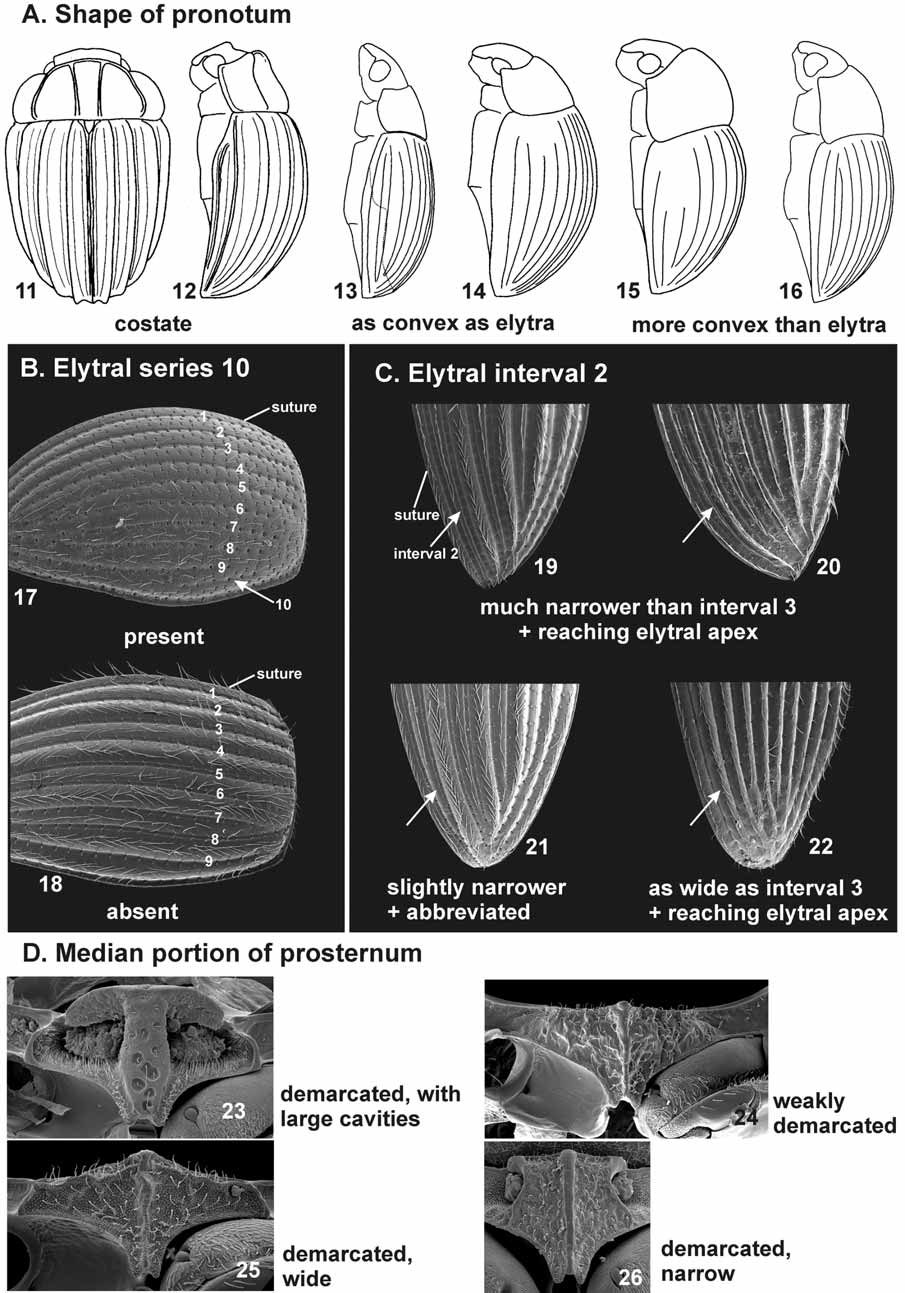
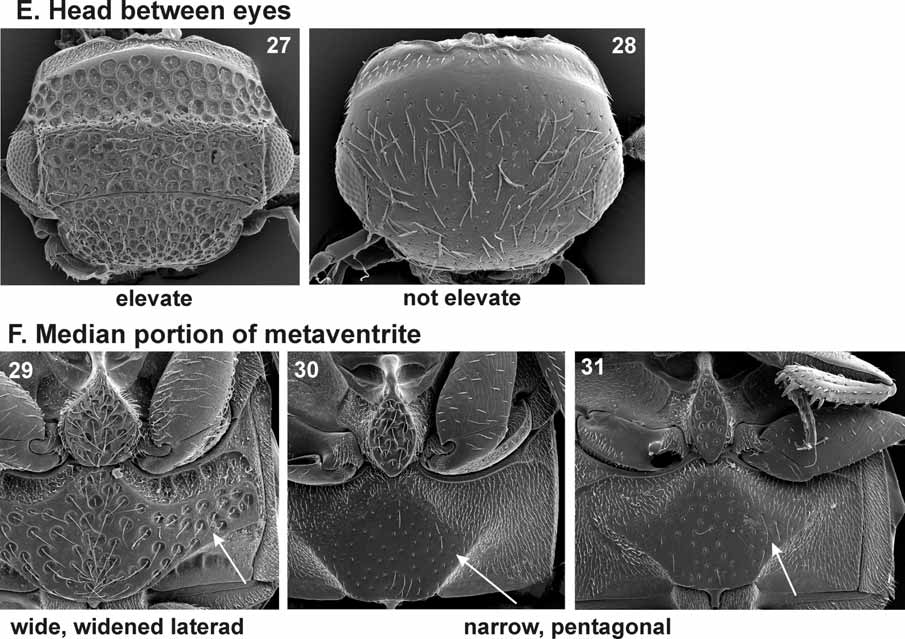
1. Pronotum bearing weak (see Fig. 13 View FIGURES 11 – 26 in Smetana 1978) to very high longitudinal costae ( Figs. 11–12 View FIGURES 11 – 26 ). Frons between eyes elevated above remaining surface ( Fig. 27 View FIGURES 27 – 31 ). Prosternal plate with large lateral cavities ( Fig. 23 View FIGURES 11 – 26 ). Elevated por- tion of metaventrite nearly reaching lateral margins of metaventrite, not pentagonal ( Fig. 29 View FIGURES 27 – 31 )...... O. sculptum View in CoL group
- Pronotum evenly convex, without any trace of longitudinal costae. Interocular portion of frons not elevated ( Fig. 28 View FIGURES 27 – 31 ). Prosternal plate without deep lateral cavities ( Figs. 24–26 View FIGURES 11 – 26 ). Elevated portion of metaventrite pentagonal, con- fined to median portion of the metaventrite ( Figs. 30–31 View FIGURES 27 – 31 ) .......................................................................................... 2
2. Elytral series 10 short but present, situated anteriorly between series 9 and elytral margin ( Fig. 17 View FIGURES 11 – 26 ) ........................... ....................................................................................................................................................... O. soricoides View in CoL group
- Elytral series 10 absent ( Fig. 18 View FIGURES 11 – 26 ) .................................................................................................................................. 3
3. Pronotum more convex than elytra ( Figs. 15–16 View FIGURES 11 – 26 ) ....................................................................................................... 4
- Pronotum not more convex than elytra ( Figs. 13–14 View FIGURES 11 – 26 ). ................................................................................................. 6
4. Median portion of prosternum at most slightly elevated, weakly demarcated from lateral portions ( Fig. 24 View FIGURES 11 – 26 ). Elytral interval 2 as wide as interval 3 ( Fig. 22 View FIGURES 11 – 26 )..................................................................................................... O. group A
- Median portion of prosternum demarcated from lateral portions by sharp ridges ( Figs. 25–26 View FIGURES 11 – 26 ). Elytral interval 2 much narrower than interval 3 ...................................................................................................................................... 5
5. Prosternal plate narrow, 1.0–1.5× wider than long ( Figs. 26 View FIGURES 11 – 26 , 66–71). Median lobe of aedeagus with lateral projec- tions (Figs. 36–41) .................................................................................................................... O. aequinoctiale group
- Prosternal plate very wide, ca. 2.0× wider than long (as in Fig. 25 View FIGURES 11 – 26 ). Median lobe of aedeagus without lateral projec- tions ............................................................................................................................................................ O. group B
6. Median portion of prosternum demarcated from lateral parts by sharp ridges ( Figs. 25–26 View FIGURES 11 – 26 ) ...................................... 7
- Median part of prosternum at most slightly elevated, not demarcated from lateral portions by sharp ridges (as in Fig. 24 View FIGURES 11 – 26 ) ................................................................................................................................................................................. 9
7. Elytral interval 2 slightly narrower than interval 3, quickly narrowing posteriad and not reaching elytral apex ( Fig. 21 View FIGURES 11 – 26 ) .................................................................................................................................................... O. sahlbergi View in CoL group
- Elytral interval much narrower than interval 3, continually narrowing posteriad, reaching elytral apex ( Figs. 19–20 View FIGURES 11 – 26 ). ...................................................................................................................................................................................... 8
8. Prosternal plate ca. as long as wide (as in Fig. 26 View FIGURES 11 – 26 )............................................................................... O. sharpi View in CoL group
- Prosternal plate very wide, ca. 2.0× wider than long ( Fig. 25 View FIGURES 11 – 26 )....................................................... O. attacomis View in CoL group
9. Elytral interval 2 much narrower than interval 3 (as in Fig. 20 View FIGURES 11 – 26 ) ................................................... O. pubescens View in CoL group
- Elytral interval 2 ca. as wide as interval 3 (as in Fig. 22 View FIGURES 11 – 26 )............................................................................. O. group C
No known copyright restrictions apply. See Agosti, D., Egloff, W., 2009. Taxonomic information exchange and copyright: the Plazi approach. BMC Research Notes 2009, 2:53 for further explanation.
|
Kingdom |
|
|
Phylum |
|
|
Class |
|
|
Order |
|
|
Family |
|
|
SubFamily |
Sphaeridiinae |