
Pazius
|
publication ID |
https://doi.org/10.11646/zootaxa.4169.3.5 |
|
publication LSID |
lsid:zoobank.org:pub:5C60283A-3458-4E37-B38D-B35409B3C3A0 |
|
DOI |
https://doi.org/10.5281/zenodo.6076100 |
|
persistent identifier |
https://treatment.plazi.org/id/03BEF05D-FFE1-FFAC-FF60-F9EE89B6FC75 |
|
treatment provided by |
Plazi |
|
scientific name |
Pazius |
| status |
|
Key to males of Pazius View in CoL
Modified from Byers, 1977
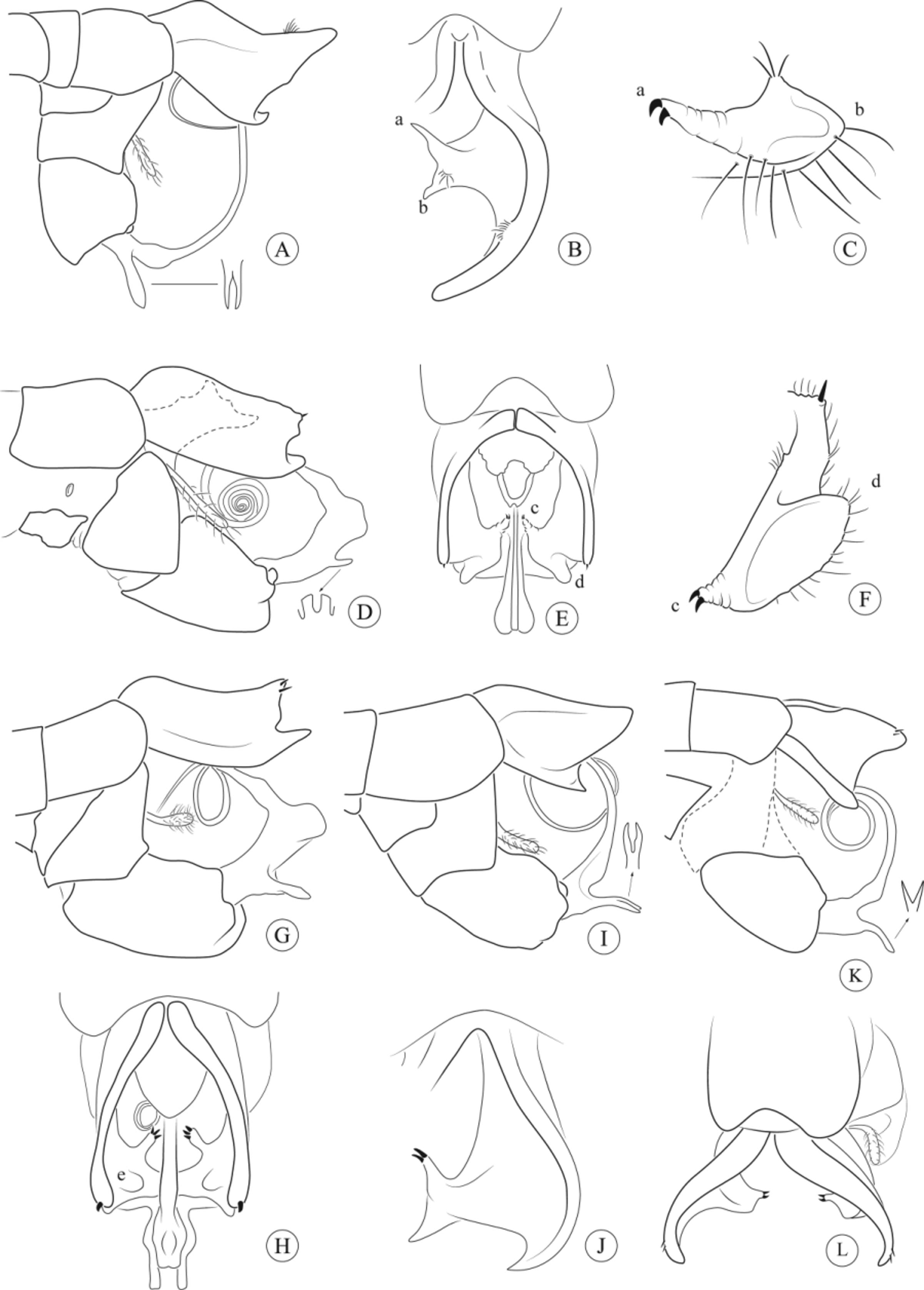
1 Aedeagus with forked ventral posterior projection near base ( furcatus View in CoL group) ( Figs. 2 View FIGURE 2 A, 2D, 2G, 2I, 2K)................ 2
1’ Aedeagus without ventral projection near base ( Figs. 3 View FIGURE 3 , 4 View FIGURE 4 , 6 View FIGURE 6 ).................................................. 6
2 Aedeagus (lateral view) with a backward rectangular protuberance above the fork ( Figs. 2 View FIGURE 2 D, 2G)..................... 3
2’ Aedeagus (lateral view) without a backward rectangular protuberance above the fork ( Figs. 2 View FIGURE 2 A, 2I, 2K)................ 4
3 Epiandrial lobes with two thick black spines in posterodorsal corner ( Fig. 2 View FIGURE 2 G); inner posterior surface with a protuberance ( Fig. 2 View FIGURE 2 H"e"); subconical projection from ventral edge terminates in three stout black spines ( Fig. 2 View FIGURE 2 H) (Brazil).. ornaticaudus View in CoL
3’ Epiandrial lobes with one small black spine in posterodorsal corner ( Fig. 2 View FIGURE 2 D); inner posterior surface without a protuberance ( Fig. 2 View FIGURE 2 E); subconical projection from ventral edge terminates in two stout black spines ( Fig. 2 View FIGURE 2 F"c") ( Brazil, Colombia).................................................................................................. cinctipes View in CoL
4 Ventral process of epiandrial lobe (dorsal view) forked, bearing a posterior and an anterior tips, the latter terminating in two blackened denticles ( Figs. 2 View FIGURE 2 B, 2C, 2J).................................................................... 5
4’ Ventral process of epiandrial lobe (dorsal view) simple, bearing just an anterior tip terminating in two blackened denticles ( Fig. 2 View FIGURE 2 L)......................................................................................... convolutus
5 Ventral bifurcate process of epiandrial lobe (dorsal view) near mid-length of lobe ( Fig. 2 View FIGURE 2 B); apex of gonocoxite (lateral view) from truncate to concave ( Fig. 2 View FIGURE 2 A); forked projection of aedeagus with compressed branches (Panama).............. flinti View in CoL
5’ Ventral bifurcate process of epiandrial lobe (dorsal view) distad of mid-length of lobe ( Fig. 2 View FIGURE 2 J); apex of gonocoxite (lateral view) conspicuously convex ( Fig. 2 View FIGURE 2 I); forked projection of aedeagus with branches of uniform diameter ( Venezuela)...................................................................................................... furcatus View in CoL
6 Epiandrial lobe in lateral view convex ( Fig. 3 View FIGURE 3 ) ( obtusus View in CoL group)................................................. 7
6’ Epiandrial lobe in lateral view not convex ( Figs. 4 View FIGURE 4 , 6 View FIGURE 6 )....................................................... 9
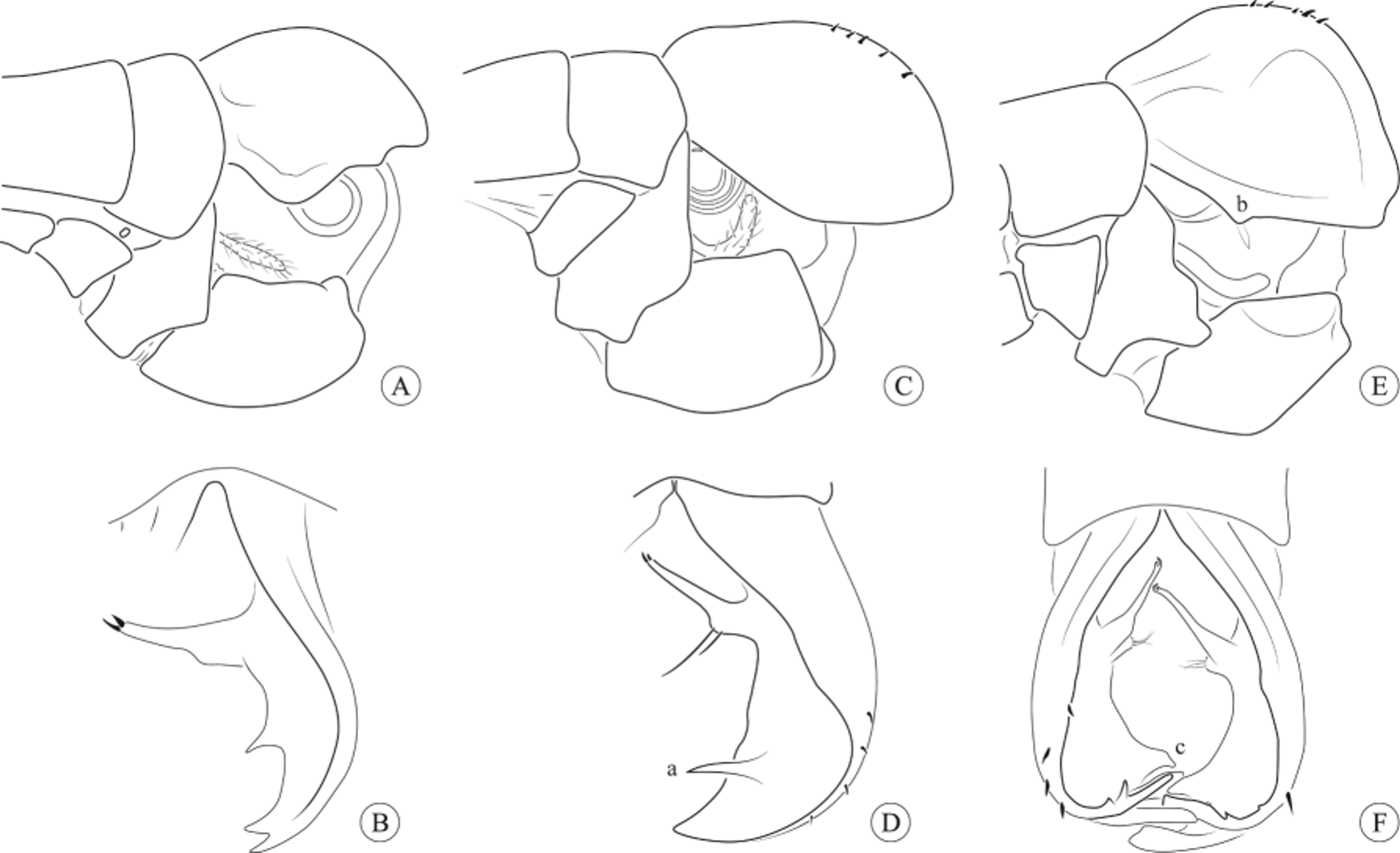
7 Epiandrial lobe without short spines on the dorsal margin ( Fig. 3 View FIGURE 3 A) (Panama, Costa Rica)...................... obtusus View in CoL
7’ Epiandrial lobe with short spines on the dorsal margin ( Figs. 3 View FIGURE 3 C, 3E)............................................ 8
8 Epiandrial lobe ventral margin with a medial projection ( Fig. 3 View FIGURE 3 E"b"); gonocoxite hexagon-shaped in lateral view ( Fig. 3 View FIGURE 3 E); inner surface of each epiandrial lobe (dorsal view) with a short and truncated subterminal spine ( Fig. 3 View FIGURE 3 F"c") ( Colombia)................................................................................................ gorgonensis
8’ Epiandrial lobe ventral margin without a medial projection; gonocoxite squared-shaped in lateral view ( Fig. 3 View FIGURE 3 C); inner surface of each epiandrial lobe (dorsal view) with a long and acute subterminal spine ( Fig. 3 View FIGURE 3 D"a") (Panama)............ spinosus View in CoL
9 Epiandrial lobes without a group of blackened spines on inner apical surface, and with acute upturned apices (lateral view) ( Fig. 4 View FIGURE 4 A) ( Peru)................................................................................ .. gracilis View in CoL
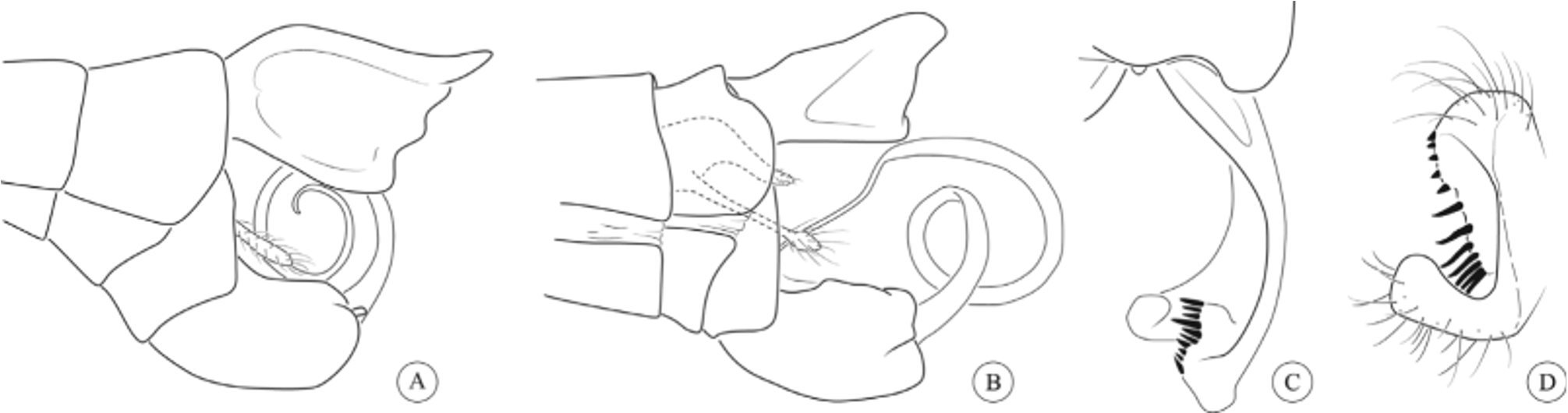
9’ Epiandrial lobes each bearing a group of thick, blackened spines on inner apical surface ( Figs. 4 View FIGURE 4 C, 4D, 6C–F) and without acute upturned apices (lateral view) ( Figs. 4 View FIGURE 4 B, 6A, 6B) ( pectinatus View in CoL group)....................................... 10
10 Sternum IX (lateral view) triangular with protruding postero-ventral corner ( Fig. 4 View FIGURE 4 B); dorsal margin of epiandrial lobe almost straight ( Fig. 4 View FIGURE 4 B); inner surface of epiandrial lobes without projection ( Fig. 4 View FIGURE 4 C) ( Ecuador)................... pectinatus View in CoL
10’ Sternum IX (lateral view) semicircular ( Fig. 6 View FIGURE 6 A); dorsal margin of epiandrial lobes protruding into a hump ( Figs. 6 View FIGURE 6 A, 6B"a"); inner surface of epiandrial lobes with anterio-mesally-directed projection with comb of thick, black spines ( Figs 6 View FIGURE 6 D, 6E"d", 6I "d") ( Brazil).......................................................................... angairaba sp. nov

No known copyright restrictions apply. See Agosti, D., Egloff, W., 2009. Taxonomic information exchange and copyright: the Plazi approach. BMC Research Notes 2009, 2:53 for further explanation.
|
Kingdom |
|
|
Phylum |
|
|
Class |
|
|
Order |
|
|
Family |