
Seira paraibensis Bellini & Zeppelini, 2009
|
publication ID |
https://dx.doi.org/10.11646/zootaxa.3972.2.4 |
|
publication LSID |
lsid:zoobank.org:pub:E90A2B73-D681-4104-9FB9-279979295BE3 |
|
persistent identifier |
https://treatment.plazi.org/id/03C287A9-FFE7-FFB0-D5C0-FEC55545FCAB |
|
treatment provided by |
Plazi |
|
scientific name |
Seira paraibensis Bellini & Zeppelini, 2009 |
| status |
|
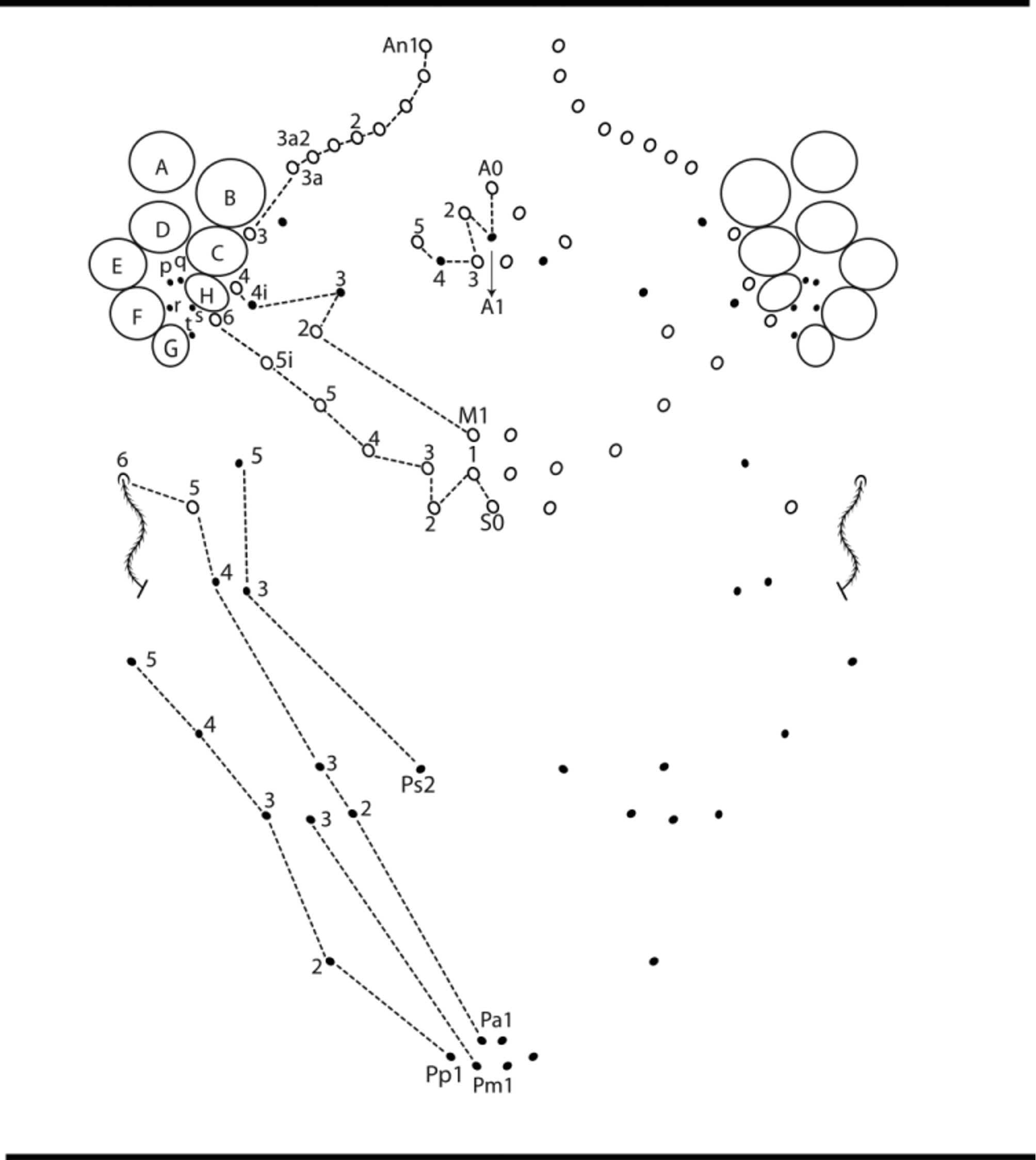
Seira paraibensis Bellini & Zeppelini, 2009 detailed dorsal chaetotaxy
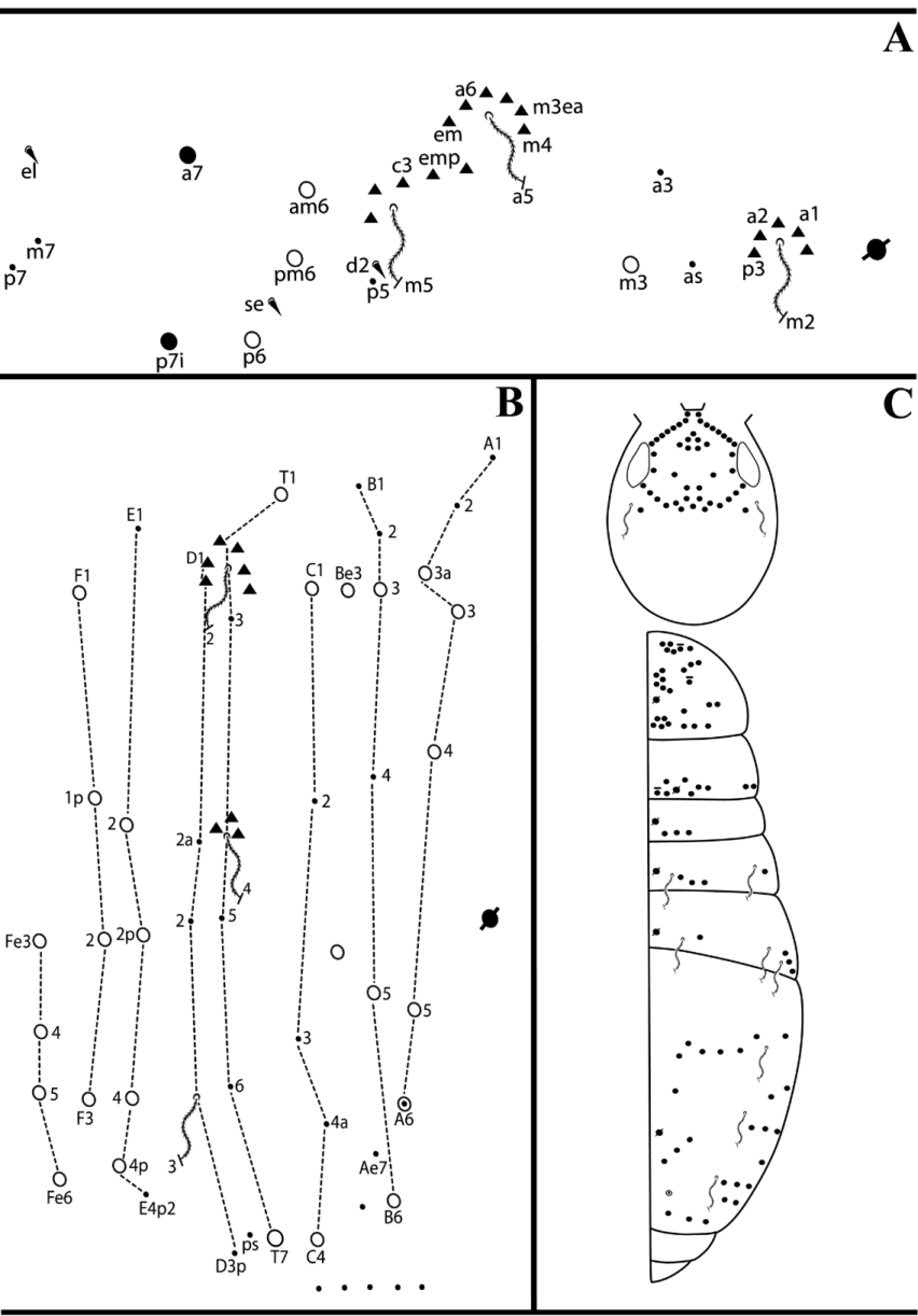
Figs 11–13 View FIGURE 11 View FIGURE 12 View FIGURE 13
Analyzed material. Paratype, one female, Brazil, Paraíba, Areia 11–12.xi. 2008. Bellini, B.C. and Zeppelini, D. col. Material deposited at Collembola Collection of DBEZ / UFRN. Other material: five females and three males, Brazil, Paraíba, Areia 24–27.xi. 2011. Bellini, B.C. col. Material deposited at Collembola Collection of DBEZ / UFRN.
Dorsal head chaetotaxy. ‘An’ series with 9 + 9 macrosetae; one super-numerary microseta between An 3 a and An 3; ‘A’ series with A 4 present; A0, A 2, A 3 and A 5 as macrosetae; A 1 and A 4 as microsetae; ‘M’ series with 5 + 5 setae; M 1, M 2 and M 4 as macrosetae; M 3 and M 4 i as microsetae; ‘S’ series with 7 + 7 macrosetae ( S 1, S 2, S 3, S 4, S 5, S 5 i, S 6) plus the umpaired S0; Interocular series with 5 + 5 microsetae ( p, q, r, s, t); ‘Ps’ series with 3 + 3 microsetae; Ps 4 absent (typical of Seira , see Soto-Adames 2008); ‘Pa’ series with 6 + 6 setae; Pa 1, Pa 2, Pa 3 and Pa 4 as microsetae, Pa 5 as macroseta, Pa 6 as post ocular trichobothrium; ‘Pm’ series with 2 + 2 microseta ( Pm 1 and Pm 3), Pm 2 absent (typical of Seira , see Soto-Adames 2008); ‘Pp’ series with 5 + 5 microsetae ( Pp 1, Pp 2, Pp 3, Pp 4, Pp 5); ( Fig. 11 View FIGURE 11 ).
Dorsal Th. II chaetotaxy. ‘a’ series (without anterior setal collar) with 7 + 7 or 6 + 6 setae; a 2 p as microseta; a 5 i 2, a 5 i 2 p, a 5 ip, a 5 i, a 5, a 5 p as macrosetae, a 5 can be absent in some specimens; ‘m’ series with 13 + 13 setae; m 1 i 3, m 4 ip, m 5 and m 5 p as microsetae; m 1 i 2, m 1 i, m 2 i, m 2 i 2, m 1, m 2, m 4 p, m 4 i and m 4 as macrosetae; one super-numerary macroseta can be present or absent next to m 4 p; m 5 a absent; ‘p’ series with 17 + 17 setae; p 2 p absent; p 1 i 2 p, p 1 i 2, p 1, p 1 ip, p 1 p, p 2 a, p 2, p 2 e, p 2 ep, p 3 p and p 3 as macrosetae; p 1 i, p 2 ea, p 4, p 5, p 6 and p 6 e as microsetae ( Fig. 12 View FIGURE 12 A).
Dorsal Th. III chaetotaxy. ‘a’ series with 8 + 8 setae; a 1 a, a 3, a 4, a 5 and a 7 as microsetae; a 1, a 2 and a 6 as macrosetae; ‘m’ series with 6 + 6 or 5 + 5 setae; m 6 p absent; m 6 as macroseta; m 1 i, m 1, m 4, m 5 and m 7 as microsetae, m 1 can be absent in some specimens; ‘p’ series with 10 + 10 or 9 + 9 setae; p 2 ea, p 4, p 5 and p 6 as microsetae; p 1 i, p 1, p 2, p 2 a, p 3 and p 2 e as macrosetae; p 1 i may be absent in some specimens; setula present near m 7 ( Fig. 12 View FIGURE 12 B).
Dorsal Abd. I chaetotaxy. ‘a’ series with 5 + 5 microsetae ( a 1, a 2, a 3, a 5 and a 6); a 1 a, a 1 e and a 4 absent; setula present near a 6; ‘m’ series with 6 + 6 setae; m 4, m 5 and m 6 as microsetae; m 2, m 3 and m 4 i as macrosetae; ‘p’ series with 2 + 2 microsetae ( p 5 and p 6) ( Fig. 12 View FIGURE 12 C).
Dorsal Abd. II chaetotaxy. ‘a’ series with 7 + 7 setae; a 2 p as fan shaped scale; a 3, as, a 6 and a 7 as microsetae; a 2 as macrosetae; a 5 as trichobothrium with 5 surrounding fan shaped scales; ‘m’ series with 8 + 8 setae; m 3 ep absent; m 3 ei, m 3 ea, m 6 and m 7 as microsetae; m 3, m 3 e and m 5 as macrosetae; m 2 as trichobothrium with 5 surrounding fan shaped scales; ‘p’ series with 3 + 3 setae; p 5 and p 7 as microsetae; p 6 as mesoseta; el and se present as setulae ( Fig. 12 View FIGURE 12 D).
Dorsal Abd. III chaetotaxy. ‘a’ series with 8 + 8 setae; as and a 3 as microsetae; am 6 as macroseta; a 7 as mesoseta; a 1, a 2 and a 6 as fan shaped scales; a 5 as trichobothrium with 6 surrounding fan shaped scales; ‘m’ series with 6 + 6 setae; m 2 as trichobothrium with 5 surrounding fan shaped scales; m 5 as trichobothrium with 5 surrounding fan shaped; m 4 and m 3 ea as fan shaped scales; m 7 as microseta; m 3 as macroseta; ‘p’ series with 6 + 6 setae; p 3 as fan shaped scale; p 5 and p 7 as microsetae; p 7 i as mesoseta; pm 6 and p 6 as macrosetae; em, emp and c 3 as fan shaped scales; se as setula; d 2 setula present, near p 5 ( Fig. 13 View FIGURE 13 A).
Dorsal Abd. IV chaetotaxy. ‘A’ series with 8 + 8 setae; A 2 a absent; A 1, A 2 and Ae 7 as microsetae; A 3 a, A 3, A 4, A 5 and A 6 as macrosetae; in some specimens A 6 can be a microseta; ‘B’ series with 6 + 6 setae; B 1, B 2 and B 4 as macrosetae; B 3, B 5 and B 6 as macrosetae; one super-numerary macroseta between B 4 and B 5; one supernumerary microseta next to B 6; Be 3 as macroseta and Be 2 absent; ‘C’ series with 5 + 5 setae; C 1 p absent; C 1 and C 4 as macrosetae; C 2, C 3 and C 4 a as microsetae; ‘T’ series with 7 + 7 setae; T 1 and T 7 as macrosetae; T 3, T 5 and T 6 as microsetae; T 2 and T 4 as trichobothria with 6 and 3 (respectively) fan shaped scales above each of them; ps present as setula next to T 7; ‘D’ series with 5 + 5 setae; D 1 as fan shaped scale; D 2 a, D 2 and D 3 p as microsetae; D 3 as trichobothria without fan shaped scales associated; ‘E’ series with 6 + 6 setae; E 3 and E 2 a absent; E 2, E 2 p, E 4 and E 4 p as macrosetae; E 1 and E 4 p 2 as microsetae; Ee 7 and Ee 10 absent; ‘F’ series with 4 + 4 macrosetae; F 2 p and F 3 p absent; ‘Fe’ series with 4 + 4 macrosetae; Fe 2 and Fe 2 p absent; Abd. IV with 5 + 5 posterior setae ( Fig. 13 View FIGURE 13 B).
Distribution of dorsal macrosetae of whole body as in Figure 13 View FIGURE 13 C.
Remarks. The analysis of detailed dorsal chaetotaxy of S. paraibensis revealed some macrosetae not presented in the original description, like a 6 and m 6 on Th. III and B 6, C 4, T 7, F 4 p and Fe 6 on Abd. IV ( Bellini & Zeppelini 2009 a). In the representation of Fig. 13 View FIGURE 13 C were also added a 5 group on Th. II, omitted from the original description since it is near from the anterior setal collar and can be confused with it. Finally, Fig. 13 View FIGURE 13 C does not present the external macrosetae of Th. II since these setae commonly are not presented or named in Seira or even in Entomobryidae descriptions (see Soto-Adames 2008).
In the original description, S. paraibensis was compared to S. pseudoannulata Bellini & Zeppelini, 2008 ( Bellini & Zeppelini 2008 b). After presenting the complete chaetotaxy of the species it is also clear S. paraibensis resembles in its dorsal chaetotaxy other two recent described species: S. primaria Godeiro & Bellini, 2014 and S. tinguira Cipola & Bellini, 2014 ( Cipola et al., 2014) . Along with some similarities on part of Th. II, Th. III, Abd. II and Abd. III dorsal setae, the three species share the presence of three homologous macrosetae on Abd. I ( M 2, M 3 and M 4 i). In the other hand, S. paraibensis is different from the other two species specially in head and Abd. IV chaetotaxy: it only presents 1 + 1 macroseta ( Pa 5) in the posterior cephalic region, while the other two species have several; in the sutural ‘S’ row: S. primaria has 6 + 6 macrosetae ( S 1, S 2, S 3, S 4, S 5 and S 6) plus the unpaired S0; S. paraibensis has 7 + 7 macrosetae ( S 1, S 2, S 3, S 4, S 5, S 5 i and S 6), plus the unpaired S0; and S. tinguira has 6 + 6 setae ( S 1, S 3, S 5 and S 6 as macrosetae and S 2 and S 4 as microsetae) and S0 is absent; on Abd. II S. tinguira presents a 2 as macrosetae; in Abd. IV, ‘F’ and ‘Fe’ series are clearly distinct in the three species and S. paraibensis is the only species who lacks F 2 p and F 3 p.

No known copyright restrictions apply. See Agosti, D., Egloff, W., 2009. Taxonomic information exchange and copyright: the Plazi approach. BMC Research Notes 2009, 2:53 for further explanation.
|
Kingdom |
|
|
Phylum |
|
|
Class |
|
|
Order |
|
|
Family |
|
|
Genus |