
Trichonotus cyclograptus ( Alcock, 1890 )
|
publication ID |
https://doi.org/10.5281/zenodo.282967 |
|
publication LSID |
lsid:zoobank.org:pub:C8599447-82D5-4A85-A381-6D4FAEE14E27 |
|
persistent identifier |
https://treatment.plazi.org/id/03C39451-FF91-FF8E-FF26-FC17FE3DF817 |
|
treatment provided by |
Plazi |
|
scientific name |
Trichonotus cyclograptus ( Alcock, 1890 ) |
| status |
|
Trichonotus cyclograptus ( Alcock, 1890)
[New English name: Bengal Sand diver] ( Figures 1 –3 View FIGURE 1 View FIGURE 2 View FIGURE 3 , 6 View FIGURE 6 ; Tables 1–2)
Taeniolabrus cyclograptus Alcock, 1890: 430 , fig. 1 ( type locality: Ganjam Coast, Bay of Bengal); Alcock, 1898: pl. 20, fig. 5 (illustration); Menon & Yazdani, 1968: 146 (note); Menon & Rama-Rao, 1970: 377 (note). Trichonotus cyclograptus: Shimada & Yoshino, 1984: 18 (comparison); Randall & Tarr, 1994: 309 (key); Katayama & Endo, 2010: 1 (comparison).
Lectotype. BMNH 1891.9. 2.1, male, 109.7 mm SL, Ganjam Coast, Bay of Bengal, 18–24 m, 2 Sep. 1891.
Paralectotypes. 2 specimens: ZSI F 12932 View Materials , male, damaged, ZSI F 12935 View Materials , male, 106.2 mm SL, same data as lectotype.
Diagnosis. Trichonotus cyclograptus is distinguished from other congeners in having the following combination of characters: no elongated dorsal-fin spines in males; dorsal-fin rays IV, 45–46; anal-fin soft rays 37–38; lateral-line scales 57–59; two free dorsal pterygiophores; gill rakers 6 + 23; body markings in males 12; median predorsal-fin scales 10; interorbital width 43.7 % of eye diameter; abdominal scales small.
Description. Data for the lectotype presented first, followed by those for the less damaged of the two paralectotypes ( ZSI 12935 View Materials ) in parentheses. Dorsal-fin rays IV, 45 ( 46); anal-fin rays I, 37 ( 38); pectoral-fin rays 15 ( 14); caudal-fin rays 13 (–); lateral-line scales 57 ( 59); scales above lateral line 4.5 (–); scales below lateral line 5.5 (–); median predorsal-fin scales 9 (damaged); gill rakers on 1 st arch 6 + 23 (–); pseudobranchial filaments 12 (–); vertebrae 53 (–).
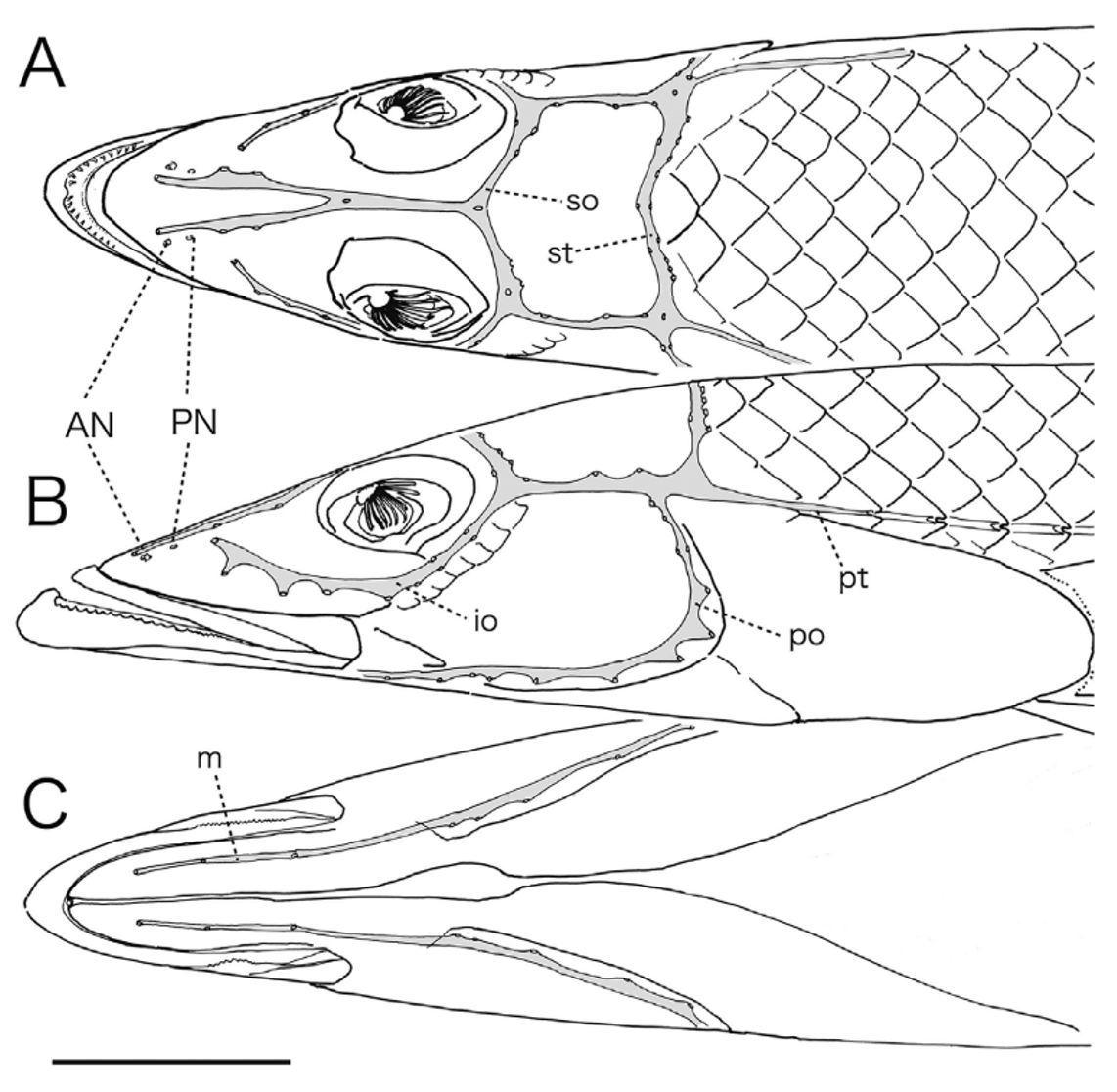
Proportional measurements are shown in Table 1, the proportional characters being based on BMNH 1891.9. 2.1. Body long, slightly cylindrical, compressed posteriorly. Snout long, pointed, its length twice eye diameter. Mouth large, maxilla reaching posteriorly to vertical through anterior rim of pupil; lower jaw extending anteriorly beyond upper jaw tip, bordered along side by uniserial row of 18 short cirri. Opercle just reaching posteriorly to pectoral-fin base. Gill membranes free from isthmus. Gill rakers long, spinous, the longest more-orless subequal to length of longest gill filaments. Tongue narrow, slightly expanded anteriorly, tip rounded. Eye small, slightly oval, 10 hair-like elongated “lashes” on iris flap. Suborbital skin fold slightly covering lower margin of eye, discontinuous at midpoint; with 7 embedded scales adjacent to infraorbital cephalic sensory canal ( Fig. 3 View FIGURE 3 B). Interorbital space narrow, its width equal to 1 / 3 eye diameter. Nostrils small, closer to snout tip than to anterior margin of eye; anterior nostrils short and tubular; posterior pore-like. Cycloid scales covering body; posterior edge of scales slightly angular. Lateral line along mid-body, each associated scale rhomboid with a posterior notch. Scales on abdomen smaller than those on sides of body, 29 rows anterior to anus. Scales between supratemporal cephalic sensory canal and dorsal-fin origin small, diagonally arrayed, those located posteriorly on pectoral-fin base half the size of body scales. Upper jaw teeth near symphysis large, canine-like, in 4 irregular rows, becoming small, conical and in 3 irregular rows posteriorly. Lower jaw teeth large, in a single row anteriorly, gradually decreasing in size, in 2–3 irregular rows posteriorly. Head of vomer crescentic, palatines narrow with villiform teeth. Dorsal-fin spines flexible, not filamentous; dorsal fin soft rays unbranched except for posteriormost. Dorsal fin high in males, its height equal to twice body depth. Anal-fin spine flexible, shorter than adjacent soft rays; all soft rays branched. Caudal fin rounded in males, uppermost and lowermost rays short, unbranched. Pelvic fin insertion anterior to pectoral-fin base; 4 th soft ray unbranched, elongated, extending beyond anus in males; 3 rd soft ray short, 2 / 3 length of 4 th ray. First 2 dorsal pterygiophores located between 6 th and 7 th neural spines; 2 free pterygiophores between 6 th and 7 th spines. First anal pterygiophore located below 15 th vertebra.
Cephalic sensory canal patterns are illustrated in Fig. 3 View FIGURE 3 . Tip of infraorbital canal closely adjacent to supraorbital canal, but separated anterior to eye. Infraorbital canal with 8 pores ( 2 pairs of 2 pores posteriorly); preopercular canal with 8 pores, the 3 th comprising 2 pores; mandibular canal with 3 pores, continuous with preopercular canal.
Color when fresh (from Alcock 1890). Head and body brownish gold. Body with 12 inconspicuous dark bands. Vertical fins translucent, with blue spots arranged in longitudinal rows; 10 rows of 50 spots on dorsal fin, 3 rows of about 40 spots on anal fin.
Color in alcohol ( Fig. 1 View FIGURE 1 ). Ground color of body and head pale brown, dorso-lateral surface of body with 12 brown marks, anterior 5 extended ventrally. Dorsal fin with numerous small white spots, anal fin with three longitudinal rows of small white spots. Three longitudinal rows of small regular dark brown-edged spots on body, the middle row along the lateral-line scales. Snout to occiput with a fine dark network of spots. Head with irregular rows of spots, those on snout to above opercle dark-edged. Ventral surface of lower jaw uniformly pigmented. Pelvic and caudal fins brownish, translucent; tips brownish. Caudal fin with scattered white spots. Female coloring unknown.
Distribution. Known only from sandy bottoms off the Ganjam Coast, Bay of Bengal, at a depth of 18– 23 m.
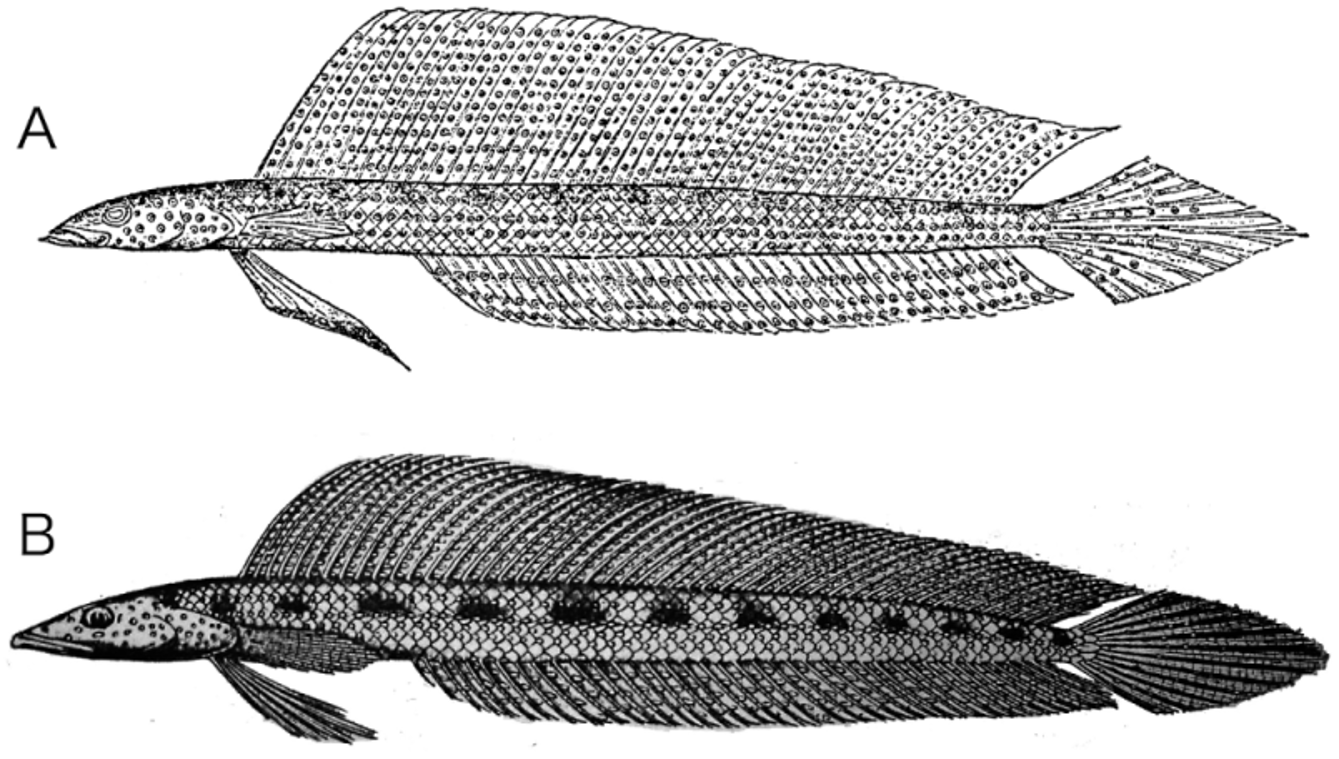
Remarks. Although the original description of T. cyclograptus was very short, the accompanying illustration clearly depicted the main diagnostic features of the species ( Fig. 2 View FIGURE 2 A). Subsequently, Alcock ( 1898) included an illustration of T. cyclograptus in a list of fishes collected by R/V Investigator ( Fig. 2 View FIGURE 2 B), apparently based on a different syntype from that figured previously.
Among the eight syntypes indicated in Alcock ( 1890), four had been deposited in the fish collection of the Zoological Survey of India (ZSI), one being subsequently transferred to the Natural History Museum, London ( BMNH). The remaining four specimens have been missing for some years ( Menon & Yazdani 1968; Menon & Rama-Rao 1970; Eschmeyer 2012). During the present investigations, three syntypes were found: BMNH 1891.9. 2.1 (formerly ZSI F 12828 View Materials ) (still in good condition), and ZSI F 12932 View Materials and ZSI F 12935 View Materials (both damaged) ( Fig. 1 View FIGURE 1 ). Although ZSI F 12936 View Materials was believed to exist at ZSI ( Eschmeyer 2012), it has recently been confirmed as missing and probably lost (S. Mishra, pers. comm.). Except for the caudal fin shape, the BMNH syntype otherwise agrees with the illustration of T. cyclograptus in Alcock ( 1890), having similar dorsal- and pelvic-fin shapes, 49 dorsal-fin rays, 13 narrow saddle-like markings on the sides of the body, and three longitudinal rows of small white spots on the anal fin ( Figs. 1 View FIGURE 1 A, 2 A). Our examination of BMNH 1891.9. 2.1 and ZSI F 12932 View Materials revealed that the posterior caudal fin margin of T. cyclograptus was somewhat rounded when expanded, rather than pointed ( Figs. 1 View FIGURE 1 , 2 View FIGURE 2 B). Hence, the diagnostic status of the caudal fin (pointed), as believed by some authors (e.g. Randall & Tarr 1994), is here regarded as erroneous. We designate BMNH 1891.9. 2.1, which closely resembles the figures by Alcock ( 1890 1898), as the lectotype of T. cyclograptus , so as to forestall any further taxonomic problems.
Among the species of Trichonotus lacking elongated dorsal-fin spines, Trichonotus cyclograptus is very similar to T. arabicus , sharing III–IV, 44–46 dorsal-fin rays, 37–39 anal-fin rays, 6–8 + 20–23 gill rakers, a nonelongated dorsal spine, and dark markings on the body, but differs from the latter in having 12 saddle-like bands on the body (vs. a longitudinal row of 14 dark markings in T. arabicus ), 57–59 lateral-line scales (vs. 55–57), small abdominal scales with 29 pre-anus rows (vs. large, 20–22 rows), and a greater interorbital width ( 43.7 % of eye diameter vs. 28.4−36.7 %).


No known copyright restrictions apply. See Agosti, D., Egloff, W., 2009. Taxonomic information exchange and copyright: the Plazi approach. BMC Research Notes 2009, 2:53 for further explanation.
|
Kingdom |
|
|
Phylum |
|
|
Class |
|
|
Order |
|
|
Family |
|
|
Genus |

Trichonotus cyclograptus ( Alcock, 1890 )
| Katayama, Eri, Motomura, Hiroyuki & Endo, Hiromitsu 2012 |
Taeniolabrus cyclograptus
| Katayama 2010: 1 |
| Randall 1994: 309 |
| Shimada 1984: 18 |
| Menon 1970: 377 |
| Menon 1968: 146 |
| Alcock 1890: 430 |