
Leonardoxa africana (Baill.) Aubrév. subsp. africana (Baill.) Aubrev.
|
publication ID |
https://doi.org/10.5281/zenodo.4605796 |
|
DOI |
https://doi.org/10.5281/zenodo.15657404 |
|
persistent identifier |
https://treatment.plazi.org/id/03E6A435-FFA6-FFDE-C269-718BA8F05CC6 |
|
treatment provided by |
Carolina |
|
scientific name |
Leonardoxa africana (Baill.) Aubrév. subsp. africana |
| status |
|
1. Leonardoxa africana (Baill.) Aubrév. subsp. africana View in CoL (= group 4)
Tree to 14 m tall. Trunk (rarely) to 40 cm diam., usually under 15 cm diam. Young shoots produced in flushes consisting of only a single internode and young leaf at each branch tip. Internodes of young twigs (2.5-)3.5-7.5(-9) cm long, modified as myrmecodomatia, swollen, with thick pith except at base; twigs 4.3-5.7 mm diam. at apex tapering to ca. 2 mm diam. at base of internode; ant-cavities each a single internode long. Swollen internodes present from the seedling stage ( 20 cm tall) onward. Prostoma of ant-domatia at apex of internode opposite leaf insertion, elliptic. Leaves (2-)3(-rarely 4)-jugate. Leaflets elliptic, falcate, apex long-acuminate, the smallest leaflets (proximal pair) (7.8-)13(-15) cm long and (3.5-)5(-6) cm broad, the largest ones (distal pair in 2-jugate leaves, next-to-distal pair in 3- and 4-jugate leaves) (9.5-)15(-20) cm long and (4-)5.5(-7) cm broad; nectary glands large (smooth gland surface oblong, about 1 × 0.75 mm, surrounded by a raised ring of tissue about 1mm broad), consistently present on abaxial surface of each leaflet, with (2-)3-5 glands on each proximal leaflet, (1-)2(-3) glands on each median leaflet, and (0-)1-2 glands on each distal leaflet. Racemes to 4 cm long, with 40-50 flowers, usually cauliflorous, borne on main trunk and on large branches, or ramiflorous on twigs of ca. 5 mm diam. and larger. Flowers 1.8-2.2 cm in diam.; pedicels 2-4 mm long; calyx green or red, sepals 0.5-0.8 cm long; petals violet, purple, mauve, pink or red, 0.6-1.0 cm long. Ovules 4-5. Fruit oblongobovate, 8-11 cm long, 2.5-4 cm broad.
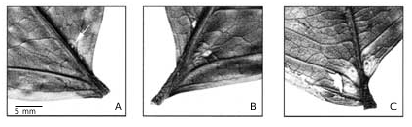
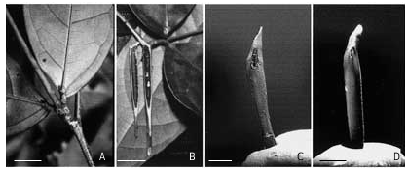
Leonardoxa africana subsp. africana is a highly specialised myrmecophyte, differing from the other myrmecophytic subspecies in a number of traits: (1) Foliar nectaries ( Fig. 5C View Fig ) are larger, more numerous, and less variable in presence/absence and number than in the other subspecies; (2) only a single leaf-bearing internode is produced in each flush of growth at a branch tip, so that each ant-cavity is a single internode long ( Figs. 6B View Fig , 7B View Fig ); (3) growth of different branch tips is not synchronised over the crown of the tree; (4) specialised swollen internodes appear much earlier (seedlings 20 cm tall) in plant ontogeny than in the other subspecies; (5) the prostoma is elliptic-oblong rather than spherical in shape ( Fig. 6D View Fig ). Also, while cauliflory on old branches, or even on the trunk, occurs in all three myrmecophytic subspecies, it appears to be especially frequent in subsp. africana ( Fig. 8B View Fig ).
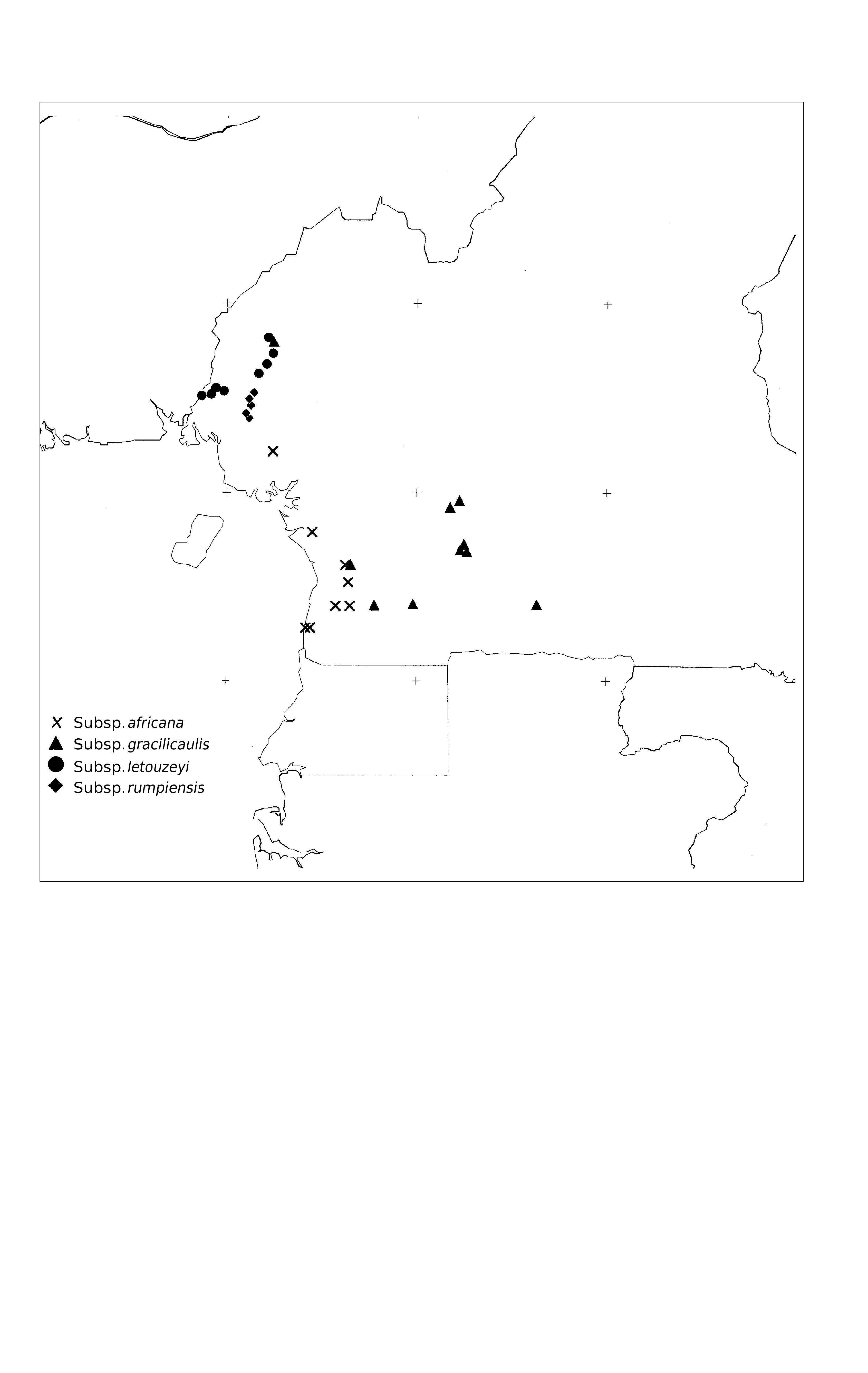
DISTRIBUTION. — Leonardoxa africana subsp. africana is restricted to coastal forests of Cameroon ( Figs. 3 View Fig , 4 View Fig ). All the field sites are below 80 m elevation. Judging from collection localities and notes on labels, this subspecies appears rarely to occur above about 100 m. The northernmost known localities are from the Southern Bakundu Forest Reserve , and the southern boundary of its range appears to be near Campo , at the border with Equatorial Guinea. Within this coastal strip, it extends inland as far as Bipindi, on the eastern edge of the coastal plain.
ECOLOGY. — This subspecies, illustrated in AUBRÉVILLE (1970), is the one that has attracted most attention as a myrmecophyte. The studies by ELIAS (1980), MCKEY (1984), GAUME et al. (1997) and GAUME & MCKEY (1999) all concern this subspecies. Internodes are swollen and hollow, and these ant-domatia are present already in seedlings 20 cm tall (see Fig. 2B View Fig in LÉONARD [1993]). This subspecies is associated with two ant species that are completely restricted to this host, the formicine Petalomyrmex phylax and the myrmicine Cataulacus mckeyi ( MCKEY 1984) . Petalomyrmex is a mutualist of the plant, protecting its young leaves against phytophagous insects ( GAUME et al. 1997), while Cataulacus is a parasite, providing no protection to the plant and excluding Petalomyrmex from plants it occupies ( GAUME & MCKEY 1999). This subspecies was termed “ L. africana taxon T4” by CHENUIL & MCKEY (1996).
Few observations of flower visitors have been made, but on a few occasions sunbirds were seen visiting the pink to red flowers, which in this subspecies at least seem to have a somewhat longtubular corolla, compared to flowers of the non-myrmecophytic subspecies (see below).
ADDITIONAL SPECIMENS EXAMINED. — CAMEROON, Southwest Province: Southern Bakundu Forest Reserve , E.W. Jones in Brenan 9499 ( K, P), FHI 29511 (K), 29672 (K), and 41007 (K); Southern Bakundu Forest Reserve, 1 km W Bombe Bakundu , Manning 1499 ( MO); Southern Bakundu Forest Reserve , near Kindonge Camp , Manning 1517 ( MO); Kumba (planted in forestry nursery), FHI 29369 ( K). Littoral Province: 24 km E Douala, Breteler et al. 2580 ( BR, K, P, YA); Douala, route Razel , Endengle 2105 ( P, YA); Douala, forêt de Yelfoume , Fleury , in herb. Chevalier 33346 ( P); 14 km E Douala, Douala-Edea Road , Mpom 303 in part ( BR); Lake Tissongo, Douala-Edea Forest Reserve , McKey & Gartlan 120 ( K), D.W. Thomas 167 ( YA), Waterman & McKey 846 ( K); stream Mangombe near Edea , Mpom 343 ( YA). Central-South Province: near Bipaga II , km 40 from Kribi to Edea , de Kruif 994 ( WAG); Lolodorf Road, 12 km E of Kribi , Bos 3630 ( BR, WAG, YA); 5 km N of Lolodorf road, 19 km E of Kribi , Bos 3913 ( BR, YA); Lolodorf Road, 18 km E of Kribi , Bos 4074 ( BR, YA); km 30 from Kribi to Ebolowa , Bos 6233 ( WAG); km 45 from Kribi to Campo , Bos 7315 ( BR); 60 km S of Edea , S of Mboke, 11 km E of km 58 from Edea to Kribi , Leeuwenberg 5500 ( BR, K, MO, P, WAG, YA); colline Nkoltsia, Villiers 775 ( P); near Bella, Letouzey 4140 ( P, YA); 2 km from Nkol-Bewa , Mpom 227 ( P, YA); Edoudouma , Mpom 283 ( YA); Bipindi, Farron 7181 ( BAS, P, YA), Zenker, s.n. ( BR, P), 52 ( WAG), 1074 ( K, MO, P, WAG), 2967 ( BR, K, WAG), 4183 ( BR, K, P), 4495 ( BR, K, MO).




No known copyright restrictions apply. See Agosti, D., Egloff, W., 2009. Taxonomic information exchange and copyright: the Plazi approach. BMC Research Notes 2009, 2:53 for further explanation.
|
Kingdom |
|
|
Phylum |
|
|
Class |
|
|
Order |
|
|
Family |
|
|
Genus |