
Afronurus species
|
publication ID |
https://doi.org/10.5852/ejt.2021.767.1491 |
|
publication LSID |
lsid:zoobank.org:pub:B606054C-025E-43AC-9507-14E755343A7A |
|
DOI |
https://doi.org/10.5281/zenodo.5528183 |
|
persistent identifier |
https://treatment.plazi.org/id/03EA87D9-5576-FFD5-1CA8-FCC3FAE5F6E4 |
|
treatment provided by |
Felipe |
|
scientific name |
Afronurus species |
| status |
|
Key to six common Chinese Afronurus species (nymph)
1. Anterior margin of head capsule without pale dot ............................................................................ 2
– Anterior margin of head capsule with pale dots ............................................................................... 3
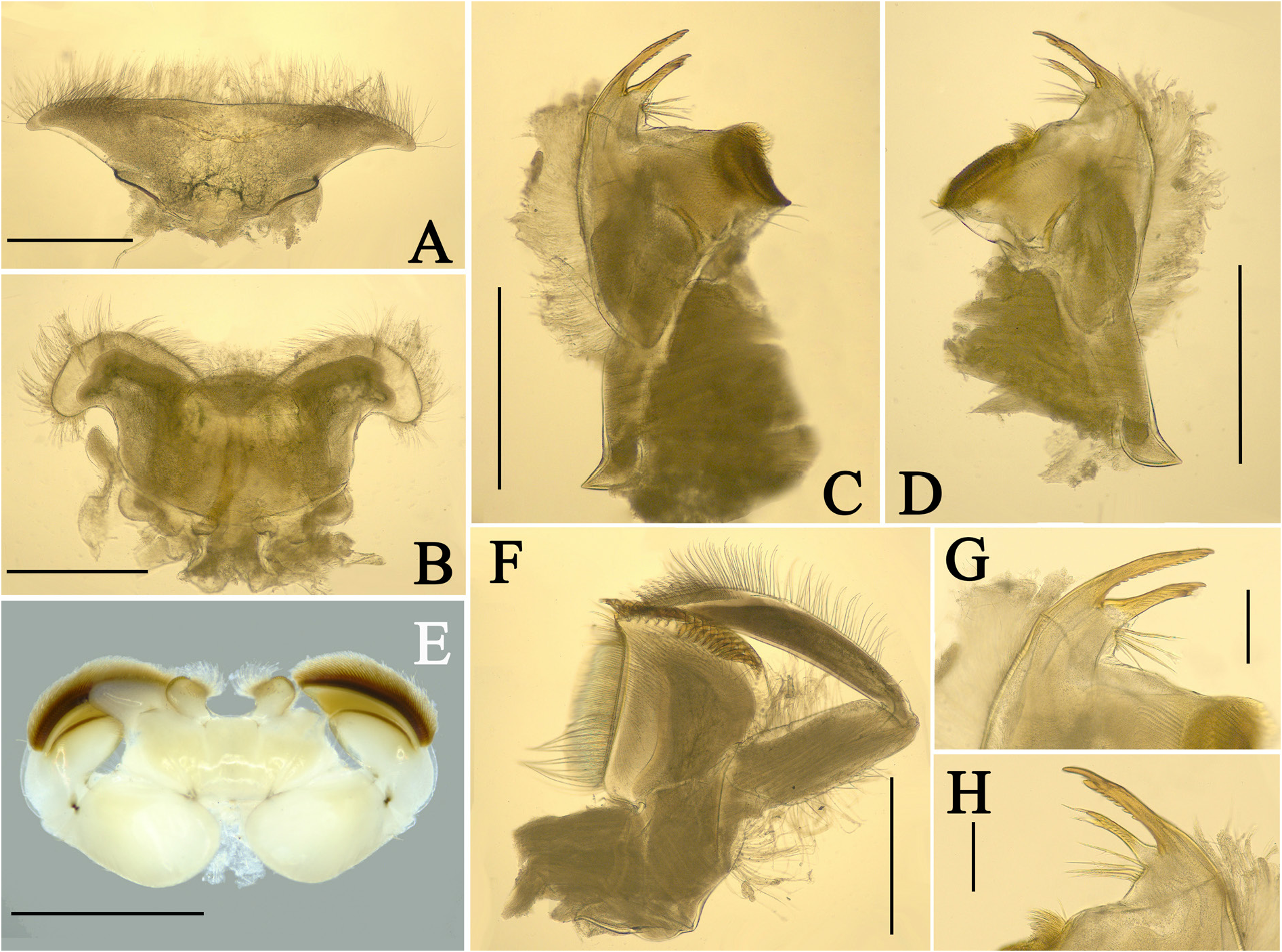
2. Lingua and superlinguae subequal in length (as in Fig. 8B View Fig ); crown of galea-lacinia with 12–14 comb-shaped setae; caudal filaments pale but with brown dots on articulations ( Fig. 7O View Fig ); glossae slightly oblong (as in Fig. 2F View Fig ) ........................................................ A. yixingensis ( Wu & You, 1986)
– Lingua obvious shorter than superlinguae ( Fig. 10B View Fig ); crown of galea-lacinia with 16–18 combshaped setae; proximate part of caudal filaments pale but other parts yellowish brown ( Fig. 7F View Fig ); glossae lobe rounded ( Fig. 10E View Fig ) ............................................... A. hunanensis ( Zhang & Cai, 1991)
3. Head capsule with two rows of pale dots (8–9) on anterior margin ( Fig. 7G, J View Fig ); caudal filaments with brown stripes on articulations ( Fig. 7I, L, O View Fig ) ................................................................................... 4
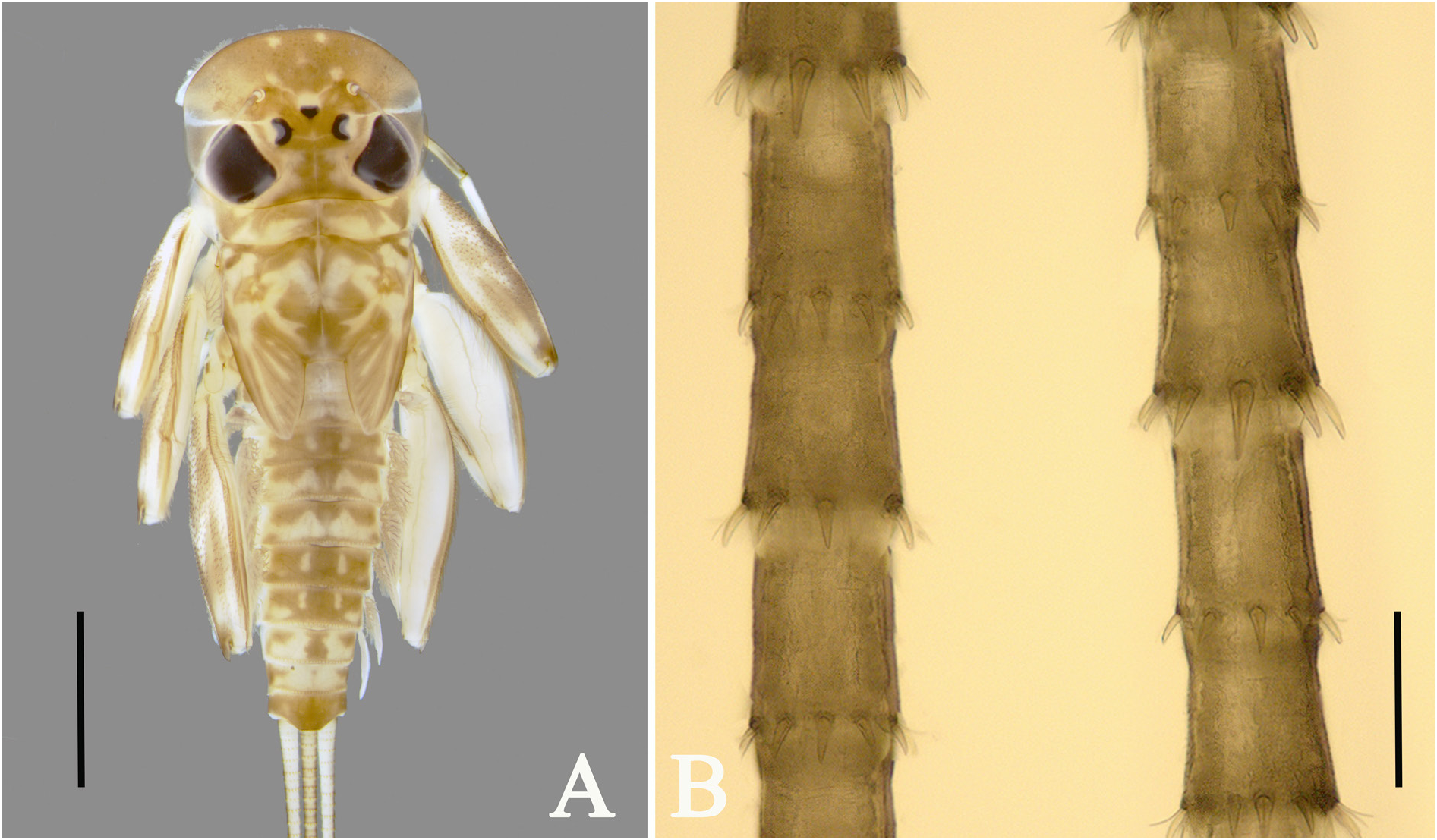
– Head capsule with 2–5 pale dots on anterior margin ( Figs 1A View Fig , 7A View Fig ); caudal filaments pale to yellowishbrown, without any stripe ( Figs 1A View Fig , 7C View Fig ) .......................................................................................... 5
4. Abdominal terga with oblique stripes laterally ( Fig. 7H View Fig ); crown of galea-lacinia with 11–13 combshaped setae; posterolateral projections of segments III–VIII moderately developed ( Fig. 7H View Fig ); lingua shorter than superlinguae (as in Fig. 10B View Fig ) ................................. A. obliquistriatus ( You et al., 1981)
– Abdominal terga without oblique stripes; crown of galea-lacinia with 14–16 comb-shaped setae; posterolateral projections of segments III–VIII weakly developed (as in Fig. 7E View Fig ); lingua and superlinguae subequal in length (as in Fig. 2C View Fig ) ..................... A. rubromaculatus ( You et al., 1981)
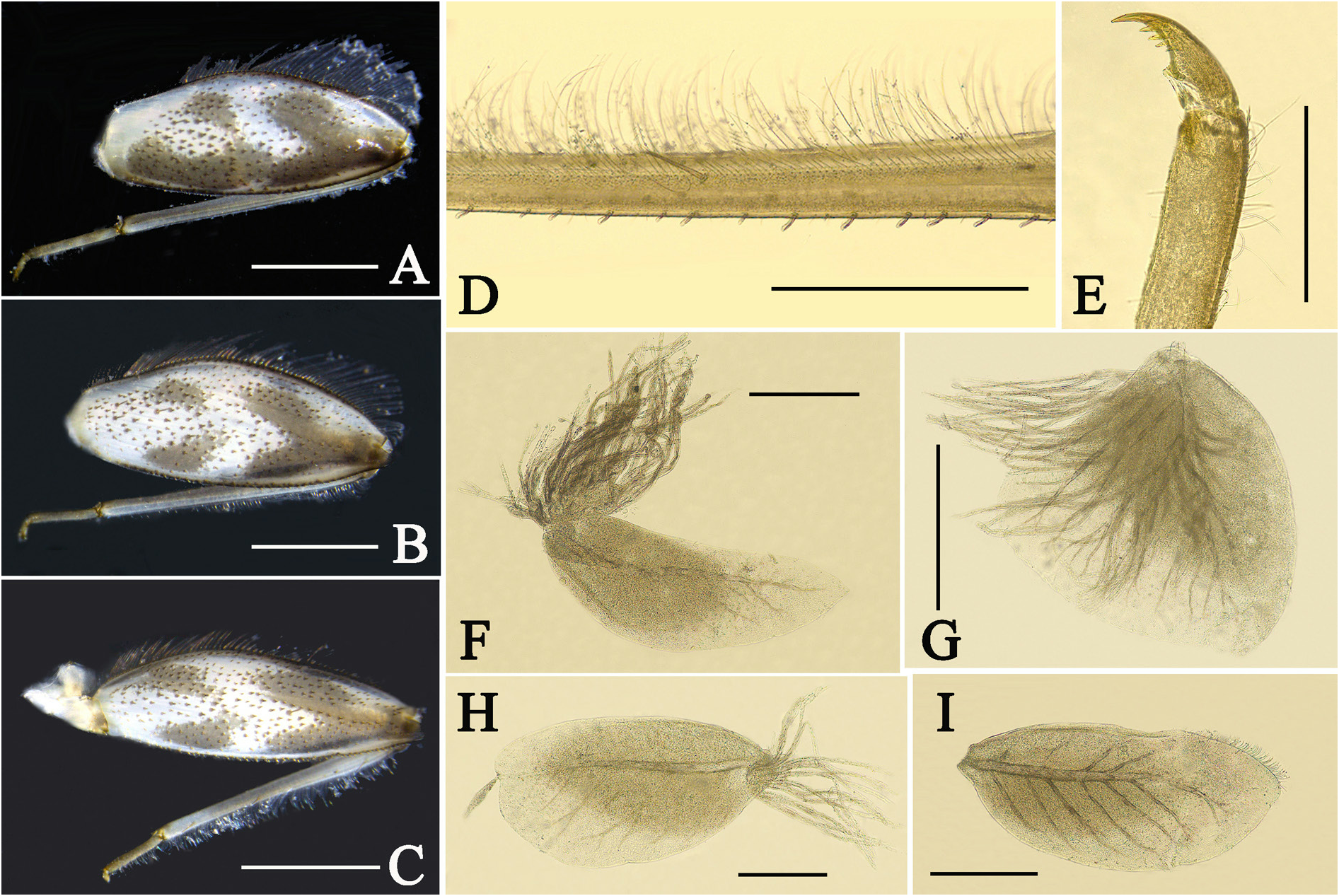
5. Gill I sickle-like ( Fig. 3F View Fig ); glossae slightly oblong ( Fig. 2F View Fig ) .................. A. drepanophyllus sp. nov.
– Gill I banana-shaped ( Fig. 9F View Fig ); glossae lobe rounded ( Fig. 8E View Fig ) ........................................................ ...................................................................................................... A. furcatus ( Zhou & Zheng, 2003)
Key to six common Chinese Afronurus species (male imago)
1. Penes with plate-like titillators ......................................................................................................... 2
– Penes with spine-like titillators ......................................................................................................... 3
2. Penes connected by foliated structure at ⅔ length from base; titillators about ⅔ of penes in length ( Fig. 13A–B View Fig ) ................................................................................ A. furcatus ( Zhou & Zheng, 2003)
– Penes lobes widely divergent; titillators about half of penes in length ( Fig. 13C–D View Fig ) ........................ ................................................................................................... A. hunanensis ( Zhang & Cai, 1991)
3. Remarkable projection between divergent penial lobes ................................................................... 4
– Penial lobes divergent but without projection between them ........................................................... 5
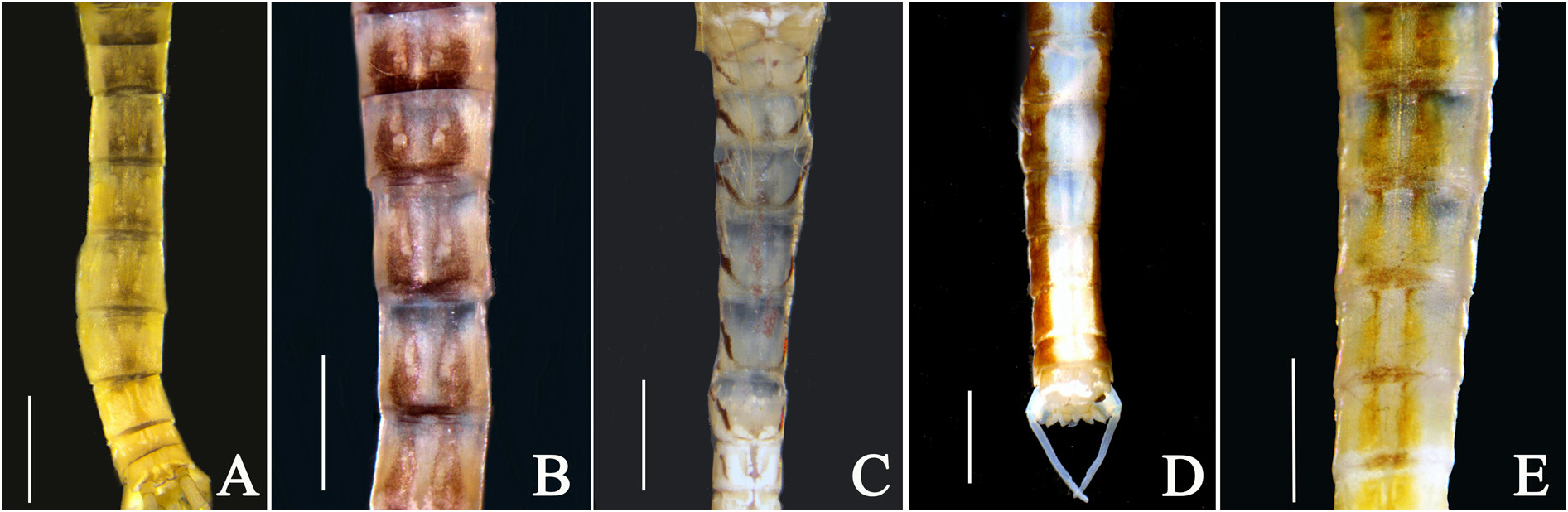
4. Spine-like projection between two penial lobes ( Fig. 13I–J View Fig ); abdominal terga with two yellowishbrown longitudinal stripes submedially ( Fig. 12E View Fig ) ....................... A. yixingensis ( Wu & You, 1986)
– Cone-shaped projection between two penial lobes ( Fig. 13G–H View Fig ); abdominal terga I–IX with distinguishable reddish stripes laterally ( Fig. 12D View Fig ) ................ A. rubromaculatus ( You et al., 1981)
5. Abdominal terga transparent, with brown oblique stripes laterally ( Fig. 12C View Fig ); penial lobes slightly divergent and with a narrow V-shaped cleft between them ( Fig. 13E–F View Fig ) .......................................... .................................................................................................... A. obliquistriatus ( You et al., 1981)
– Abdominal terga with broad longitudinal stripe and pair of pale dots medially ( Fig. 12A View Fig ); penial lobes obviously divergent and with a deep U-shaped cleft between them ( Fig. 5D–E View Fig ) ..................... .................................................................................................................. A. drepanophyllus sp. nov.





No known copyright restrictions apply. See Agosti, D., Egloff, W., 2009. Taxonomic information exchange and copyright: the Plazi approach. BMC Research Notes 2009, 2:53 for further explanation.
|
Kingdom |
|
|
Phylum |
|
|
Class |
|
|
Order |
|
|
Family |