
Schendylops cyclareatus ( Attems, 1947 ), 2020
|
publication ID |
https://doi.org/10.11646/zootaxa.4852.5.5 |
|
publication LSID |
lsid:zoobank.org:pub:857ABEA3-5667-49A4-BD08-4A42306A6521 |
|
DOI |
https://doi.org/10.5281/zenodo.4506629 |
|
persistent identifier |
https://treatment.plazi.org/id/4E328329-FFC9-FFF2-FF30-3E28E07CF85E |
|
treatment provided by |
Plazi |
|
scientific name |
Schendylops cyclareatus ( Attems, 1947 ) |
| status |
comb. nov. |
Schendylops cyclareatus ( Attems, 1947) comb. nov.
Figures 1–3 View FIGURE 1 View FIGURE 2 View FIGURE 3
Sogona cyclareata Attems, 1947 View in CoL (53, Pl. 3, Figs 14–16).
Type material examined. Sogona cyclareata: NHMW 436 as described above.
Redescription. Color: (fixed material) yellow body, dark brown forcipular claw.
Cephalic plate ( Fig. 1A View FIGURE 1 ): longer than wide ( 1.1 mm long). Cephalic plate with convex margins, anterior margin rounded; posterior border straight. Cephalic plate with few bristles.
Antennae ( Fig. 1A View FIGURE 1 ): 2.4 times longer than the cephalic plate; length; width ratio of the first, second and third a.a., respectively: 0.20 mm x 0.30 mm; 0.28 mm x 0.26 mm; 0.29 mm x 0.22 mm. Length: width ratio of the ultimate antennal article: 0.23 mm x 0.13 mm.
Clypeus ( Fig. 1B View FIGURE 1 ): Clypeal area densely areolate with 1+1 bristles.
Labrum ( Figs 1B View FIGURE 1 , D–E): not divided into median and lateral portions, continuous with the clypeus, with 15 short and triangular median denticles, and 5+5 pointed triangular lateral teeth.
Mandible ( Fig. 1D View FIGURE 1 ): with pectinate lamella.
Maxilla I ( Fig. 1F View FIGURE 1 ): with coxosternite not covered by the second maxilla, with several short bristles; coxal projections with subtriangular shape, and with bristles. Distal article of the first maxilla with rounded tip and long bristles.
Maxilla II ( Figs 1 View FIGURE 1 F–G): with well-developed coxosternite, bristles arranged mainly in the median region. Bristles present in the articles I, II and III. Claw with filaments and slightly curved.
Forcipular segment ( Fig. 1C View FIGURE 1 ): coxosternum with 1.30 mm maximum width, and with anterior margin of concave surface without denticles.
Forcipules ( Fig. 1C View FIGURE 1 ): telopodite: trochanteroprefemur with smooth edges without teeth. Femur and tibia without denticles. Forcipular claw without basal denticle, smooth and strongly curved.
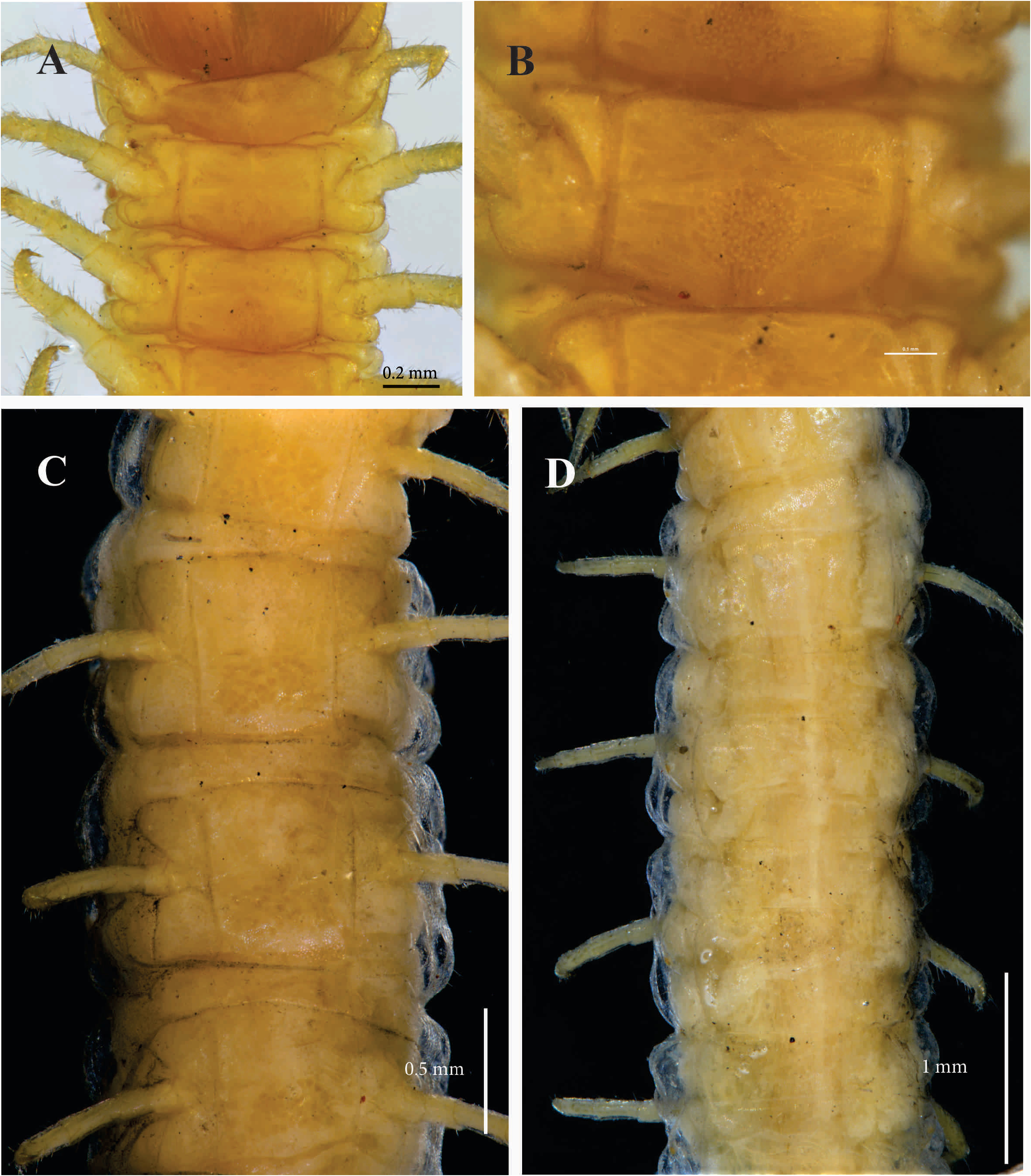
Sternites ( Figs 2 View FIGURE 2 A–C): Sternite 2 to penultimate with pores; on segments 2–18 round to oval, then dividing into 2 round pore fields, which gradually become smaller and again merge into a round field on the last 6 segments. Sternite sparsely setose. Sternite of ultimate leg bearing segment wide, trapezoidal with straight posterior margin.
Tergites ( Fig. 2D View FIGURE 2 ): with two, and pre-tergites with one, row of very small bristles, terga with two furrows, preterga not grooved, both smooth. Tergite of the last leg-bearing segment broad, with rounded posterior margin.
Ultimate leg-bearing segment ( Figs 3A View FIGURE 3 , B): Coxal pores open in two pits. Ultimate legs long and thin (mainly the tarsi), with several bristles, but without a claw; length of ultimate legs with 1.9 mm.


No known copyright restrictions apply. See Agosti, D., Egloff, W., 2009. Taxonomic information exchange and copyright: the Plazi approach. BMC Research Notes 2009, 2:53 for further explanation.
|
Kingdom |
|
|
Phylum |
|
|
Class |
|
|
Order |
|
|
Family |
|
|
Genus |

Schendylops cyclareatus ( Attems, 1947 )
| Fonseca, Régia Mayane Pacheco, Akkari, Nesrine & Chagas-Jr, Amazonas 2020 |
Sogona cyclareata
| Attems 1947 |