
Chimerocoris, BARROs & Barão & Grazia, 2020
|
publication ID |
https://doi.org/10.26049/ASP78-2-2020-07 |
|
DOI |
https://doi.org/10.5281/zenodo.4362536 |
|
persistent identifier |
https://treatment.plazi.org/id/904BEC25-5751-FF85-3E58-FDE505E2F7A0 |
|
treatment provided by |
Valdenar |
|
scientific name |
Chimerocoris |
| status |
gen. nov. |
Chimerocoris gen.n.
Type species. Chimerocoris luridus sp.n., here desig-nated.
Diagnosis. Head longer than wider; labium long; sur-passing the middle of abdominal sternite 6; labiomere 2 flattened laterally. Anterolateral margins of pronotum not reflexed. Basal angles of scutellum with foveae subequal to the diameter of a compound eye. Layers of ventral rim of pygophore separated by a carina; parameres reduced, with obsolete crown; segment Xwith a transverse carina and 1 + 1 thorn-like processes at base.
Description. Body ovate. Head: Head longer than wide, apex rounded ( Figs. 6A View Fig ; 19D View Fig ). Mandibular plates shorter than clypeus, obtuse at apices; lateral margins of mandib-ular plates sinuous. Clypeal apex obtuse, in a higher level than mandibular plates in lateral view; clypeal suture be-ginning after an imaginary line crossing anterior margin of compound eyes; antenniferous tubercles visible in dorsal view, each with an obtuse process laterally. Anten-nomere 1 not reaching apex of head; antennomere 2 vis-ible; antennomere 3 cylindrical; antennomere 4 conical, convex dorsally ( Fig. 18 View ← Fii). Bucculae sinuous, truncate posteriorly. Labium long, surpassing middle of sternite 6; first labiomere lying entirely between the bucculae; la-biomere 2 flattened laterally and labiomeres 3 and 4 uni-formly entire. Thorax: Pronotum trapezoidal ( Fig. 19D View Fig ); anterolateral margins explanate, not reflexed, impunc-tate; posterior margin slightly convex. Mesosternal ca-rina elevated, smooth; metasternal furrow shallow. Each of ostiole of ESES guttiform, opening posterolaterally; each peritreme spout-shaped; medial furrow of the each ostiolar peritreme long, occupying more than of length of peritreme; evaporatorium punctate, each occupying more than half of meso- and metapleuron; evaporatorium on mesopleuron reaching its anterior and posterior lateral angles, and surpassing the limits of mesocoxal sutures ( Fig. 18I View ← ). Metathoracic spiracle wide. Length of femora and tibiae subequal; femora unarmed; tarsi 3-segmented. Scutellum longer than wide ( Fig. 6A View Fig ). Basal angles of the scutellum foveate; foveae subequal to diameter of a compound eye. Corium longer than scutellum, surpass-ing apices abdominal tergite 5 and apex of each radial vein conspicuously calloused. Abdomen: Connexivum exposed ( Fig. 6A View Fig ). Sublateral margins of abdominal sternites not concolourous with abdominal venter ( Figs. 6C View Fig , 19H View Fig ). Medial longitudinal groove reaching sternite 6 ( Fig. 6B View Fig ). Male terminalia: Genital cup of pygophore broad, open posterodorsally; ventral rim composed of two layers, the inferior and superior layers, separated by a carina ( Figs. 6E View Fig , 19J – L View Fig ). Superior layer of ventral rim, projecting toward genital cup, developed laterally to seg-ment X, not covering parameres; lateral margin of each projection of superior layer notched. Segment Xcarinate and with 1 + 1 thorn-like processes at base. Parameres reduced, with obsolete crown.
Etymology. From Greek Chimero - mythological figure characterized by a hybrid appearance referring to the combination of characters of two genera ( Tibraca and Paramecocephala ); and - coris, stink bug; masculine.
Comments. Chimerocoris has the habitus and length of labium similar to Paramecocephala , and the morphol-ogy of pygophore similar to Tibraca . The comparison of these genera is presented in Figure 19 View Fig .
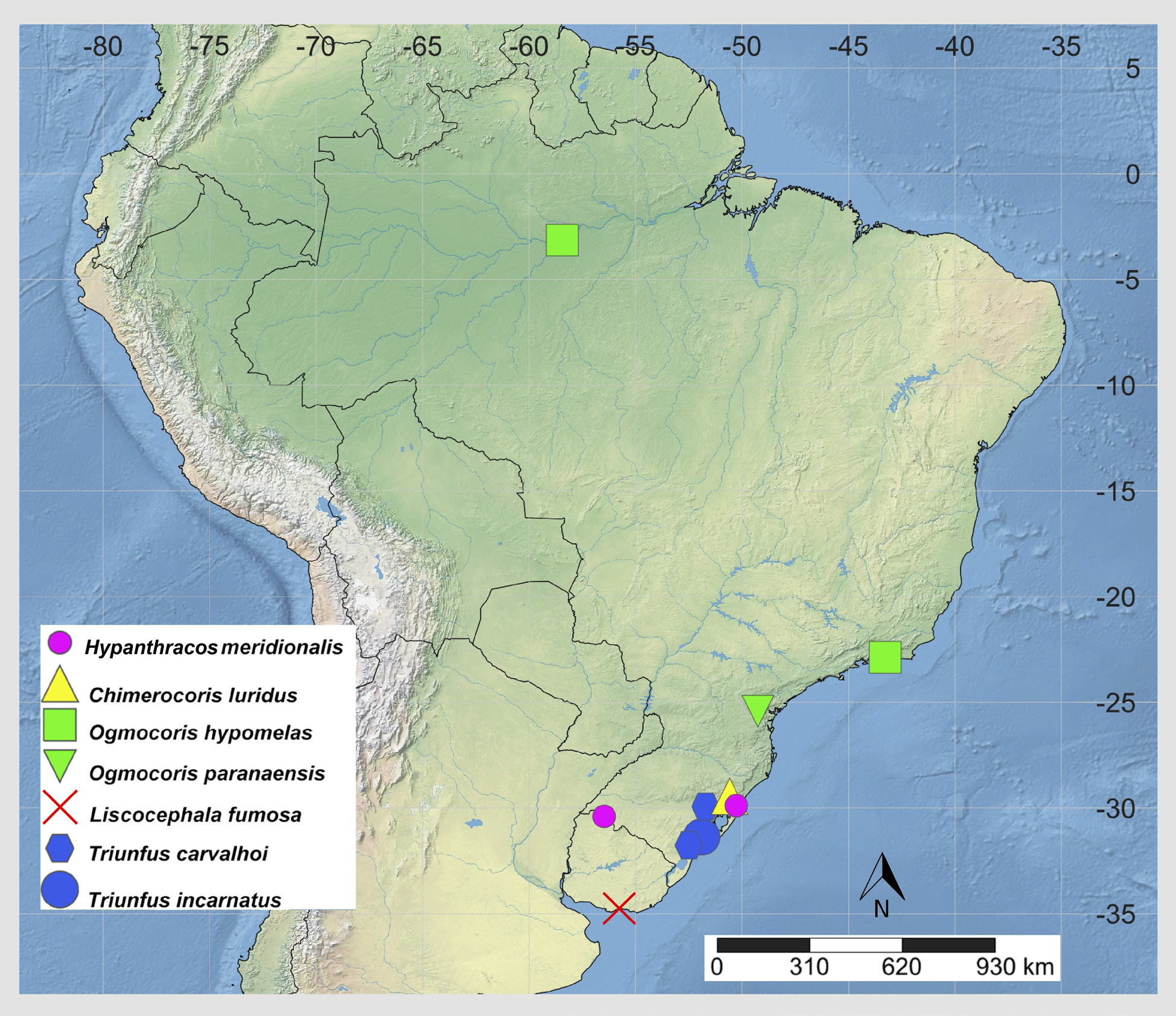
Distribution. Brazil: Rio Grande do Sul ( Fig. 17 View Fig ).


No known copyright restrictions apply. See Agosti, D., Egloff, W., 2009. Taxonomic information exchange and copyright: the Plazi approach. BMC Research Notes 2009, 2:53 for further explanation.
|
Kingdom |
|
|
Phylum |
|
|
Class |
|
|
Order |
|
|
Family |