
Paravibrissina parvula, Shima, Hiroshi & Tachi, Takuji, 2008
|
publication ID |
https://doi.org/10.5281/zenodo.183935 |
|
DOI |
https://doi.org/10.5281/zenodo.6231618 |
|
persistent identifier |
https://treatment.plazi.org/id/9A17A230-FFFF-FFBD-09F4-FF42FE565F43 |
|
treatment provided by |
Plazi |
|
scientific name |
Paravibrissina parvula |
| status |
sp. nov. |
Paravibrissina parvula View in CoL sp. nov.
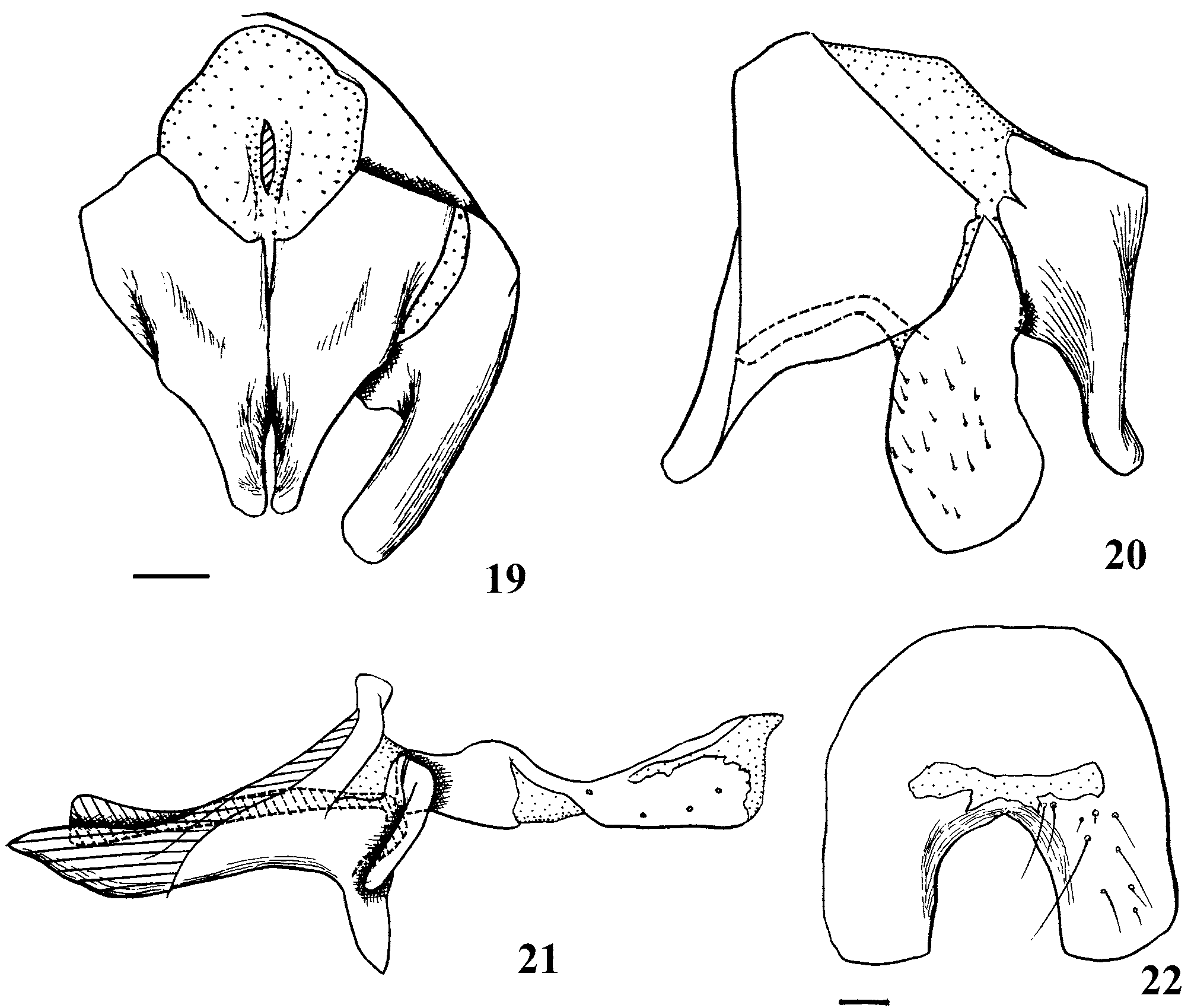
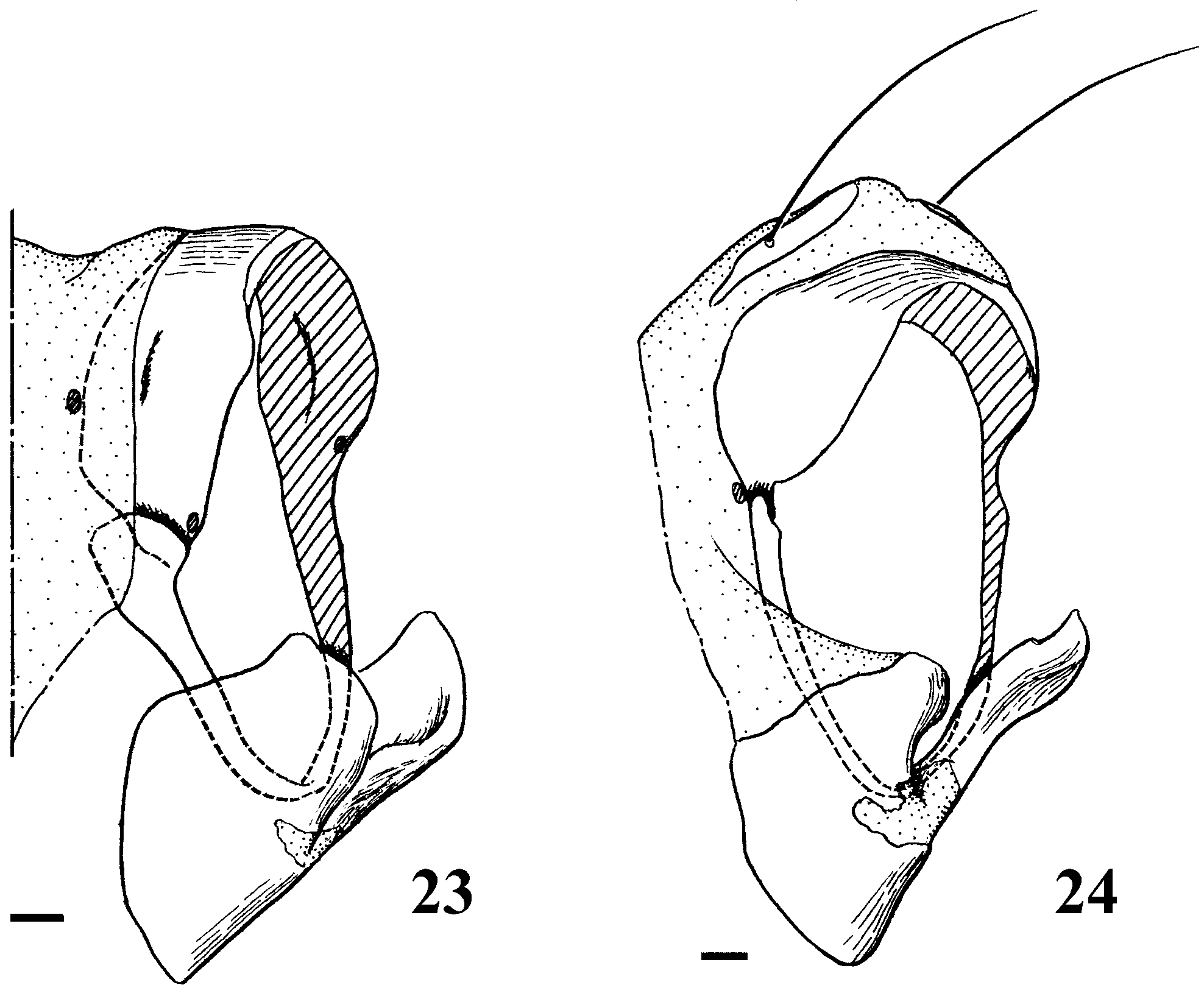
Figs. 19–22 View FIGURES 19 – 22 , 24 View FIGURES 23 – 24 .
Recognition. This species closely resembles P. pacifica in general appearance, but is smaller and lacks median marginal setae on the abdominal syntergum 1+2. The male terminalia of this species have broad and short cerci, which differ from the rather narrow and slender cerci in P. pacifica .
Description. Closely resembling S. pacifica , but differing as follows:
Male. Vertex slightly narrower than 1/5 of head width (about 0.19); parafacial about 1/2 as wide as 1st flagellomere at middle height; gena about 1/5 of eye height, with occipital dilation on lower 1/2. Inner vertical seta about 2/3 as long as eye height; ocellar seta absent; 2 reclinate orbital setae, anterior seta slightly longer than posterior seta and about 3/4 as long as inner vertical seta; 8–10 frontal setae, upper 1–2 setae strong and reclinate; gena with a row of 3–4 long and strong setae and several fine hairs. Antenna falling short of lower margin of face by about 2/3 length of pedicel; 1st flagellomere about 2.5 times as long as pedicel.
Thoracic dorsum with 4 narrower longitudinal black vittae on presutural area, scutellum black on basal 2/ 3. Distance between bases of 2 subapical scutellar setae about 2/3 of that between subapical and basal setae of corresponding side.
Wing hyaline, well tinged with brown on anterior and basal portions. Second costal sector about 3/5 as long as 3rd and nearly subequal in length to 4th.
Abdominal syntergum 1+2 without median marginal setae; 3rd tergum with 2 strong median marginal setae; 4th tergum with a row of strong marginal setae; 5th tergum with a row of discal and marginal setae; discal setae absent on 3rd and 4th terga; venter of 4th tergum with hair patch of short and fine hairs on quadrate area of entire length, 5th tergum without hair patch. Male terminalia: 5th sternum with U-shaped median cleft, posterior lobe only slightly less than 1/2 of whole length of the sternum; 6th tergum of 2 small hemitergites, each with a long hair; cerci in dorsal view short and wide, strongly narrowed to apex, narrowly separated from each other on apical 1/5 and converging at apex, in lateral view weakly curved dorsally on apical 1/5; surstylus in lateral view weakly curved dorsally near middle, about 2 times as long as wide, with several short fine hairs; pregonite bare.
Female. Unknown.
Body length: 5mm.
Distribution. New Caledonia.
Holotype. Male, NEW CALEDONIA: Hiengen to Bourail, 23.ii. 1978, H. Shima (BPBM).
Etymology. Specific name refers to the smaller size of this species in comparison to the similar and also sympatric species, P. pacifica .
No known copyright restrictions apply. See Agosti, D., Egloff, W., 2009. Taxonomic information exchange and copyright: the Plazi approach. BMC Research Notes 2009, 2:53 for further explanation.
|
Kingdom |
|
|
Phylum |
|
|
Class |
|
|
Order |
|
|
Family |
|
|
Genus |