
Eupithecia solianikovi Viidalepp, 1988
|
publication ID |
https://doi.org/10.11646/zootaxa.5219.3.5 |
|
publication LSID |
lsid:zoobank.org:pub:091A1ABF-85B7-47DE-9D9B-E24A495F45BA |
|
DOI |
https://doi.org/10.5281/zenodo.7417525 |
|
persistent identifier |
https://treatment.plazi.org/id/C82487BB-FFC4-0020-489A-31B8C84DFBFE |
|
treatment provided by |
Plazi |
|
scientific name |
Eupithecia solianikovi Viidalepp, 1988 |
| status |
|
Eupithecia solianikovi Viidalepp, 1988 View in CoL
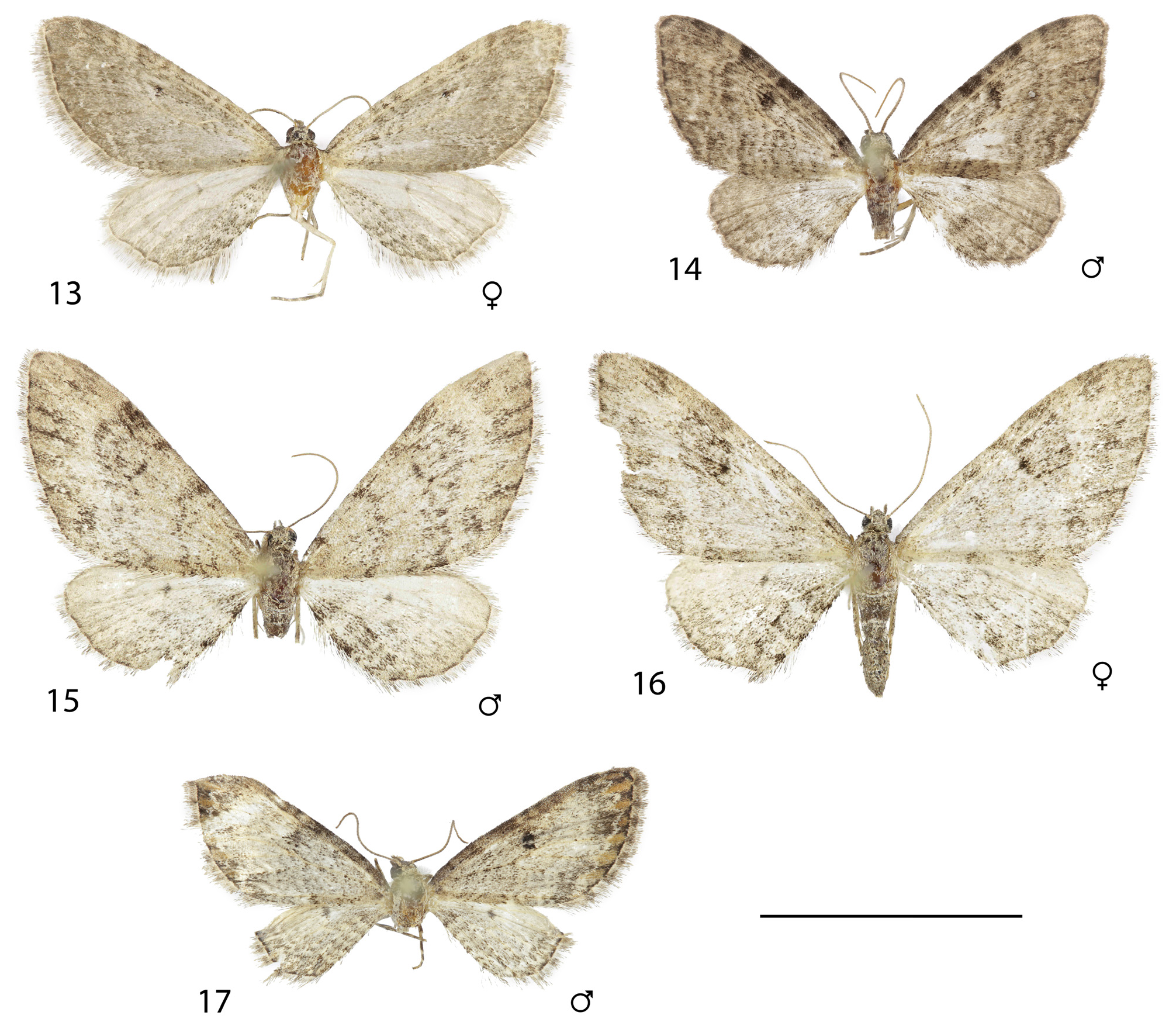
( Fig. 13 View FIGURES 13–17 )
Eupithecia solianikovi Viidalepp, 1988 View in CoL , Fauna pyadenits gor Sredney Azii [Geometridae fauna of the Central Asian mountains]: 106, pl. 2: fig. 9; text-pl. 22, figs 2-4, 10, 14.
Holotype ♂ (IZBE; examined), [ Tajikistan], Tadzh. SSR, W. Pamirs, Vanch river , Guchevast, 2200 m .
Examined material: 1 ♀, China, Tibet mer., Himalaya Mts, Nyalam , 3700 m, 10.–12.vi.2005, L. Bieber leg. Gen. prep. J. Procházka 20171; Photo J. Šumpich 21/423 ( NMPC) .
Note. This is a new species for the fauna of China. It was described from Tajikistan and Kyrghyzstan ( Viidalepp 1988). Based on the structure of the female genitalia this species belongs to the leucostaxis species group with the following species: E. leucostaxis Prout, 1926 , E. mustangata Schütze, 1961 and E. thomasi Mironov & Galsworthy, 2008 ( Mironov & Galsworthy 2014). The first two species listed have been recorded from Tibet ( Mironov & Galsworthy 2014). The female genitalia of the Chinese specimen are illustrated ( Fig. 27 View FIGURES 27–28 ).

| NMPC |
National Museum Prague |
No known copyright restrictions apply. See Agosti, D., Egloff, W., 2009. Taxonomic information exchange and copyright: the Plazi approach. BMC Research Notes 2009, 2:53 for further explanation.
|
Kingdom |
|
|
Phylum |
|
|
Class |
|
|
Order |
|
|
Family |
|
|
Genus |

Eupithecia solianikovi Viidalepp, 1988
| Mironov, Vladimir & Šumpich, Jan 2022 |
Eupithecia solianikovi
| Viidalepp 1988 |