
Gonatocerus ( Lymaenon ) kusaka Triapitsyn
|
publication ID |
https://dx.doi.org/10.11646/zootaxa.3644.1.1 |
|
publication LSID |
lsid:zoobank.org:pub:DF42B735-9A47-48D5-B382-F6A980563914 |
|
DOI |
https://doi.org/10.5281/zenodo.5099083 |
|
persistent identifier |
https://treatment.plazi.org/id/DC2687A4-E56C-FFF5-68CC-0A361CA95EC4 |
|
treatment provided by |
Plazi |
|
scientific name |
Gonatocerus ( Lymaenon ) kusaka Triapitsyn |
| status |
sp. n. |
Gonatocerus ( Lymaenon) kusaka Triapitsyn , sp. n.
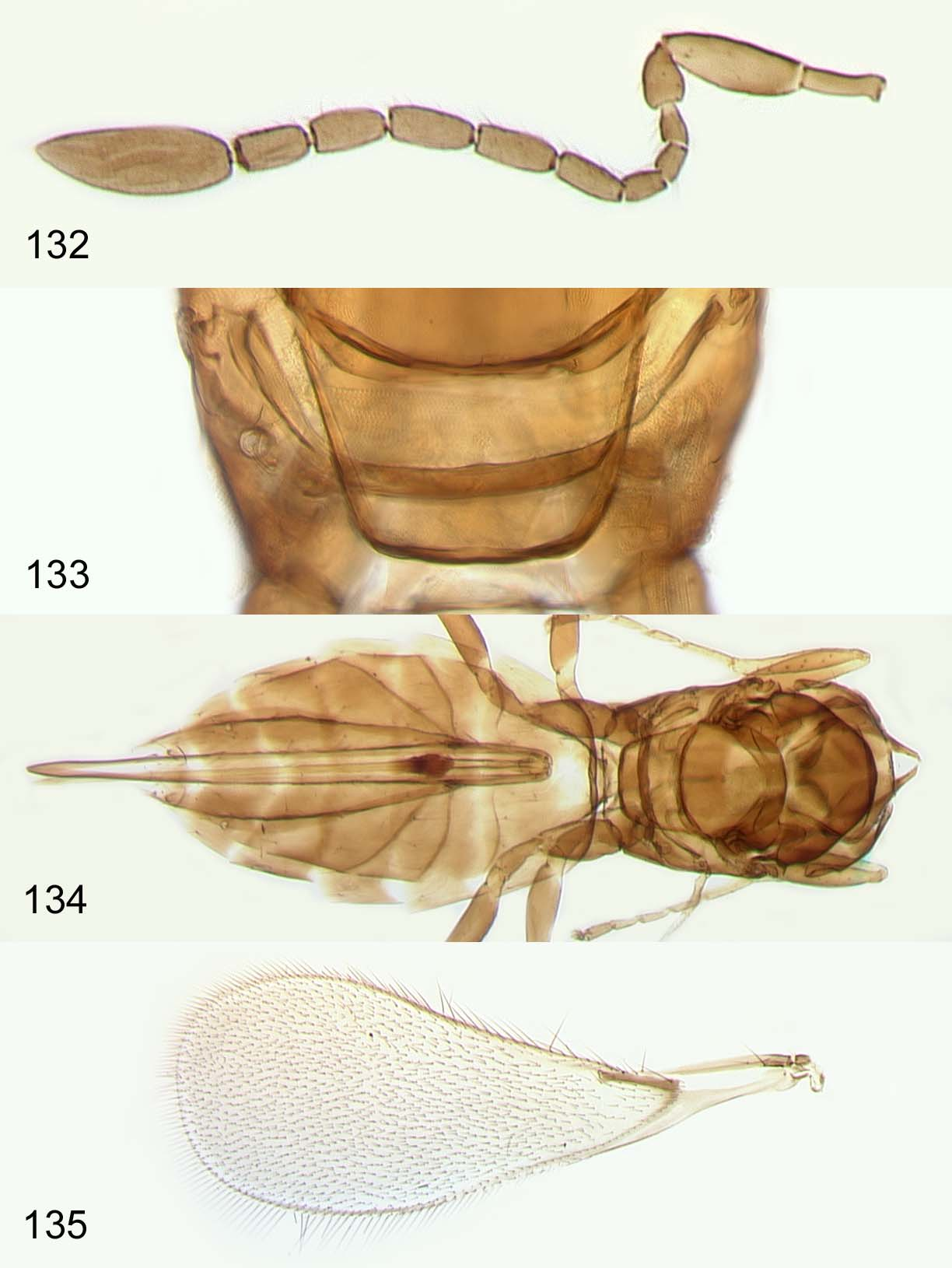
( Figs 132–135 View FIGURES 132 – 135 )
Type material. Holotype female [ ZIN] on slide: RUSSIA. PRIMORSKIY KRAY, Ussuriyskiy rayon, Gornotayozhnoye, 27–29.v. 1999, M.V. Michailovskaya, YPT. Paratypes: PRIMORSKIY KRAY: Terneyskiy rayon, Mel'nichnyi, 1–5.vi. 2001 M.V. Michailovskaya [ 1 Ƥ on slide, UCRC]. Ussuriyskiy rayon, Gornotayozhnoye, M.V. Michailovskaya: 31.v– 2.vi. 1999 [ 1 Ƥ on point, UCRC]; 5–11.vi. 1999 [ 1 Ƥ on slide and 1 Ƥ on point, UCRC]; 10–14.vi. 1999 [ 1 Ƥ on slide and 1 Ƥ on point, UCRC]; 21.vi. 2000 [ 1 Ƥ on point, UCRC]; 10– 20.v. 2002 [ 1 Ƥ on slide, IBPV, and 4 Ƥ on points, CNCI ( 1), UCRC ( 2), ZIN ( 1)]; 20–31.v. 2002 [ 1 Ƥ on point, UCRC]; 1–10.vi. 2002 [ 2 Ƥ on points, UCRC].
Description. FEMALE. Body length 960–1220 µm (dry-mounted paratypes). Head and mesosoma dark brown to black, gaster brown to dark brown; antenna brown, legs mostly brown to dark brown.
Antenna ( Fig. 132 View FIGURES 132 – 135 ) with radicle 0.34–0.36 × total length of scape, rest of scape 2.8–3.3 × as long as wide, almost smooth (slightly longitudinally striate); pedicel longer than F 1; F 1 –F 3 shorter than following funicle segments, F 5 and F 6 subequal in length and a little longer than F 4, F 7, or F 8; mps on F 4 (0 or 1), F 5 ( 2), F 6 (usually 2, rarely 3), F 7 ( 2), and F 8 ( 4 or 5); clava with 9 or 10 mps, 2.8 –3.0× as long as wide, a little longer than combined length of F 7 and F 8.
Mesosoma ( Fig. 134 View FIGURES 132 – 135 ). Propodeum ( Fig. 133 View FIGURES 132 – 135 ) with submedian lines wide apart. Fore wing ( Fig. 135 View FIGURES 132 – 135 ) 2.6– 2.9 × as long as wide; longest marginal seta 0.23–0.25 × maximum wing width; disc with a brownish tinge throughout, bare behind submarginal vein and setose elsewhere. Hind wing 16–17 × as long as wide; disc rather densely setose and with a slight brownish tinge; longest marginal seta 1.9–2.3 × maximum wing width.
Metasoma ( Fig. 134 View FIGURES 132 – 135 ). Gaster notably longer than mesosoma. Petiole 2.7–3.2 × as wide as long. Ovipositor long, occupying from 0.9 × to usually entire length of gaster, markedly exserted beyond its apex (by 0.17–0.24 × own length) posteriorly and occasionally slightly projecting anteriorly under petiole; ovipositor length: mesotibia length ratio 2.6–2.8: 1.
Measurements (µm) of the holotype. Mesosoma 474; petiole 27; gaster 769; ovipositor 843. Antenna: radicle 72; rest of scape 133; pedicel 60; F 1 32; F 2 33; F 3 39; F 4 66; F 5 76; F 6 77; F 7 68; F 8 67; clava 179. Fore wing 1125: 424; longest marginal seta 97. Hind wing 922: 58; longest marginal seta 121.
MALE. Unknown.
Diagnosis. Gonatocerus kusaka is similar to G. acuminatus from which it differs by not having a bare area between the marginal vein and the cubital row of setae ( Fig. 135 View FIGURES 132 – 135 ). The antenna of G. kusaka often bears a mps on F 4 whereas that of G. acuminatus does not. Also see the diagnosis of G. kum .
Etymology. The species name (a noun in apposition) means “one that bites” in Russian.
Hosts. Unknown.
No known copyright restrictions apply. See Agosti, D., Egloff, W., 2009. Taxonomic information exchange and copyright: the Plazi approach. BMC Research Notes 2009, 2:53 for further explanation.
|
Kingdom |
|
|
Phylum |
|
|
Class |
|
|
Order |
|
|
Family |
|
|
Genus |