
Gonatocerus ( Lymaenon ) karlik Triapitsyn
|
publication ID |
https://dx.doi.org/10.11646/zootaxa.3644.1.1 |
|
publication LSID |
lsid:zoobank.org:pub:DF42B735-9A47-48D5-B382-F6A980563914 |
|
persistent identifier |
https://treatment.plazi.org/id/DC2687A4-E57E-FFE7-68CC-0ECA1CA95DDA |
|
treatment provided by |
Plazi |
|
scientific name |
Gonatocerus ( Lymaenon ) karlik Triapitsyn |
| status |
sp. n. |
Gonatocerus ( Lymaenon) karlik Triapitsyn , sp. n.
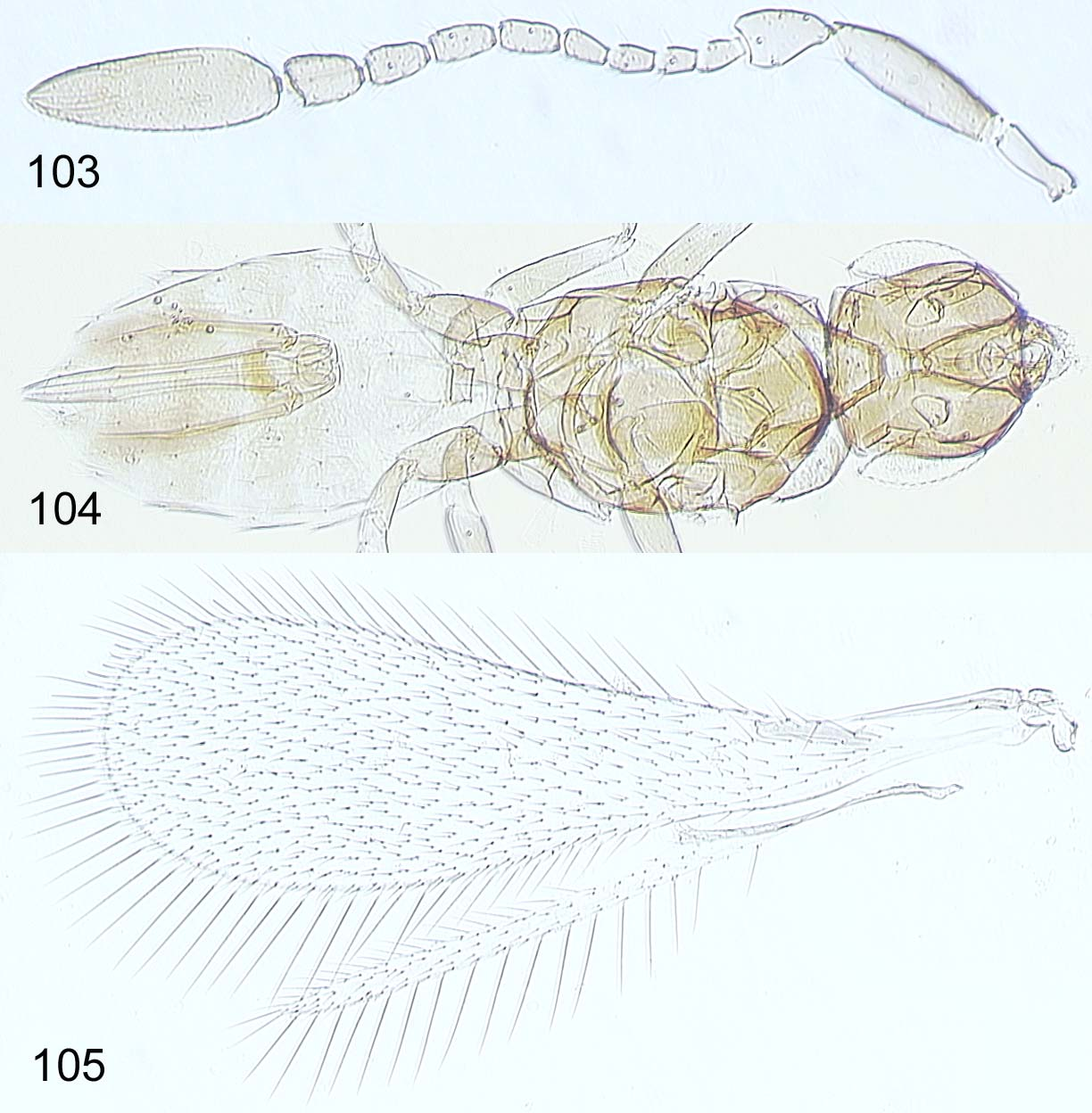
( Figs 103–105 View FIGURES 103 – 105 )
Type material. Holotype female [ UCRC] on slide: CHINA. BEIJING, Mentougou District, Xiaolongmen Station, 39 ° 59.220 ’N 115 ° 31.479 ’E, 1095 m, 28.vii. 2002, G. Melika [ UCRC ENT 294199]. Paratypes: CHINA. BEIJING, Mentougou District: Liyan Ling (Linshan Mts.), 40 °00.279’N 115 ° 30.753 ’E, 1749 m, 2.viii. 2002, G. Melika (sweeping alpine meadows) [ 3 Ƥ on slides, UCRC]. Same data as holotype [ 9 Ƥ on slides, CNCI ( 1), UCRC ( 7), ZIN ( 1)]. REPUBLIC OF KOREA. GYEONGGI-DO, Suwon-si, Seodun-dong, Seoul National University, 15.ix. 2001, J.-W. Kim [ 1 Ƥ on slide, UCRC]. RUSSIA. STAVROPOL’SKIY KRAY: Achikulak, V.V. Kostjukov: 19.viii. 2002 [ 2 Ƥ, 1 3 on slides, UCRC]; 18.viii. 2003 [ 4 Ƥ, 4 3 on points, UCRC ( 2 Ƥ, 2 3), ZIN ( 2 Ƥ, 2 3)]. Prietokskiy, V.V. Kostjukov: 7.ix. 2002 [ 1 Ƥ on slide, UCRC]; 13.vii. 2003 [ 2 Ƥ on points, UCRC, ZIN, and 1 Ƥ on slide, UCRC].
Description. FEMALE. Body length 450–650 µm (point-mounted specimens) or 600–800 µm (slidemounted specimens). Head and mesosoma brown to dark brown, gaster and appendages mostly brown except base of gaster a little lighter (light brown).
Antenna ( Fig. 103 View FIGURES 103 – 105 ) with radicle 0.3–0.36 × total length of scape, rest of scape 2.9–3.3 × as long as wide, faintly sculptured; pedicel longer than F 1; F 1 –F 4 subequal in length and a little shorter than following funicle segments, F 8 the longest and broadest funicle segment and incised apically; mps on F 7 (usually 0, occasionally 1 on one or both antennae) and F 8 ( 2); clava with 7 or 8 mps, 3.1–3.7 × as long as wide, longer than combined length of F 6 –F 8 (sometimes about as long as combined length of F 5 –F 8).
Mesosoma ( Fig. 104 View FIGURES 103 – 105 ). Propodeum with submedian lines rather close to each other anteriorly but very wide posteriorly. Fore wing ( Fig. 105 View FIGURES 103 – 105 ) 3.1–3.8 × as long as wide; longest marginal seta 0.51–0.58 × maximum wing width; disc with a slight brownish tinge, mostly bare behind submarginal vein except for a few setae behind its apex and setose elsewhere. Hind wing ( Fig. 105 View FIGURES 103 – 105 ) 22–24 × as long as wide; disc about as wide as or a little wider subapically than just beyond hamuli, setose, and with a slight brownish tinge; longest marginal seta 3.6–4.2 × maximum wing width.
Metasoma ( Fig. 104 View FIGURES 103 – 105 ). Gaster longer than mesosoma. Petiole 1.4–1.8 × as wide as long. Ovipositor occupying 0.6–0.7 × length of gaster, not exserted beyond its apex; ovipositor length: mesotibia length ratio 1.3–1.4: 1.
Measurements (µm) of the holotype. Body 787; mesosoma 277; petiole 18; gaster 356; ovipositor 242. Antenna: radicle 43; rest of scape 98; pedicel 48; F 1 18; F 2 18; F 3 21; F 4 22; F 5 30; F 6 32; F 7 32; F 8 37; clava 129. Fore wing 633: 183; longest marginal seta 94. Hind wing 500: 22; longest marginal seta 79.
MALE. Body length (dry-mounted paratypes) 450–650 µm. Similar to female except for normal sexually dimorphic features and the longest marginal seta about 0.64 × maximum wing width (in only one slide-mounted specimen measured).
Diagnosis. Gonatocerus karlik is very similar to G. kazak , from which it differs by usually lacking mps on F 7 of the female antenna, the relatively shorter F 1 –F 4 ( Fig. 103 View FIGURES 103 – 105 ), and especially by the consistently relatively longer marginal setae on the fore wing (the longest such seta is at least 0.5 × the maximum wing width). In G. kazak F 7 always bears 1 or 2 mps, F 1 –F 4 are relatively longer ( Fig. 113 View FIGURES 113 – 115 ), and the marginal setae on the fore wing are consistently relatively shorter (the longest such seta is at most 0.34 × the maximum wing width). Gonatocerus karlik differs from that of the similarly looking Nearctic species G. ( Lymaenon) pygmaeus Girault in having F 3 subequal in length to F 1, F 2, and F 4, and also in lacking a distinct bare area on the fore wing disc behind the marginal vein anterior to the cubital row of setae, whereas in the latter F 3 is longer than F 1, F 2, or F 4, and the fore wing disc has a distinct bare area behind the marginal vein anterior to the cubital row of setae.
Etymology. The name (a noun in apposition) stands for a dwarf in Russian; the species is named so because of its relatively minute size.
Hosts. Unknown.

No known copyright restrictions apply. See Agosti, D., Egloff, W., 2009. Taxonomic information exchange and copyright: the Plazi approach. BMC Research Notes 2009, 2:53 for further explanation.
|
Kingdom |
|
|
Phylum |
|
|
Class |
|
|
Order |
|
|
Family |
|
|
Genus |