
Enaphalodes, Haldeman, 1847
|
publication ID |
https://doi.org/10.11606/1807-0205/2018.58.11 |
|
DOI |
https://doi.org/10.5281/zenodo.3681303 |
|
persistent identifier |
https://treatment.plazi.org/id/E35587F2-E26B-FFEB-4715-8D97F05C2C41 |
|
treatment provided by |
Carolina |
|
scientific name |
Enaphalodes |
| status |
|
Key to species of Enaphalodes View in CoL (updated from Lingafelter & Chemsak, 2002)
1. Elytra with pubescence dense and conspicuous, either erect or appressed orincombination..............................................................2
— Elytra withvery sparse,inconspicuous pubescence; U.S.A. (Arizona, California),Mexico (Sonora)................... E.seminitidus (Horn, 1885)
2(1). Elytrawithoneto threewell‑defined areasof dense,appressedpubescence.........................................................................................3
— Elytra withpubescence otherwise:either uniform,without patches of dense,appressedpubescence,orwithnumerous interconnecting, poorlydefined appressed patches,givingamottledappearance ...6
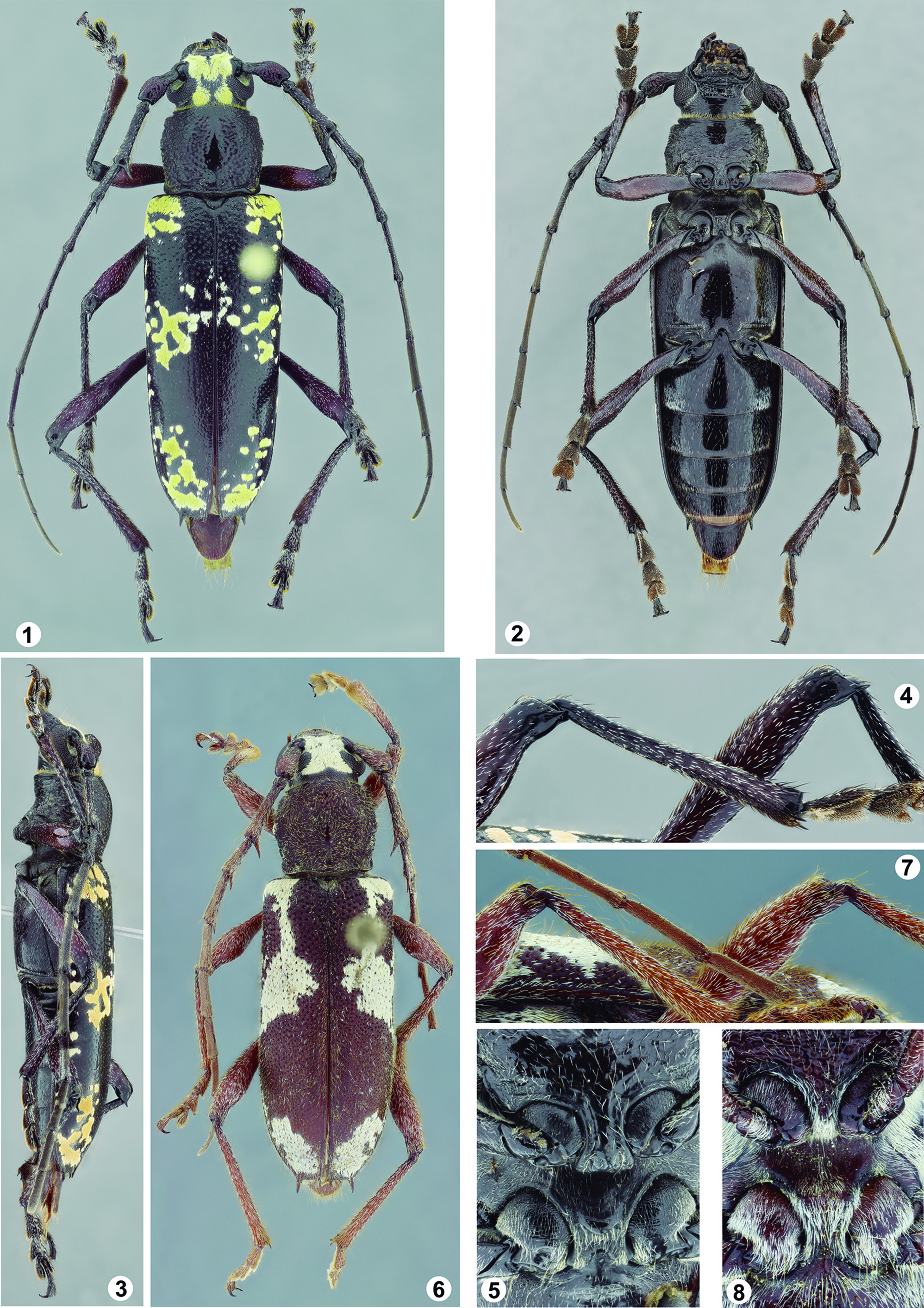
3(2). Mesosternal process with large central tubercle ( Fig. 5 View Figures1-8 ); meso‑ and metafemoral apicesspiniform ( Fig.4 View Figures1-8 )............................................4
— Mesosternalprocesswithsmalltubercleoneachsideclosetocurvature ( Fig. 8 View Figures1-8 ); meso‑ and metafemoral apices withrounded ortriangularlobes ( Fig. 7 View Figures1-8 )..........................................................................5
4(3). Elytral pubescence scattered, mostly pale yellow‑ochre, forming three distinctgroupsof spots ( Fig.1 View Figures1-8 ); Costa Rica.............................. .................................................................... E.antonkozlovi View in CoL , sp.nov.
— Elytralpubescencecompact,white,formingtwogroupsof maculae; Panama, Colombia................................. E.boyacanus Martins,2005 View in CoL
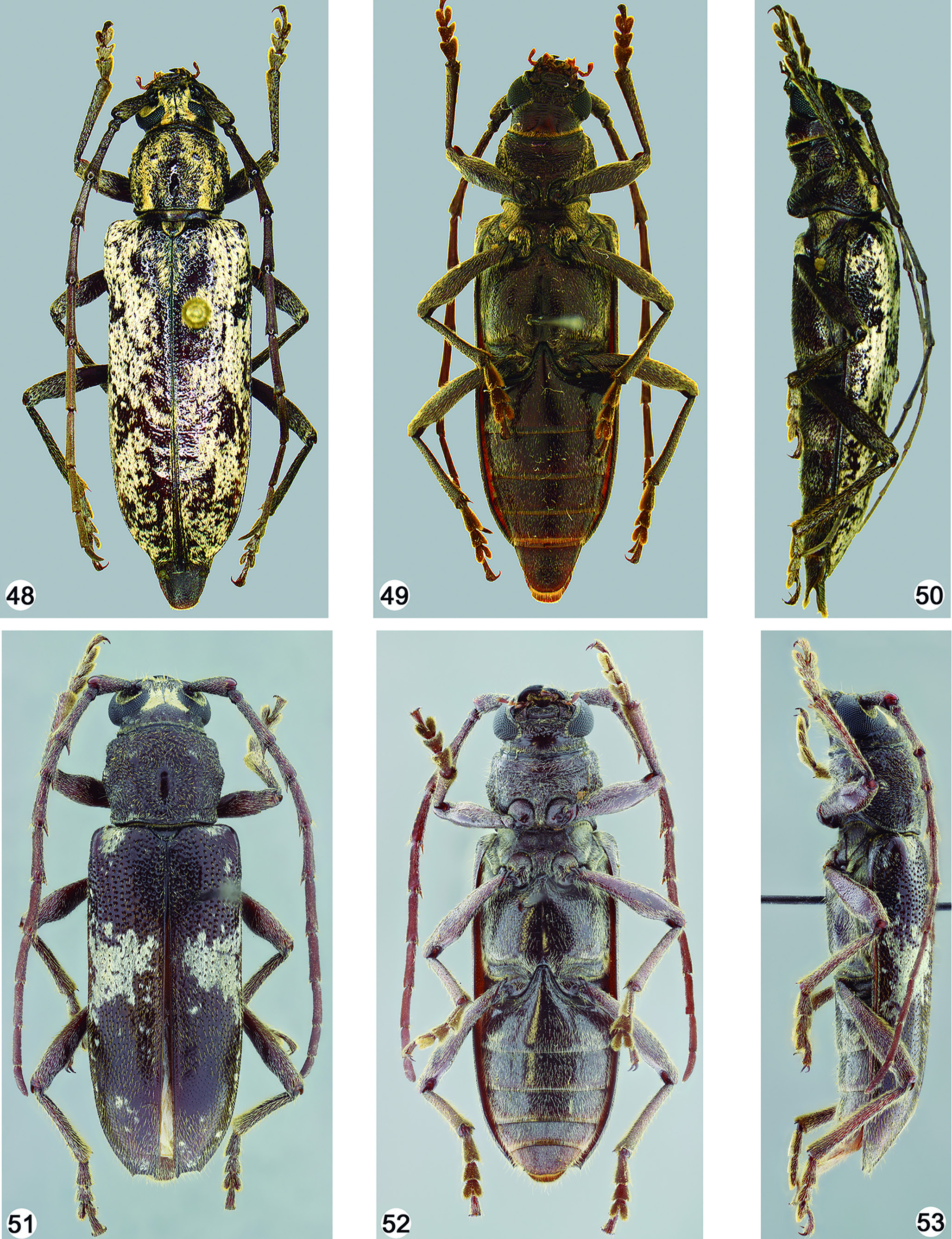
5(3). Elytra without dense patch of white pubescence on distal area ( Fig.51 View Figures 48-53 ); U.S. A (Texas), Mexico (Tamaulipas).................................... ............................................................. E.taeniatus (LeConte,1854) View in CoL
— Elytra with patch of white pubescence at apex ( Fig. 6 View Figures1-8 ); Mexico (Chiapas, Oaxaca), Guatemala, Honduras, Belize, Nicaragua, Costa Rica......................................................... E.coronatus (White,1853) View in CoL
6(2). Elytranot appearing mottled; withoutpatches of appressedpubescence;erect,suberect,andappressedpubescence uniformindensity and distribution..........................................................................7
— Elytra appearing mottled; with patches of appressed pubescence; erect,suberect,orappressedpubescencenotuniformindensityand distribution ....................................................................................8
7(6). Large species, with pubescence inconspicuous and not heavily obscuring elytral surface; ventral pubescence mostly translucent with slight golden sheen; last ventral sternite of females with a deep notch at apex; U.S.A. ( Georgia, Missouri, California, Arizona, Texas,Idaho,Florida,Minnesota,New Jersey,Mississippi,Alabama), Mexico ( Sonora, Tamaulipas)............. E.hispicornis (Linnaeus,1767) View in CoL
— Moderate to large species with conspicuous uniform appressed fulvous pubescence that densely covers elytral surface; ventral pubescencemostlywhiteandnottranslucent,distinctlydifferentcolor from dorsal pubescence; last ventral sterniteof females withavery shallownotch at apex;U.S.A.(Florida)............................................. ......................................... E.archboldi Lingafelter & Chemsak,2002 View in CoL
8(6). Sides of pronotum at middle nearly as wide as base of elytra in males;elytralighttodarkbrownwithappressedpubescenceextensive not contrastingas intensely withelytral ground color (appearingdiffusely mottled).....................................................................9
— Pronotum with slight widening anterior to middle, but much narrower at widest point than base of elytra; elytra dark brown with appressedpubescence distinctlymottled.....................................11
9(8). Elytra with fulvous appressed pubescence and reddish or light brown ground color; without erect setae (except a few along suture and apical third); last abdominal sternite of females with very shallow notch at apex; Canada ( Quebec, Ontario), U.S.A. (Georgia, Philadelphia, Texas, New York, South Carolina, Maine, Florida, Minnesota, Iowa, Ohio, Kentucky, Pennsylvania, Arizona, Mississippi, Massachusetts, Arkansas, Missouri, Alabama, Rhode Island,Maryland,Delaware,Districtof Columbia)............................ ............................................................. E.rufulus ( Haldeman,1847 View in CoL )
— Elytra with white or off‑white appressed pubescence and light to darkbrowngroundcolor (rarely reddish‑brown);longererecttosuberect setae present; last abdominal sternite of females with deep orshallownotch at apex...............................................................10
10(9). Pubescence of metasternum primarily translucent; last abdominal sterniteoffemaledeeplynotchedatapex;elytrawithdiffusepatches of off‑white pubescence; Canada (Quebec, Ontario), U.S.A. (New York,Pennsylvania,Maryland,North Carolina,Massachusetts, Texas, Districtof Columbia,Georgia,Florida,Arizona,Mississippi,Alabama, Arkansas, Colorado, Connecticut, Iowa, Illinois, Indiana, Kansas, Louisiana,Michigan, Missouri, New Jersey,Ohio, Oklahoma, Rhode Island, South Carolina, Tennessee, Wisconsin), Mexico ( Veracruz, Tamaulipas),Honduras............................ E.atomarius (Drury,1773 View in CoL )
— Pubescence of metasternum primarily white and not translucent; last abdominal sterniteof female with very shallow notch at apex; elytrawithdiffusepatchesof whiteor off‑white pubescence; U.S.A. ( Pennsylvania, Arizona, New York, Illinois, North Dakota, Ohio, Kentucky, New Jersey, Virginia, Mississippi, Nebraska), Mexico ( Sonora)........................................ E.cortiphagus (Craighead,1923) View in CoL
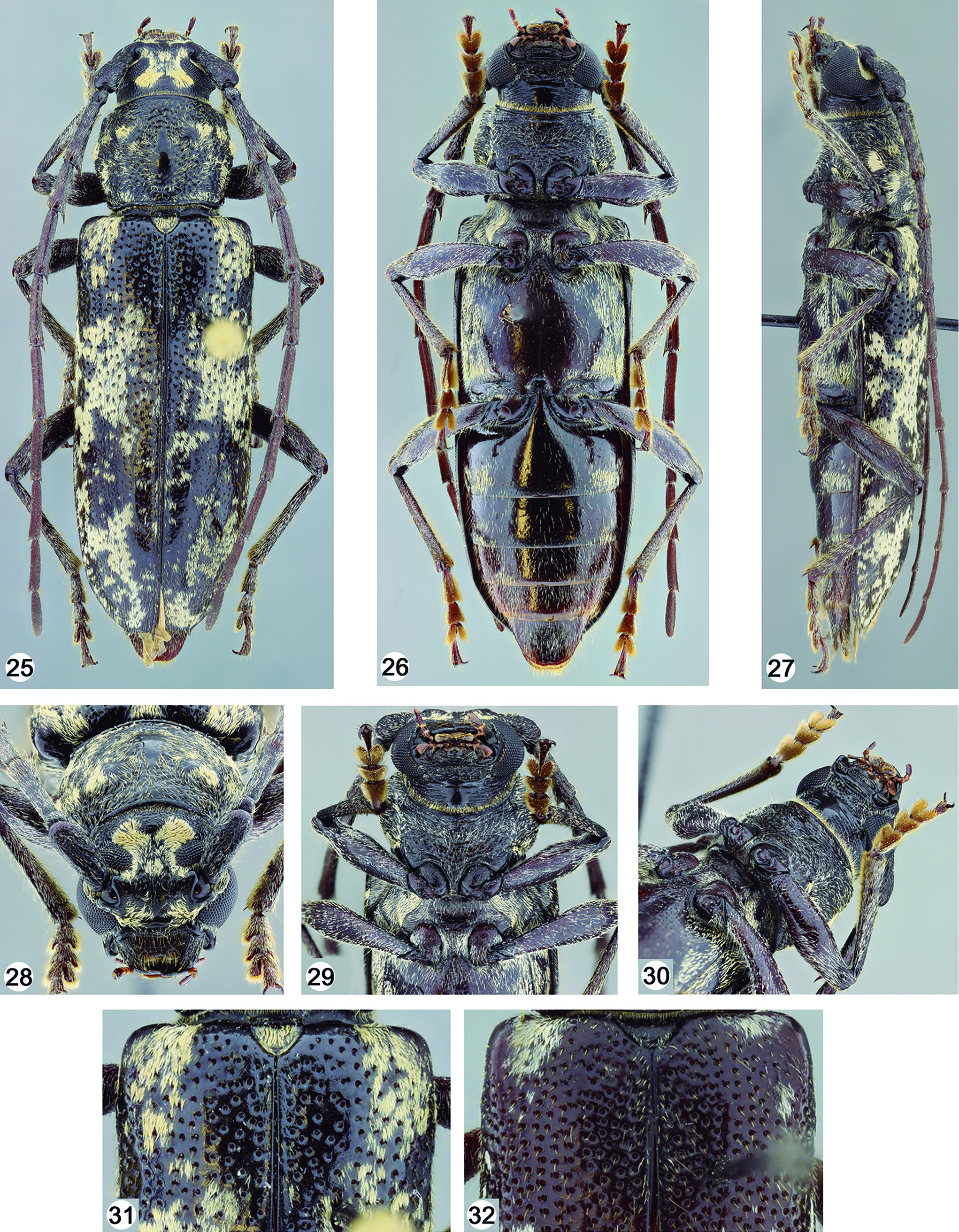
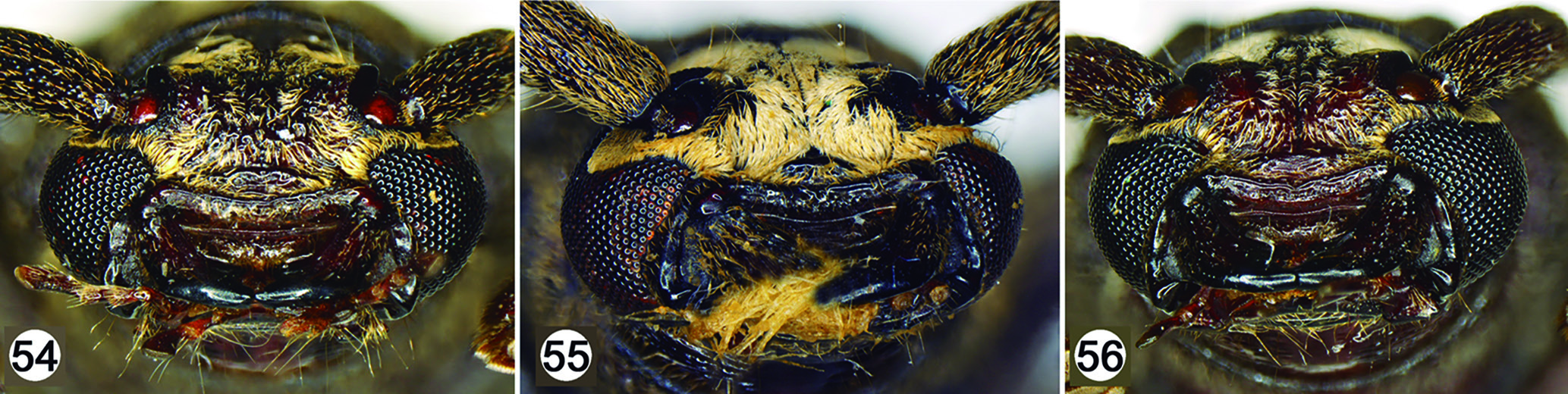
11(8). Apexof antennaltubercleselevated ( Figs.28 View Figures 25-32 , 54 View Figures 54-56 )........................12
— Apexof antennaltuberclesflattened ( Fig.55 View Figures 54-56 )..............................13
12(11). Prothorax wide, distinctly rounded laterally ( Figs. 25, 28 View Figures 25-32 ); antennomere IV short, thick, shorter than median pronotal impunctate region ( Fig.25 View Figures 25-32 ); Mexico ( Baja California Sur).................................... .................................................................... E.cunninghami View in CoL , sp.nov.
— Prothorax moderately narrow, not distinctly rounded laterally ( Fig. 48 View Figures 48-53 ); antennomere IV elongate, narrow, longer than median pronotalimpunctateregion ( Fig.48 View Figures 48-53 ); Mexico ( Tamaulipas) ............. ......................................................... E.niveitectus (Schaeffer,1905 View in CoL )
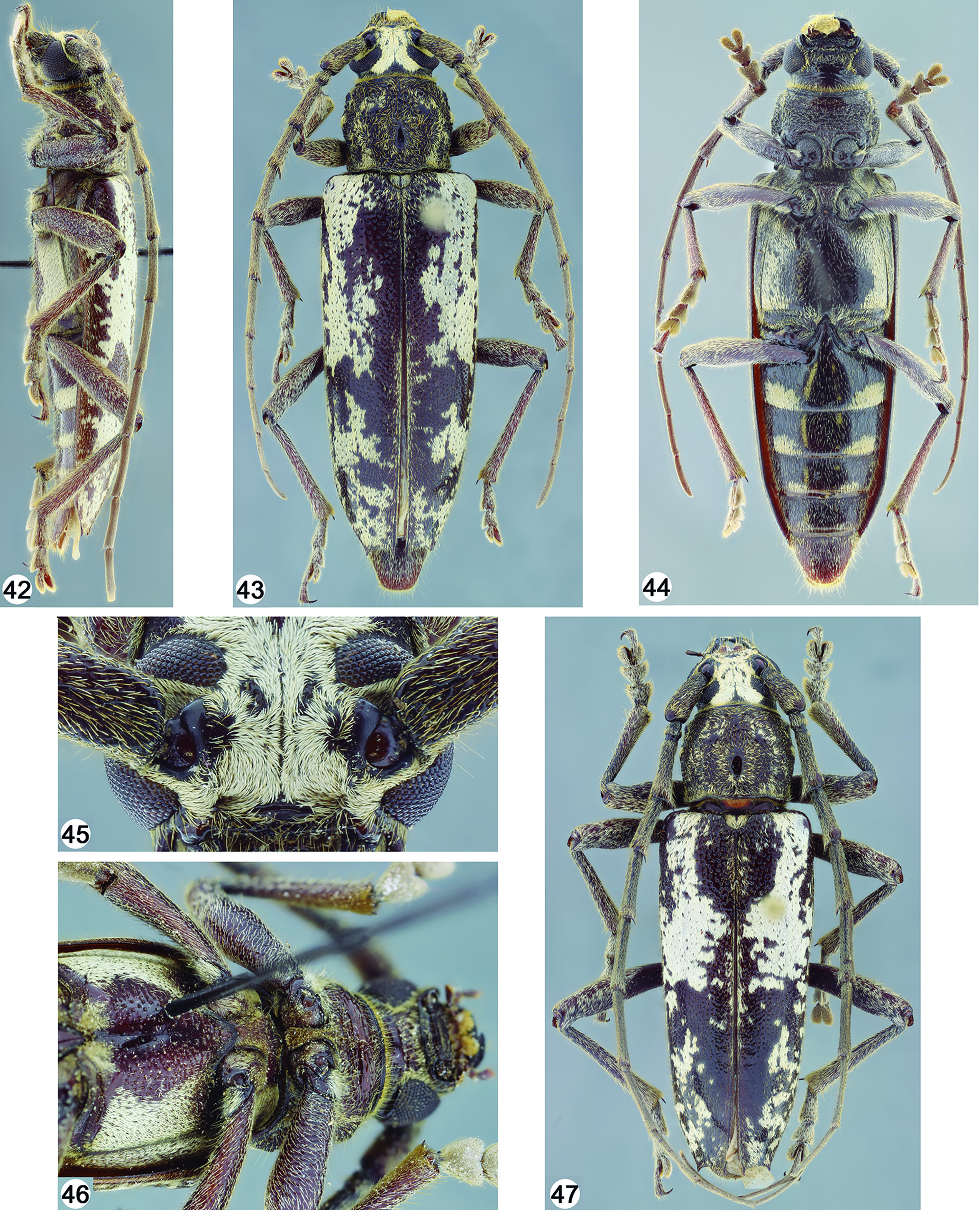
13(11). Antennae in female reaching elytral apex ( Fig. 43 View Figures 42-47 ); pubescence of headandelytraprimarily white;Mexico,Guatemala ....................... ....................................................................... E.senex ( Bates,1884 View in CoL )
— Antennae in female not reaching elytral apex; pubescence of head andpronotumochreoryellowish‑white ......................................14
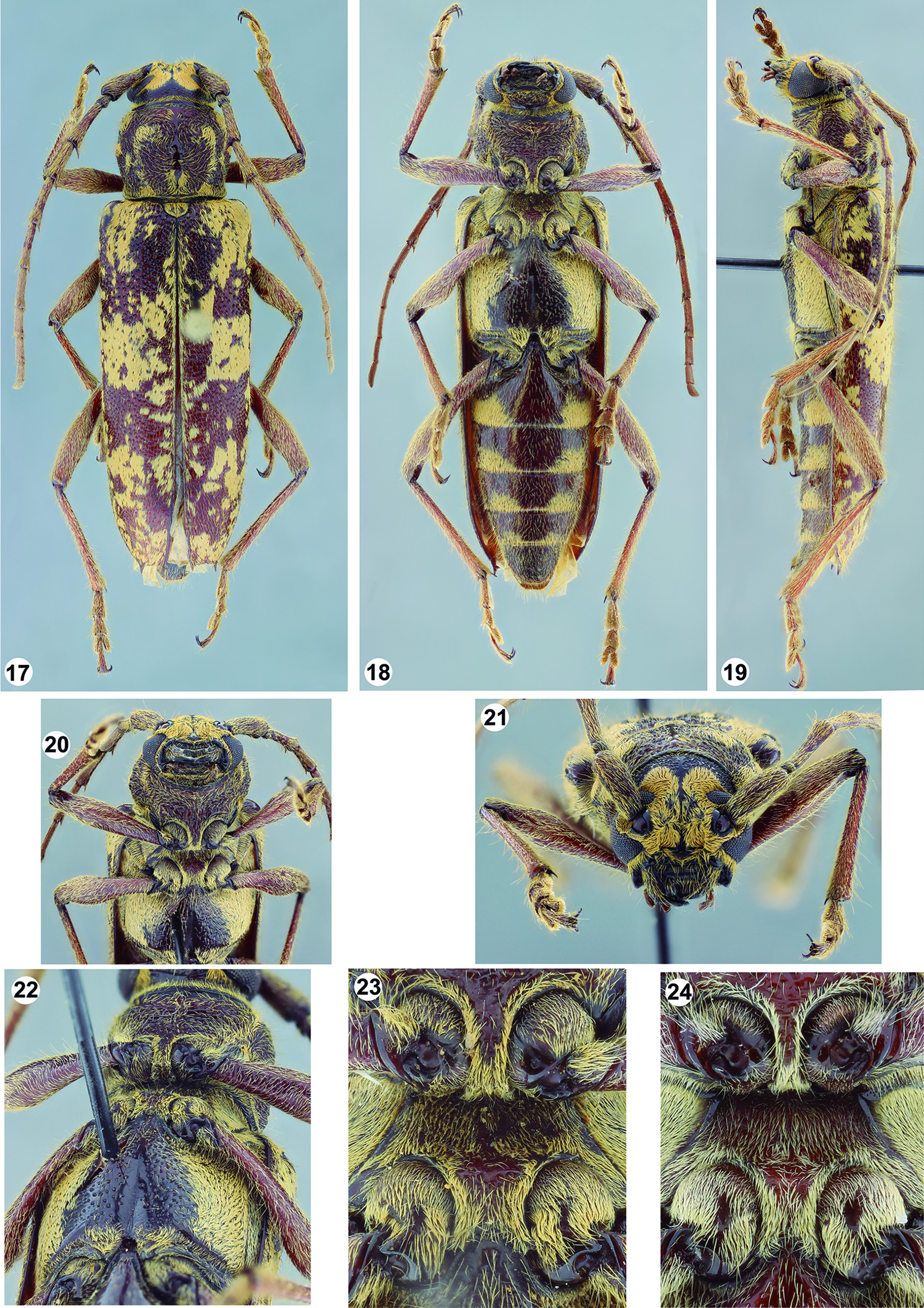
14(13). Antennae reaching at about base of distal third of elytra ( Fig. 17 View Figures 17-24 ); pro‑ and mesosternal processes wide ( Fig. 23 View Figures 17-24 ); uniformlyochre pu‑ bescence;Guatemala.......................................... E.monzoni View in CoL , sp.nov.
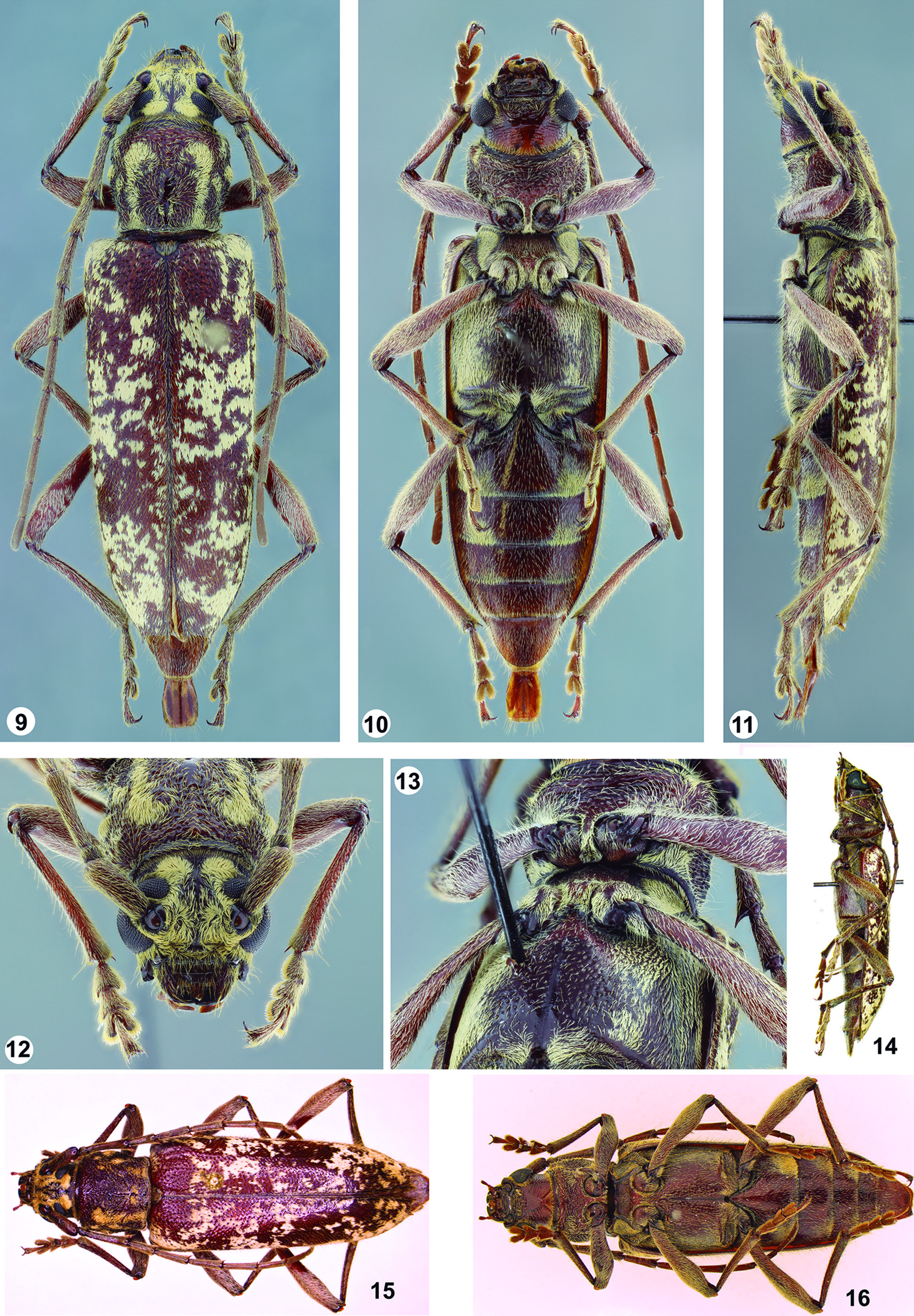
— Antennae distinctly surpassingbase of distalthird of elytra ( Fig.9 View Figures 9-16 ); pro‑ andmesosternal processesnarrow ( Fig.24 View Figures 17-24 );pubescenceamix‑ tureof ochreand yellowish‑white;Nicaragua .... E.bingkirki View in CoL , sp.nov.
No known copyright restrictions apply. See Agosti, D., Egloff, W., 2009. Taxonomic information exchange and copyright: the Plazi approach. BMC Research Notes 2009, 2:53 for further explanation.
|
Kingdom |
|
|
Phylum |
|
|
Class |
|
|
Order |
|
|
Family |