
Neotropicomus indicus, Nanu & Kumar, 2024
|
publication ID |
https://cryptogamie.com/mycologie/45/5 |
|
DOI |
https://doi.org/10.5281/zenodo.10892053 |
|
persistent identifier |
https://treatment.plazi.org/id/EF188D0E-FF88-FFF5-FC5C-F98B7853F8A6 |
|
treatment provided by |
Plazi |
|
scientific name |
Neotropicomus indicus |
| status |
sp. nov. |
Neotropicomus indicus sp. nov.
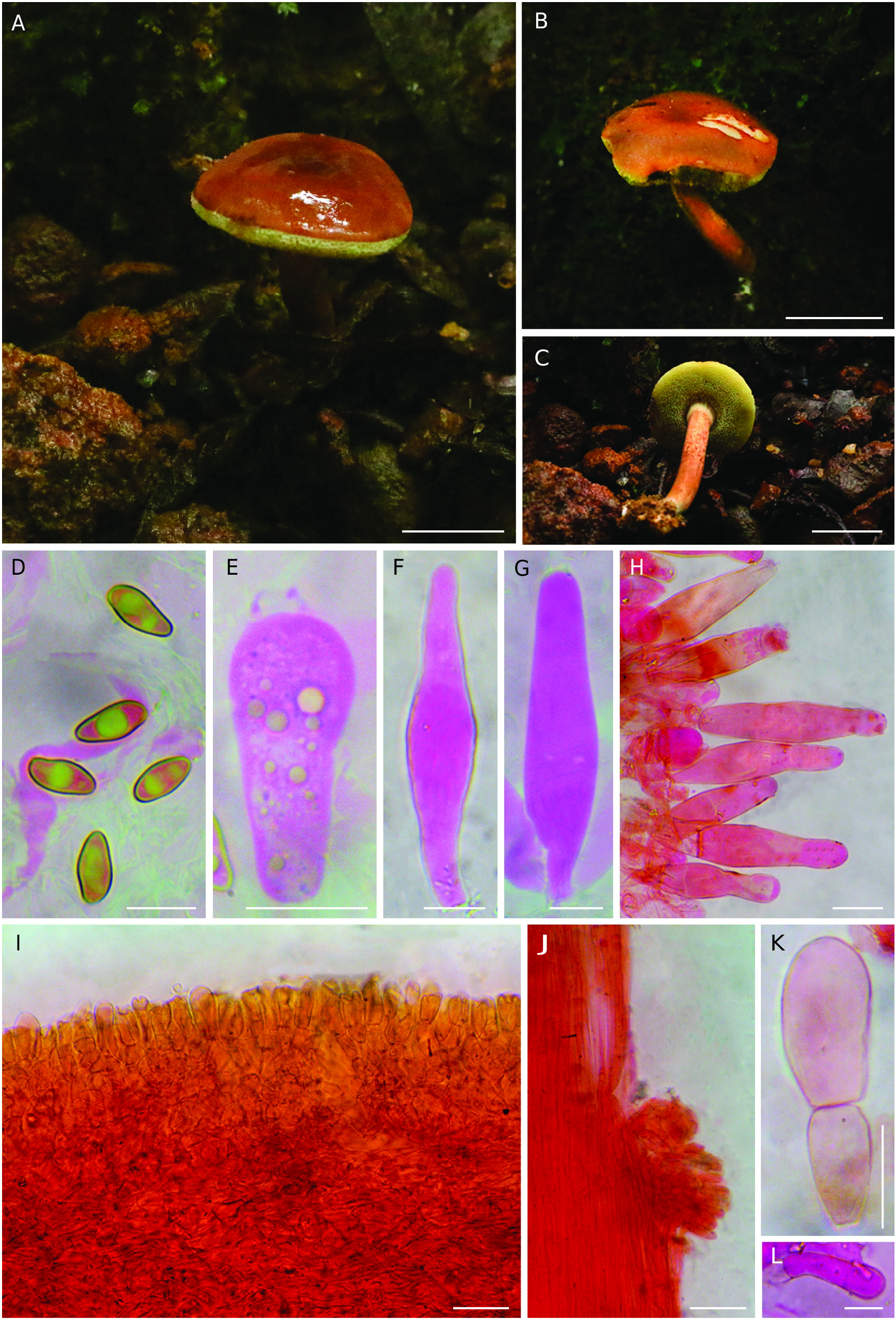
( Fig. 1 View FIG )
Neotropicomus indicus sp. nov. is characterized by basidiomata with a smooth to minutely pruinose, reddish brown pileus, stipe surface finely pruinose at the apex, downward to the middle with small reddish brown squamules, subfusoid to fusoid basidiospores, and a cutis type of stipitipellis interrupted by caulocystidia clusters. The species differs from N. australis by its smaller basidiospores, larger cheilocystidia and stipitipellis structure.
TYPE MATERIAL. — India • Kerala State, Thiruvananthapuram District, Palode ; 6.VII.2022; holotype: ZGC[ ZGCSN180 ]; GenBank: OQ633210 ( ITS), OQ633194 (28 S) .
ETYMOLOGY. — “ indicus ” indicates the distribution and collection locality of the species.
GenBank accession numbers Taxon Voucher Locality ITS 28S Austroboletus albidus Yan C. Li & Zhu L. Yang
HKAS107148, holotype
China
– NG088131 A. olivaceoglutinosus K.Das & Dentinger HKAS57756 China – KF112383 Boletus fagacicola B.Feng, Y.Y.Cui, J.P.Xu & Zhu L.Yang HKAS55975, holotype China JN563899 JN563853 B. reticuloceps (M.Zang, M.S.Yuan & M.Q.Gong) Q.B.Wang & Y.J. Yao HKAS57671 China – KF112454 B. bainiugan Dentinger HKAS52235 China JN563905 KF112457 B. edulis Bull. HMJAU4637 Russia JN563894 KF112455 Brasilioporus olivaceoflavidus A.C.Magnago FLOR 68467 Brazil OM068901 – B. olivaceoflavidus FLOR 68468 Brazil OM068902 – B. olivaceoflavidus VIES 9901322, holotype Brazil OM068903 – B. rufonigricans (T.W. Henkel) A.C.Magnago & T.W.Henkel G472 Guyana KJ786658 – B. simoniarum A.C.Magnago VIES 9901327, holotype Brazil OM068905 OM068914 Hortiboletus amygdalinus Xue T. Zhu & Zhu L. Yang HKAS54166, holotype China KT990581 KT990777 H. subpaludosus (W.F.Chiu) Xue T. Zhu & Zhu L. Yang HKAS59608 China KF112371 – Imleria badia (Fr.) Vizzini MB 03-098a United States – KF030355 I. badia Xb2 Germany – KF030357 I. obscurebrunnea (Hongo) Xue T. Zhu & Zhu L. Yang HKAS52557 China KC215207 KF112374 Indoporus shoreae A.Parihar, K.Das, Hembrom & Vizzini AP 6693, holotype India MK123972 MK123973 I. shoreae AP 6697 India MK123977 MK123976 Neotropicomus australis A.C.Magnago FLOR 68471 Brazil OM068909 – N. australis ACM1138 Brazil OM068907 OM068916 N. australis VIES 9901328, holotype Brazil OM068906 – N. australis VIES 9901329 Brazil OM068908 OM068917 N. indicus sp. nov. ZGCSN180 India OQ633210 OQ633194 N. parvogracilis (T.W.Henkel & Husbands) A.C.Magnago & T.W.Henkel TH9209, holotype Guyana JQ751261 JQ751262 N. parvogracilis TH8850, paratype Guyana JQ751263 HQ161865 Parvixerocomus aff. aokii (Hongo) G.Wu, N.K.Zeng & Zhu L. Yang HKAS52633 China – KF112379 P. aokii HKAS59812 China – KF112378 P. pseudoaokii G.Wu, K.Zhao & Zhu L. Yang HKAS80480, holotype China – KP658468 Porphyrellus castaneus Yan C. Li & Zhu L. Yang HKAS52554, holotype China – KT990697 P. castaneus HKAS63076 China – KT990548 P. orientifumosipes Yan C. Li & Zhu L. Yang HKAS53372, holotype China – KT990629 Strobilomyces echinocephalus Gelardi & Vizzini HKAS59420 China – KF112463 S. floccopus (Vahl) P. Karst. AFTOL-716 United States AY854068 AY684155 S. floccopus AFTOL-716 United States AY854068 AY684155 S. strobilaceus (Scop.) Berk. WU0016537 Austria – KT990647 Tengioboletus glutinosus G.Wu & Zhu L. Yang HKAS53425, holotype China – KF112341 T. glutinosus HKAS53452 China – KT990655 T. reticulatus G.Wu & Zhu L. Yang HKAS52241 China – KT990657 T. reticulatus HKAS53453, holotype China – KT990656 Tylopilus dunensis A.C.Magnago & M.A.Neves MAN216, paratype Brazil MF113418 OM068920 T. dunensis MAN218, holotype Brazil MF113419 MF113428 T. felleus (Bull.) P. Karst. HKAS54926 Germany – KF112411 T. felleus HKAS90203 China – KT990545 T. violaceobrunneus Yan C. Li & Zhu L. Yang HKAS89443, holotype China – KT990702 Xanthoconium purpureum Snell & E.A.Dick NY00720964 United States – KT990663 X. sinense G.Wu, Y.Y.Cui & Zhu L. Yang HKAS77758, holotype China – KT990665 Xerocomellus corneri Xue T. Zhu & Zhu L. Yang HKAS52503 China – KT990668 X. communis Xue T. Zhu & Zhu L. Yang HKAS50467 China – KT990670 Xerocomellus sp. HKAS56311 China KF112340 KF112170
HABITAT. — Solitary, on ground in forest dominated by Dipterocarpaceae members.
MYCOBANK. — MB848296.
DESCRIPTION
Basidiomata small-sized. Pileus 20-30 mm broad, convex when young, becoming plano-convex on maturity; surface viscid when wet, smooth to minutely pruinose, reddish brown to grayish brown towards the centre; margin straight. Pileal context whitish, unchanging when cut. Hymenphore adnate, depressed around the apex of stipe; surface pale yellow to olive yellow; pores 1-2 per mm, angular, unchanging on bruising; tubes 2-4 mm long, concolourous to the hymenophore surface, unchanging when cut. Stipe 20-40 × 3-4 mm, central, almost equal; surface finely pruinose at the apex downward to the middle with small reddish brown squamules, whitish to pale yellowish in apex, reddish brown in middle to bottom in a cream background. Stipe context whitish, unchanging on bruising. Basal mycelium white.
Basidiospores 9-11× 4-5µm (Q=1.8-2.75, Qm= 2.2), subfusoid to fusoid, thin- to slightly thick-walled (up to 0.5µm), smooth, yellowish in water,inamyloid.Basidia 20-27×7-10µm, clavate, thin-walled, 4-spored, hyaline with many oil droplets; sterigmata up to 3 µm long, hyaline with many oil droplets. Pleurocystidia 42-62×6-12 µm, narrowly fusiform to fusiform, thin-walled, hyaline, inamyloid.Cheilocystidia 28-50×7-10 µm, narrowly utriform, nearly fusiform, broadly clavate or nearly cylindrical, hyaline, inamyloid. Hymenophoral trama phylloporoid; hyphae 3-15µm wide, thin-walled, hyaline.Pileipellis a trichodermium, made up of densely packed chains of terminal elements formed on subglobose cells; terminal elements 16-31×4-13 µm, nearly cylindrical or broadly clavate, some of them having subacute apex, thin-walled, inamyloid. Pileus trama tightly interwoven; hyphae 3-12 µm wide, thin-walled, hyaline, inamyloid. Stipitipellis a cutis interrupted by caulocystidia clusters; caulocystidia 13-28× 4-7 narrowly clavate to clavate, rarely with subacute apex, thin-walled, inamyloid. Stipe trama parallel to interwoven; hyphae 3-12 µm wide, thin-walled. Clamp-connections absent.
| S |
Department of Botany, Swedish Museum of Natural History |
No known copyright restrictions apply. See Agosti, D., Egloff, W., 2009. Taxonomic information exchange and copyright: the Plazi approach. BMC Research Notes 2009, 2:53 for further explanation.
|
Kingdom |
|
|
Phylum |
|
|
Class |
|
|
Order |
|
|
Family |
|
|
Genus |